0
0

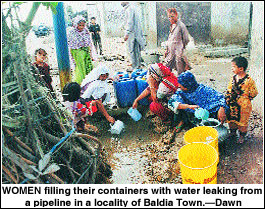 KARACHI, July 9: Two persons belonging to the Gadap Town died on Wednesday reportedly after consuming contaminated water. At least 250 others fell sick.
They were reportedly suffering from gastro-enteritis — a water-borne disease. With the two deaths on Wednesday the total death toll in the gastro-enteritis cases in Karachi during the last 13 days has shot up to ten. Eight persons died in Muslimabad, Landhi Town, between June 27 and 29.
The two persons who died on Wednesday were identified as Nabi Bakhsh, 58, and Iqra, 3, who were residents respectively of the Old Thano Village, Union Council Murad Memon, and Bhiroo Goth, Gadap Town.
Dr Waheed Panhwar, the medical superintendent of the Rural Health Centre in Old Thano Village, told Dawn that only Nabi Bakhsh had reported to the RHC on Tuesday. He was initially diagnosed as having gastro-enteritis and had been referred to the Jinnah Postgraduate Medical Centre.
According to Dr Panhwar, Nabi Bakhsh stayed at the hospital for some time but left it against the advice of the doctors. He succumbed to the disease on Wednesday.
Dr Panhwar said that though the total number of the diseased persons visiting the RHC since Tuesday, with acute pain in the abdomen, had not been recorded properly the number of patients who were administered intravenous fluids and given ORS was estimated to be between 70 and 75. “In fact, a large number of patients presenting symptoms of severe diarrhoea visited the RHC and were treated by three doctors,” he remarked.
Asked if he could attribute the two deaths to use of contaminated water, Dr Panhwar replied in the affirmative. Considering all aspects of the episode, the two died of a water-borne disease called gastro-enteritis, he said.
When a similar question was put to the Gadap Town’s Nazim, Ghulam Murtaza Baloch, Dawn was told that the source of the contaminated water was yet to be determined. The two affected areas got water both from pipes, laid by the water and sanitation department, and tube wells, sunk by the public health engineering department.
The naib nazim of the same town, Maula Bakhsh Baloch, however, dispelled the impression that the residents of the Old Thano Village and Bhiroo Goth had fallen sick after consuming water that was supplied through pipelines. He claimed that since the motor of the Sammo Lasi pumping station was out of order for the last few days, the affected localities had been getting water only through the tube well.
Both the nazim and naib nazim said the doctors of the Rural Health Centre had sent some samples of the water which the victims had consumed to a laboratory to determine the actual cause of the outbreak.
Meanwhile, a spokesman for the city government’s water and sanitation department claimed that the residents of Bhiroo Goth and Old Thano Village had fallen sick after consuming well water and not by consuming water supplied through a pipeline.
Clarifying the W&S department’s position, a senior official said the public health engineering department had laid a two-and-a-half-kilometre-long pipeline for providing water to the affected localities about two or three years back. The pipeline was given a six-inch-diameter connection from the W&S department’s 33-inch pipeline, passing under the National Highway near Malir River.
The water from the pipeline was first mixed with tube well water and then supplied to the localities, he claimed. The residents were nowadays getting water only from the tube well, he added.
Dr Safdar Hussein, who voluntarily works for the Sindh Police, told Dawn over the telephone that many of the patients in Murad Memon Goth were suffering from gastro-enteritis. The affected persons, numbering more than 300, were having watery stools.
“This indicates that they are suffering from gastro-enteritis.”
Hussein Asghar, an AIG of Sindh Police, told Dawn that there was a shortage of medicines in the health care centres of the area. However, he said, his colleagues had provided medicines to the doctors in the emergency camp set up in the affected area.
In response to a question, he said many political parties and NGOs had set up camps in Muslimabad after a breakout of gastro-enteritis last month. “But here in Murad Memon Goth, there is only one camp which has been set up by the police.”
Meanwhile, eleven of the patients were reportedly shifted to the Jinnah Postgraduate Medical Centre because their condition was critical. When contacted, however, Dr Seemin Jamali of the JPMC could not confirm the number of patients visiting her hospital.
She told Dawn that some cases of gastro-enteritis were indeed reported on Wednesday in the hospital’s casualty ward. “But whether the patients belonged to the affected areas or not cannot be confirmed at the moment.”
Dr Jamali ruled out cholera. “It is premature to say that the people affected are suffering from cholera.”