0
0

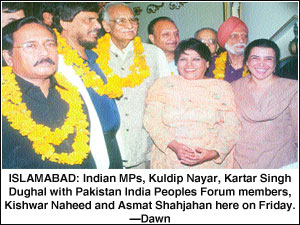 ISLAMABAD, June 20: The visiting Indian parliamentary delegation on Friday called for an end to cross border terrorism.
“The cross border terrorism in Kashmir is one of the major stumbling blocks in the establishment of peace,” said Kuldip Nayyar, the head of six-member team, while speaking at the Pak- India Peoples Forum for Peace and Democracy here on Friday.
He urged the people of both the countries to assert their governments to hold dialogues and take measures to guarantee permanent peace in the region.
Any incident like that of Indian parliament firing could derail the entire process and initiative towards peace, which was essential to root out the scourge of poverty and hunger, he said.
Besides Kuldip Nayyar, the delegation comprised Kirtar Singh Duggal, a prominent Punjabi writer and member of Rajiya Sabha, Abdul Rasheed (Congress), Shahid Siddiqui (Samajwadi Party), Laxman Singh and Pawan Singh.
From the Pakistani side, Aitzaz Ahsan, Dr Mubasshir Hassan, Ms Zarina Salamat and Kishwar Naheed also spoke on the occasion.
Earlier, the delegation was received amidst beating of drums and applause. The delegation was provided the chance to enjoy a popular folk song “Heer” presented by the renowned folk singer, Babar Niazi, while Ahmad Faraz also recited his poem emphasizing the urge for peace.
A resolution was also read out and approved at the end of the dialogue, which states that in the context of the increasing militarization and nuclearization of the sub-continent, the people of both the countries could no longer afford to consider any action other than peace.
“The sheer folly of trying to defend a nation by destroying all life on the planet must be apparent to anyone capable of rational thought, thus nuclear capability must reduced to zero-regional and globally and permanently - as there is no other option.”
The statement said the old pro-nuclearization concept of “MAD” (mutually assured destruction) has failed and neither country could afford to think of even conventional war. “However, in the Indo-Pakistani context, we advocate bilateral-not unilateral-denuclearization and disarmament and the setting up of a nuclear-free zone in South Asia and beyond.
Mr Nayyar expressed the hope that the series of exchange visits would help strengthen the cause of peace and normalization of relations between the strife-torn neighbours.
“There is a need to remove misunderstanding, mistrust, misconceptions and the environment of suspicion between the two nuclear countries,” he asserted.
“We are not afraid of any solution on Kashmir, but at least Kashmir should not be allowed to hostage other subjects,” he said.
For the last many years, he said, he was propagating for peace and was witness to so many similar efforts. “But, all such attempts died down because we failed to unite the people at one platform, which was evident from the fact that people still listens to those, who were creating hatred to safeguard their vested interest.
The people should rise and should say at the face of such elements that enough was enough and they will not play in their hands. “This window of opportunity should not be lost, for which we need a strong commitment from the people,” he said adding that once this process was diverted again, the present momentum would take years to resume.
This window of opportunity should be expanded and the people of both the countries should talk to each other more often, including all sensitive issues like Kashmir and water, by keeping aloof from their biases.
“Let’s have a commitment on building Indo-Pak relationship and tell the foreign masters to keep their hands off as we are the master of our own destiny,” he said.
The people were eager for peace but the governments of both the sides were slow, he said adding that he was in favour of removing visa restrictions between the two countries.
The members of the Indian delegation further said process like building pipelines will help improve the economic condition for which both the countries should cooperate instead of depending on other countries. People were the ultimate source of power and the moment they get united all evils will be uprooted. “The power of people can fight all kinds of onslaught,” they said.
They also asked to put Kashmir in the back burner since the issue which could not be solved in 50 years will not going to be solved in few days.
Replying to a question Shahid Siddiqui explained that the perception of Indian Muslims have changed now and the illusion that Pakistan was the citadel of Islam was shattered the moment Bangladesh came into being. They have realized that no body was going to protect them.
“The Indian Muslims have realized that the ruling elite of Pakistan talks of seven million Kashmiris but has shut the doors for the 150 million Muslims of India,” he said.
When President Musharraf came to Agra, he recalled, he had told him that the Indian Muslims were also part of the core issue and not the Kashmiri alone.
Comparing the recent Gujrat massacre, he said its intensity was far less than that of Ahmadabad riot of 1969 besides the Gujrat incident also generated intense media riot in India.