0
0

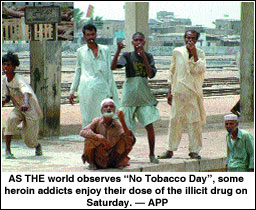 KARACHI, May 31: The World No Tobacco Day was observed in Karachi on Saturday with many organizations holding events to spotlight the hazards of tobacco consumption either through smoking it or chewing it as part of concoctions like paan and gutka.
An important event in this regard was organized by the Aga Khan University in which well-known physicians and surgeons and one renowned television actor — Shakeel — resolved to mount a media campaign of their own to counter the effects of promotional activities regularly sponsored by manufacturers of cigarette, sweet supari and gutka.
On the occasion Yousuf Kamal — popularly known as Shakeel — pointed out that the makers of at least one brand of sweet supari had sponsored some drama serials in which their products were shown in the drama proper. Needless to say ads featuring their sweet supari were aired both before and after it as well.
He said the manufacturers of cigarettes, on the other hand, sponsored sports events to project a positive image of their organizations. “You see the manufacturers of products injurious to health have found ingenious ways to put their messages across. We too should pick our tools and methods carefully and after pondering deep and long.”
Mr Shakeel was of the opinion that a counter-campaign should be launched to persuade smokers to quit smoking. Similarly, non-smokers be persuaded never to start smoking. He volunteered his services and asked the Aga Khan University to lead the way.
Mr Shakeel underscored the need to take the message to the masses. “Holding seminars in which a few hundred people from the elite and privileged class participate will not solve the problem.
“We need to organize meetings and rallies in which hundreds of thousands of the common people are educated about the ill-effects of tobacco.”
The television actor was of the view that the government’s brief message which followed every advertisement sponsored by a cigarette manufacturer had failed to deter people from smoking.
Dr Abul Faizi — giving a presentation on psychology of tobacco addition — stated that smoking cigarettes opened the path to use of drug addiction. Elaborating he said: “Adolescent smokers were eight times more likely to use illicit drugs and 11 times more likely to consume alcohol as compared to non-smokers.”
He said 80 per cent of the alcoholics and 90 per cent of heroin addicts were simple smokers initially. The chances of smoking were increased considerably if a role model in the family used cigarettes. He said fear of weight gain, easy availability of tobacco products and psychiatric disorders acted as barrier to cessation of tobacco consumption.
Dr Faizi also made the extraordinary claim that paan sellers sold heroin and charas in addition to their usual ware.
Prof Javaid A. Khan of the Aga Khan University — in his touching presentation — said 40 per cent of the Pakistani males and 8 per cent of the females regularly consumed cigarettes. “If the people who use gutka and tobacco-laced paan are included then more than 54 per cent of the adults use tobacco.”
The professor said tobacco was the world’s most lethal “weapon of mass destruction”. Out of the 10 diseases which killed the most people, up to seven could be linked to tobacco use.
He said in 2002 five million had died because of diseases caused by tobacco consumption. “If the present trend continues, in 2025 10 million people will die in the world.”
Prof Khan said smoking exposed a person to over 4,700 chemicals, 50 of which had already been identified as being carcinogenic. Ninety per cent of the lung cancers occurred in smokers, he pointed out.
Prof Khan criticized the Pakistani governments for failing to control the consumption of tobacco. The Pakistani manufacturers of cigarette had been given a free hand to promote their products while those in Bangladesh and India faced curbs and bans on advertising.
“Cigarettes are promoted and presented as glamorous and ‘cool’ products which are used by smart and genius people,” he remarked. Smoking placed considerable economic burden on Pakistan. “We spend considerable sums of money to import the raw materials, then we also spend a lot on importing medicines which are needed for health care of the chronic consumers.
Prof Serajudaula Syed spoke at length about the hazards of use of gutka, paan and sweet supari. He informed the audience that the colours and flavours used in the manufacture of gutka and sweet supari were not food grade.
The professor said overuse of gutka, paan and supari caused submucous fibrosis which could progress into cancer of the mouth. “Every person has to die, but what one should guard against is painful and unseemly death.”
Dr Irfan Vazeri of the Aga Khan University said over 60,000 studies had been published in international journals that linked tobacco use with fatal diseases. The first such paper was published back in 1928 in the British Medical Journal.
Tobacco conception was responsible for up to 30 per cent of deaths, he said. Tobacco consumption was linked to a host of cancers.
Dr Marie Andrades of the Aga Khan University also spoke. Talaat Tyabji conducted the proceedings of the seminar