0
0

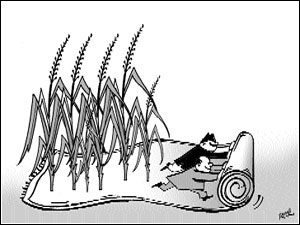 Low per acre yield has increased the cost of production in spite of incentives made available to growers in the past. The cost of production is even higher than that in other agrarian economies of the region, making exports less competitive.
Punjab had earlier announced a reduction in the mark-up rate from 11 to 9 per cent on loans from the Bank of Punjab. Now a new package of incentives for borrowers of Zarai Tarraquiati Bank has been announced. It envisages loan payment at reduced mark-up and relaxation in return of stuck-up loans.
In Sindh, banks have agreed to finance purchase of wheat by the food department at a mark-up of 5.65 per cent against the previous rate of 9.5 per cent. Increase in support price of wheat had made foodgrain production somewhat rewarding, luring some farmers to shift from oilseed to wheat and paddy. But it did not help to reduce subsidies much less bring down the production cost, which is still higher than support price.
The small farmer is placed in a more disadvantageous position. In the absence of adequate marketing support, a major portion of the benefit from price support operation has accrued to the big and medium farmers who market a large proportion of their output. There are problems other than pricing. Wage costs have risen and higher input costs and delayed and stagnant realizations eat into profit of foodgrain farmers, many of whom are in debt. Uncertainty increases in times of good crop when there are few takers and restrictions on movement of foodgrain add to difficulties. Growers are compelled to sell crops at low prices.
The challenge is to improve return from agriculture through cost-effective agronomic practices to realize the yield potential so that dependence on subsidies can be reduced. Recently, the Punjab government is reported to have approached various banks for starting a tractor-financing scheme. The provincial government has also approached the centre for an increase in wheat support price. While necessary, new technologies may not always increase productivity. If the cost of increasing yield at a given point of time through higher use of inputs is greater than the value of production, the farmer will not be tempted to use more inputs.
Many factors determine the level of productivity, including the full complement of inputs and adequate marketing, storage and processing facilities. The best available technical package is adopted on 18 per cent of acreage under wheat—generally on problem-free land— belonging to progressive farmers. The average yield on these lands is 3,000 kg/ha. On about 46 per cent of total acreage, the available package is only partially used. Yield in this category averages around 2,200 kg/ha. The remaining acreage of about 36 per cent is poorly farmed with little exposure to technology.
Focusing attention on the group which is already receptive to modern farming techniques is not enough. The real problem lies with the third category where land holdings are predominantly small, soils are relatively poor, access to inputs, advice and credit is limited and productive relationship tends to be exploitative. This group should be the target for institutional reform. The problem is roughly similar in the barani arrears where the technology packages are more expensive and less readily available. There is more emphasis on subsidies than investment.
There is hardly a crop for which all factors influencing yield and productivity are totally positive. In some like wheat, cotton and rice technical progress is better. In other crops, even the basic technical improvements have not been achieved. With reduced possibilities for inter-cropping, wheat competes directly with edible oil and prices have been relatively favourable for the latter to induce domestic production.
Wheat crop suffers from harvesting, threshing and marketing which account for 23 per cent of total cultivation costs of farmers in Punjab and somewhat higher in Sindh. Methods are inefficient resulting in considerable grain losses. Use of quality and disease-resistant seed varieties and balanced use of micro-nutrients, weed and pest control as well as efficient and timely use of water can play a major role in improving yield.
Better seedbed preparation, moisture conservation and seeding with particular reference to barani areas and use of gypsum on problem soil are important. The question is whether Pakistan can maintain self-sufficiency in wheat with the increase in population. Wheat production will have to be increased through the best agronomic practices available. There are imbalances in fertilizer use in relation to soil characteristics and possibilities of varietal breakthrough and improved seed dissemination have not been fully explored.
In Punjab, many rice areas are under insect-susceptible variety. Optimum plant population and correct planting time of nurseries is an important factor in achieving better yield.In sugar-cane, there is reliance on imported fuzz and improvement in cropping practices has come about as a result of private initiative. If these can become more widespread, yield can go up substantially. Though ginning is a weak link in the cotton chain, cotton production in Punjab is an example of what can be achieved if the necessary institutional support is forthcoming and proper attention is paid to agronomy and judicious policies are followed with respect to input supplies.
Greater use of tractor through improved institutional sale and distribution will release valuable resources used to maintain draught animal power and increase cropping intensity. Except for seedbed preparation, there has been little use of tractor-drawn implements or in the improvement of traditional tools and implements. Tractorization has led to an increase in cropped area. It rose from 14.86 million hectares in 1960-61 to 91.33 million hectares in 1980. It is more pronounced in double cropped area and where there is shortage of farm power. Pricing, exchange rate and subsidy policy can be used to elicit production responses reflecting domestic comparative advantage and export competiveness leading to efficiency gains and therefore higher growth rates. Incentives like credit and tax exemptions can be encouraging, but without an improved crop purchase process, cheap electricity, an efficient marketing system of farm commodities higher yield cannot be achieved.
An ADB loan of $60 million has been sought for storage facilities. But there is scant information about the storage systems available. Storage facilities, moreover, are available in the public sector mainly for wheat, rice and cotton. Against a target of 7.30 million tons of the total public sector storage capacity in the 6th Plan, the actual achievement was only 5.62 million tons. There is need for greater private sector involvement in this area. This can be brought about through dissemination of information on the alternative storage techniques and emphasizing the benefit of setting up such units at the local level.
Yield targets by progressive farmers are not unattainable but measured against average yields obtained by farmers it is clear they will not be realized. In Indian Punjab, the average yield of 68 tons/ha is substantially higher than Pakistani Punjab’s average of 38 tons/ha. The progressive farmers category does not represent the majority of farmers with small and medium -sized holdings and with limited access to credit, inputs and extension. The challenge therefore is to create conditions to ensure higher productivity. At the processing level, it is efficiency and at the policy level, prices and rebate. Linkages are expected among these channels underscoring a coordinated approach to strengthen institutions that could multiply yield and production.
The government would have to focus on agriculture because of its preponderance and the position it holds in the economy. Countries have tried to improve agriculture and rural economy through different kinds of institutions. At one extreme is the purely government institutes like the Block Development Offices in India which take responsibility for a cluster of villages in a locality, are multipurpose in their activities and are manned by salaried government employees. At the other extreme are the communes of China, largely autonomous collective bodies, taking care of all economic, social and civil problems of a defined rural area.
They are subject to regulatory directives from above but enjoy considerable freedom in the internal organization of their work and offer much scope of spontaneous initiatives by their members. In between these two extremes lie various kinds of institutions which incorporate a mixture of central authority and local autonomy in various kinds of cooperative and collective frameworks, such as the Ujamaa villages of Tanzania. There are deficiencies in the first approach and the second approach has not been tried out enough to assess whether it can yield better results. The problem has not been resolved at the practical level since all decisions, however local, have to be connected with the decisions taken centrally about macro-economic variables.
Agriculture production in Pakistan is faced with a grim situation. Not only growers are demoralized, but agricultural exports are also affected. Sugar industry is beset by crisis in the absence of proper disposal of stocks and mills have yet to repay dues of growers. In cereals we are not self-sufficient. Perhaps rice is the only crop in which we have some export position but even here we are constantly faced with the challenge of India making inroads in our market.
Village aid programme was organized during Chaudhry Mohammad Ali’s tenure of office as prime minister. Training institutes and village councils were set up for involving the local people in agricultural and rural development. Roads were built and pesticides, good quality seed and fertilizer were made available. Poultry, fisheries and sericulture were developed. For reaching out to the farmers, village aid officials had facilities which even district officers did not enjoy.
Although it had started to produce encouraging results, village aid came to an end with the advent of the basic democracy system. The BDs as the electoral college for the President had become involved in politics. This deflected attention from the crucial task of agricultural development, especially the needs of growers in maximizing output. Subsequent grassroots measures for farmers’ uplift could not make much headway.
Earlier, the Punjab government constituted an agricultural research body. The Sindh Abadgar Board while appreciated this step, asked the EPB to ensure that it should inform the cultivators before sowing which crop they should cultivate so that they are aware of forces of supply and demand in the international market and are not badly affected by price fluctuations. What is important is that an environment for improving yield is created. In this context, the instructions given by the State Bank governor to banks to provide loans for inputs to farmers at reduced mark-up are encouraging. During the current financial year, the agriculture sector has been given loans worth Rs25 billion, representing an increase of 10.7 per cent over the previous year. What is more, the ADB has allowed the government to grant subsidy to agriculture as against the restrictions imposed by the IMF and the World Bank in this regard. If appropriate steps are taken, this could provide a fillip to the farming sector.