0
0

ISLAMABAD, May 22: The Pakistan Muslim League (PML-Q) on Thursday advised its government to put Kashmir on the top of agenda in the forthcoming talks with India and diversify country’s foreign policy to increase the number of its friendly countries in the region.
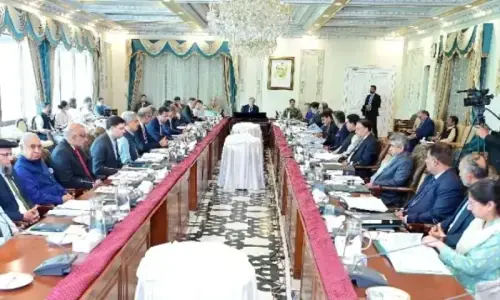
This advice emerged as a consensus at a seminar titled “Indo-Pak Relations: Problems and Prospects”, which was organized by the PML-Q at its central secretariat.
Many participants criticized what they termed framing of policy by other than politicians. The policy had neither any direction or diversity, they added.
Senator Prof Khurshid Ahmed of Jamaat-i-Islami warned that India wanted to dilute the Kashmir issue by offering measures for normalization of ties.
He said the Indian mindset got to be changed as the hard core Hindu leadership still did not recognize Pakistan as a geo political reality.
India might use the talks offer to lessen internal and external pressures without addressing the core issue of Kashmir, he opined.
Dr Wasim Shehzad, who was part of an unofficial parliamentary delegation to New Delhi recently, said the people in India did want to normalize relations with Pakistan, but they were least interested in resolving the issue of Kashmir.
PML-Q Secretary-General Salim Saifullah Khan in his key note address said Kashmiris hated Indian rule and they must be given their right to self-determination. He however expressed the hope that sanity would prevail as recent pronouncements by Indian leaders seemed to be directed at finding a lasting peace in the region through resolution of the Kashmir dispute.
Senator Mushahid Hussain Syed suggested that Pakistan should not seek American intervention or mediation to help resolve the Kashmir issue, and instead it should go for bilateral talks.
Explaining his suggestion, Mr Mushahid said that after Sept 11, the US saw Kashmiri struggle and all other movements that Muslims were running in the world as terrorism. He said that while international pressure continued to remain on Pakistan with regard to so-called cross border movement/infiltration, India was hard pressed by the resistance from inside Kashmir.
Most of the speakers, including Mushahid Hussain Syed and Prof Khurshid criticized the US for putting a ban on the Hizbul Mujahideen, the premier resistance movement in the Indian held Kashmir, and said it was an internationally-recognized indigenous organisation which was struggling for the liberation of the occupied land. The Hizb had never targeted any civilian, they said.
Senator Nisar A. Memon said Kashmir was relevant in all the documents that Pakistan and India had signed since the partition and gave example of the Liaqat-Nehru pact, Simla Agreement or Lahore Declaration.
Dr Hameeda Khoro said it was high time that country’s foreign policy should be taken over by politicians.
Others who also spoke on the occasion were analysts Nasim Zehra, Prof Khawaja Masood, Lt-Gen Talat Masood (Retd), Dr Maqbool Bhatti and PML-Q’s organizing Secretary Azeem Chaudhry.