0
0

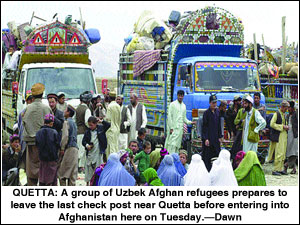 QUETTA, May 20: A group of 100 Uzbek Afghan families returned to their homeland via Chaman on Tuesday under the United Nation High Commissioner for Refugees’ (UNHCR) repatriation programme.
These families comprising around 600 persons were living in Latifabad refugee camp, Mohammad Khal area, some 90km west of Quetta, for the last many years.
“Their destination is Kabul as they are all Uzbek,” Babar Baloch, a spokesman of the UNHCR sub-office Quetta, told Dawn. Later they would left for Mazar-i-Sharif, Sare Pul and Bulkh provinces of northern Afghanistan.
They set off from the refugee camp at around 4.30am on Tuesday morning and reached at the Pak-Afghan border at 12 noon, covering almost 230km from Mohammad Khal to border town Chaman.
“They will travel up to Kabul under the supervision of Afghan security force,” the UNHCR spokesman said. Before agreeing for repatriation to Afghanistan, he said, they had demanded full security from Chaman to Kabul.
The resident director of the Afghan ministry of repatriation, based in Quetta, Haji Safi, had a meeting with Kandahar Governor Gul Agha and other Afghan authorities concerned. Kandahar administration had agreed to provide them full security from Spin Buldak to Kabul.
Afghan security officials were present at the border when the caravan of Afghan refugees, comprising 14 trucks, buses and other vehicles, crossed into Afghan side at 3pm. Afghan troops took the refugees into custody for taking them to Kabul.
It was the first Uzbek Afghan refugees group from Pakistan which was travelling in their own country under security arrangements by Afghan government. They fear attacks on the caravan in Pukhtun-dominated areas of southern and eastern Afghanistan.
With the repatriation of 100 more families, the number of repatriated Afghans reached up to 12,000 from Balochistan since March last when the first group of 400 Afghans living in urban areas of Quetta left for their homeland voluntarily. “So far around 73,000 refugees had returned to their country from all over Pakistan,” UNHCR spokesman told this reporter.
I had been living in Pakistan, along with my family, for the last 18 years and before shifting to Latifabad camp, I was living on the outskirts of Quetta, Ghulam Mohammad, a 55-year-old Afghan refugee returning to his homeland, told reporters.
“Peace has been restored in our country, so we have decided to go back,” he said and added that the UNHCR had arranged a safe journey up to Kabul.
Another refugee Saadullah told this reporter: “This time we are all sure that this time peace will last, that’s the reason that we are going back in a large group.” He had visited his native town Sare Pul six years ago, but then ongoing fighting did not allow him to stay there
“I am returning to my country with the aim to take part in the reconstruction of Afghanistan which has destroyed in 23 years of fighting,” Saadullah said.