0
0

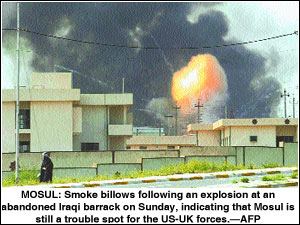 NEW YORK, April 20: The United States is planning a long-term military relationship with a new government in Iraq, that would give Pentagon access to military bases and project American influence into the heart of the unsettled region said the New York Times quoting senior Bush administration officials.
The Times said that the American military officials, in interviews this week, spoke of maintaining almost four bases in Iraq that could be used in the future: one at the international airport just outside Baghdad; another at Tallil, near Nasiriya in the south; the third at an isolated airstrip called H-1 in the western desert, along the old oil pipeline that runs to Jordan; and the last at the Bashur airfield in the Kurdish north.
A military foothold in Iraq would be felt across the border in Syria, and, in combination with the continuing United States presence in Afghanistan, it would virtually surround Iran with a new web of American influence the paper said.
“There will be some kind of a long-term defence relationship with a new Iraq, similar to Afghanistan,” one senior administration official told the paper. “The scope of that has yet to be defined — whether it will be full-up operational bases, smaller forward operating bases, or just plain access.”
These goals do not contradict the administration’s official policy of rapid withdrawal from Iraq, officials told the paper. The United States is acutely aware that the growing American presence in the Middle East and Southwest Asia invites charges of empire-building and may create new targets for terrorists.
The US military is already using these bases to support operations against the remnants of the old government, to deliver supplies and relief aid and for reconnaissance patrols. But as the invasion force withdraws in the months ahead and turns over control to a new Iraqi government, Pentagon officials expect to gain access to the bases in the event of some future crisis the paper said.
However, the NYT noted whet-her that can be arranged depends on relations between Washington and whoever takes control in Baghdad. If the ties are close enough, the military relationship could become one of the most striking developments in a strategic revolution now playing out across the Middle East and Southwest Asia, from the Mediterranean to the Indian Ocean.
So, without fanfare, the Pentagon has also begun to shrink its military footprint in the region, trying to ease domestic strains in Turkey and Jordan.
In a particularly important development, officials said the United States was likely to reduce American forces in Saudi Arabia, as well. The main reason for that presence, after all, was to protect the Saudi government from the threat Iraq had posed since its invasion of Kuwait in 1990.
The Times said, regardless of how quickly the Americans reverse the buildup of the last several months, it is plain that since Sept 11, 2001, there has been a concerted diplomatic and military effort to win permission for United States forces to operate from the formerly Communist nations of Eastern Europe, across the Mediterranean, throughout the Middle East and the Horn of Africa, and across Central Asia, from the periphery of Russia to Pakistan’s ports on the Indian Ocean.
It is a swath of Western influence not seen for generations the paper noted.
These bases and access agreements have established an expanded American presence, or deepened alliance ties, throughout one of the world’s most strategic regions. “The attacks of Sept 11 changed more than just the terrorism picture,” one senior administration official told the paper. “On Sept 11, we woke up and found ourselves in Central Asia. We found ourselves in Eastern Europe as never before, as the gateway to Central Asia and the Middle East.”