



 0
0

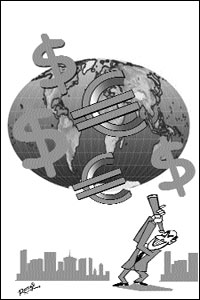 The introduction of the euro in the form of coins and coloured notes marks the final stage of the three-year launch for the new currency, which could become a rival for the dollar and have some far-reaching effects on the US economy.
Depending on how it is accepted, the euro could ultimately become an alternative to the dollar as a global reserve currency and provide a place of refuge if mounting US debt finally leads to a weaker dollar, according to international research institutions.
In many ways the euro has succeeded even better than what was thought. But looking ahead, it is not yet obvious that it is going to displace the dollar as the primary vehicle in the international currency transactions. While the euro may never reach the supremacy the dollar enjoys today, it is likely to become a respected equal over the long-term. The worst that can happen for the dollar is that the euro becomes as important and we will have a bi-polar world.
In trade, the euro is already taking business from the dollar in transactions between the European companies and the non-US businesses. The dollar will continue to be used in the US trade with the non-EU countries, but the key question will be how the US-EU sales will be handled. The likely scenario, in 10 or 15 years, is that exports of some European commodities will be denominated in euros, and the US will denominate exports in dollars. It is less clear whether international commodities, such as oil, which are now sold almost entirely in dollars, will ever convert to euros.
In finance, the euro is beginning to play a role in the development of a growing market for the European corporate debt. But compared to the United States, that market remains small. It is suspected that on the trade side we’ll see greater use of euros sooner rather than later. In the financial markets, the euro has a lot of catching up to do.
The rise of the euro could reduce the cushion that the US consumers get from the dollar’s global stature. People all around the world accept the US dollars and they cost Americans nothing to print. That allows them to have protracted deficits and an imbalance of trade. Basically, they’re financing their consumption for nothing.
Countries are likely to buy euros as a reserve currency to diversify the holdings that back up their own money. Eventually, the euro could account for half of all reserves. Already, the Chinese government has had negotiations with the Europe about buying euros as a reserve currency. Other countries, such as Iran, that view the dollar as politically incorrect might also be interested in switching to the euro.
Capital flows into the US rose from $111 billion in 1996 to $400 billion in 2000. Before foreigners can buy a share of stock or a bond, they must convert their home currency to the dollars. What will really trigger a turnaround is that at some point markets will stop focusing on relative growth and start focusing on the long-term debt buildup and a day of reckoning will arrive. That day could come in around five years.
The euro, which has begun to circulate in eight denominations of coins and seven bank notes, is now the combined currency of 12 nations and 300 million people, with an economy as large as the United States and expected to grow larger. But the dollar has an outsized role in the global economy. It is used four times more in transactions than the US share of total world output.
The current euro holdouts — Britain, Sweden and Denmark — are likely to sign on soon. The euro may ultimately be adopted by another 10 or 11 countries in Southern and Eastern Europe. That’s a lot of heft. There is another game in town now.
First introduced for use in electronic financial transactions in 1999, the euro got off to a slow start. It began trading at $1.18 per euro and has gone on to lose a quarter of its value. The decline of the euro from its launch, which has been quite sharp, has raised some questions. You see some rumblings from the Italians in particular that might suggest doubts about the long-term sustainability. But the best bet is the euro is here to stay.
So far, the European policymakers have done a good job in building the economic systems to back up their new currency. However, despite their unified monetary policy and currency, it might still be difficult politically to manage fiscal policy if different countries face cyclical problems at the same time.
But the future of the euro-dollar relationship will be determined not by what Europe does right, but by what the US does wrong. Following the World War I, long after Britain’s economic superiority had been lost, its Sterling remained the world’s primary currency, until a botched devaluation and other policy debacles. Once you have a particular currency that’s dominant, it takes a strong reason to roll out of it. But if the US has hyperinflation or imposes capital controls, or if its current account balance should start to soar again so people worry about the solvency of the dollar, there is now a very ready substitute.





























