0
0

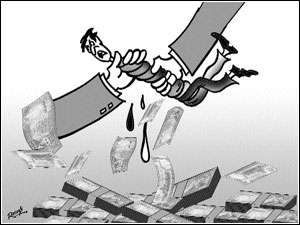 In the first seven months of the current financial year revenue collection has gone up by a hefty 15 per cent compared to what was earned in the same period last year. In absolute terms, the income amounted to Rs. 238.63 billion until January 2003 while in the same period last year it was to the tune of Rs. 207.32 billion.
The break-down of the collection in July- January 2003 was as follows: Sales tax, 108.86 billion;income tax, Rs.72.55 billion; customs, Rs. 33.65 billion and ;central excise duty, Rs. 23.56 billion. Compared to last year the sales tax and customs have shown increases of 26.4 per cent and 57 per cent respectively. Last year in the same period sales tax fetched Rs.86.11 billion while customs department collected Rs. 21.42 billion. On the other hand both income tax and central excise duty collection in the first seven months of this year fell by 4.72 per cent and 0.3 per cent respectively as during this period last year Rs. 76.15 billion were collected by way of income tax and Rs. 23.62 billion as CED.
The increase in sales tax collection by a significant percentage of 26.4 and at the same time a reduction in CED by 0.3 per cent indicate a healthy trend. The increase in customs collections indicate an expansion in the import of dutiable items. However, the negative growth in income tax by 4.72 per cent at a time when both sales tax and customs duties are fetching increasing revenue appears rather incomprehensible.
The increase in the overall collection, especially in the category of sales tax and the customs duty indicates a resumption of economic activity in the country which has been stagnating over the last three years. The growth trends in the export sector confirm this assumption. And if this is sustained in the remaining period of the fiscal year, the chances of attaining a growth rate of around 4.5 per cent by June 31, 2003 look rather very bright. And since the long cycle of drought also seems to have broken, this year the country is likely to be blessed with a good agriculture output adding to the overall growth rate. The optimistic economic outlook is likely to encourage the budget makers to propose highly ambitious income and expenditure targets for the next fiscal year. This must be guarded against strictly because it is not yet very clear how the Pakistani economy has suddenly started showing signs of life after having remained in a kind of recessionary mode for almost five years. The official economic managers would certainly like the people at large to believe that the macroeconomic stability achieved through reforms and structural adjustments over the last three years has started yielding the desired results. But then in the absence of any significant improvement on the investment front, this argument appears too self-serving. The domestic private sector has so far not shown any marked enthusiasm. Investment in the public sector continues to be dictated by the need to keep the budgetary deficit well within the IMF imposed limits. And foreign direct investment continues to remain shy because of the overall, political, economic and law and order situation obtaining currently in the country. Though the officials have estimated that by the year end Pakistan would have obtained almost a billion dollar worth of foreign direct investment, most of this is going into oil and gas sector which has very limited potential for job generation and whose revenue yielding capacity too is dependent on new discoveries which take in normal circumstances at least about three years.
It is, therefore necessary for the official economic managers to stop deluding themselves that it was all the result of the macroeconomic stability they have achieved and instead start looking rather more closely at the actual factors that have played a decisive role in boosting the exports and revenue collection in the last seven months by such a hefty margin. It is possible that the reforms being carried out in the CBR have actually resulted in improving the efficiency of the collection machinery of the Board and it has collected due taxes from an economy which perhaps is still stagnating. The increase in exports income could be attributed partly to the increase in the access to European markets and partly to the decision of our exporters to bring back part of their earlier exports earnings stashed away in foreign banks outside the country through under-invoicing for fear of being confiscated by the countries looking around for dubious deposits. Our private sector and our public sector bankers are masters in keeping their papers and documents clean. So, it is not possible to produce evidence of this kind of jugglery at this time.
The EU has already expressed its annoyance over Pakistan’s Boeing deal as it was expecting Islamabad to buy its Airbus for the PIA in return for giving us increased market access. The Community, therefore, is not likely to be so helpful in the coming years. And after all the money stashed away in foreign banks by the exporters is brought back, there would be nothing there to fatten the export bill, say, by the end of this year. What would happen then?
Perhaps, the factors mentioned above as being instrumental in enhancing the exports earnings in the last seven months do not exist at all and the earnings are all genuine. But one needs to be very careful in jumping to conclusion. A time lag of at 18 months would require for things to become clear. Until then, the government should be very careful and continue to make efforts to find new markets, increase access in the existing markets for exports and also diversify exports by adding enough value to enhance earnings per unit.
Domestically, the government needs to utilize the increase in the revenue collection on public sector development projects so that jobs are generated and the money going into the hands of more people would induce demand for various items in the country which in turn would create conditions for the private sector to start investing and this in turn would yield to the government enough revenues to keep the budgetary deficit within IMF limits and achieve the macroeconomic stability it wants so badly.