



 0
0

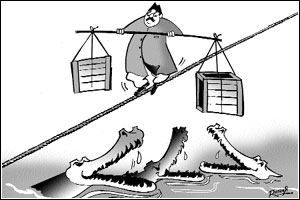 Pakistan agreed to join the WTO in 1994, one of the benefits of which is the integration of the textile sector into GATT. When we look at 2005, some of us assume that the only WTO impact on Pakistan would be in textile sector, which is not correct, as 2005 will have implications in many areas, of which one is textile. The commerce minister’s statement was encouraging, wherein he is reported to have said that he would consult and involve the private sector for defining Pakistan’s position in the WTO, thus effectively shifting policy-making from Geneva to Islamabad and from the bureaucrats to the real stake-holders.
The year 2005 would be crucial because the Uruguay round could not ensure what it was supposed to be,” a round to end all rounds”. For quite some time, the EU, Japan and other countries have been lobbying for initiating a new round in the WTO. In November 2001, at the fourth WTO ministerial conference, the Doha Development Agenda, essentially the start of a new multilateral trade (and other) negotiation round, was authorized. New issues were introduced and 2005 is one of the important deadline by which these negotiations may be finalized. During the 5th ministerial conference to be held in Cancun, Mexico in Sept 2003, new issues will be added in the round. Most of the waivers granted to developing countries like Pakistan will expire by then. Thus the implication for Pakistan and other countries will be in several sectors and not just confined to the textile.
Impact on textile sector: Most Pakistani exporters have mixed feelings. While they appreciate that there would be no limits on exports, they are also apprehensive of the competition from China and the Asian tigers with the perceived increment in the non-tariff barriers (NTBs). They ignore the fact that the EU and the US themselves are large, though inefficient producers. For example, of the estimated $525 billion global export in textile and clothing, the EU’s share is over $70 billion, making it the second largest exporter, after China. Its domestic production is estimated at over $300 billion. The US is the other major player with imports at around $70 billion. While our share will reduce, the size will increase as some of the US and the EU units will be forced to shut down. How many could be saved, for how long, and by how many measures?
As far as China is concerned, it has already cornered the world’s largest non-quota clothing market of Japan. It supplies 85 per cent of Japan’s over 15 billion garments’ import alone, along with a huge domestic market to cater to. How much will it expand and to what extent would the West allow it to dominate their market? Besides economic reasons, there is something like the “multifunctionality” of clothing, a concept used by the EU and Japan to protect their agriculture. Overdependence on one country for clothing is a security risk. One of the condition on which China’s accession to the WTO was accepted allows the US and the EU to extend quota on China till 2008; this breathing space, by default, to other developing countries may be an important advantage to exploit and entrench oneself in the market.
If one analyses the Pakistani and Chinese composition of textile exports to the EU and the US, he will see that in case of Pakistan’s core products, China does not utilize its full quota. The quota for China is less than that available to Pakistan. China’s exports reach 100 per cent utilization in products which are not exported by Pakistan. In case of other Far Eastern countries, their exports concentrate on higher value chain like relatively more expensive garments, suits, coats, ensembles and ladies dresses,etc,. Thus the product mix is different and the Pakistani exporters will not face any sudden danger in 2005 on this account, at least.
Since quotas would be removed from other garment and made-up producing countries too, there would be more demand for Pakistani yarn and fabrics. Pakistan will need to devise a strategy to ensure that its garments and made-up producers do not suffer on account of increased raw material export. Pakistanis can influence the global trade to the extent of raw material supplies. Due to it’s commitment, the government will hardly be in a position to intervene either in terms of discouraging exports of cotton, yarn or fabrics or providing subsidies to garments and made-up exporters. The private sector will have to put their head together and exploit this to the benefit of all instead of focusing on narrow traditional inter-sectoral conflicts.
Billions of rupees would be liberated from quota trading. Where will this money go? To divert it to other speculative and non-productive activities, including the hedge trading, will not be productive, as the price of speculated entities would collapse if not matched by a strong manufacturing and productive base. The “bubble bursts” have been a phenomenon of 90s in many Asian economies including Japan. Rather, it would be good to invest in modern units and dyeing, etc,. Joint venture with the Japanese, Chinese, Korean or even Western companies to value-add the textile industry may be sought.
There are prospects for increasing the quality and productivity of cotton, ginning, dyeing, production of higher value-added apparels like ladies dress, suits ensembles etc,. Many exporters are manufacturing and exporting textile products from the countries having unutilized quota or which are quota-free like Myanmar and Bangladesh. Once quotas are lifted, these exporters may bring back their investment to Pakistan. This would be a good development. However, they may decide to relocate to countries for where there would be tariff advantages. The government may provide incentives to ensure they relocate in Pakistan.
At the government level, tariff reduction becomes more important. We have advantage in the EU and may keep it that way. Important commercial issues involving market access for the EU into Pakistan may be kept in mind. Important decisions may be made at the inter-ministerial and the cabinet levels.
Focus on exports needs to be increased as honeymoon with the IMF, the World Bank, and the Paris Club will be over at some stage, and then, only exports would bring in foreign exchange and provide job opportunities. Market access agreement rather than financial benefits should be the theme of new negotiations. The US has given duty-free access to several counties under various treaties, it can give similar benefits to Pakistan through free trade agreement.The US support to Pakistan is currently confined to financial sector, and not extended to enhanced market access. We may now concentrate on it.
While new forms of barriers like the countervailing duty, anti-dumping duties, social, labour, and security issues will play an important role by the end of 2004, the developed economies would be lobbying for support to their interests in the WTO.
Pakistan’s artificial and synthetic textile exporters would face a unique problem. On account of the government commitment to the MNC, the EU, the US, and the WTO on tariff, there is distortion in pricing, tariff rates and drawback schemes. Local producers of the PTA and the PSF (polyester staple fibre) are compensated but the producers of the VSF (viscose staple fibre) and acrylic staple fibre are faced with anomalies. The spinners are also demanding compensation and the policy relating to the sector needs to be reviewed to ensure the growth of local industry, competitive exports, and minimum loss to the exchequer.
In Doha, the ministers had agreed to adopt around 50 decisions clarifying the obligations of the member governments with respect to agriculture, subsidies, textiles and clothing, technical barriers to trade, trade-related investment measures and the rules of origin. Many other implementation issues have not been settled. However, the ministers agreed on a future work programme.
As for Pakistan, asking for the accelerated integration is not of much use, as only home furnishing categories would have helped. More important is anti-dumping allegations. However, Pakistan has to be careful in this, as it will be the only tool to protect domestic industries from the increased competition.
Ironically, it may be better for us to join the West in making this tool powerful, as we will need to apply these to our textile industries, particularly for the viscose staple fibre, polyester staple fibre and fabrics sector. There are many sectors that would be hit by China. There is nothing political about using these tools, these are company-oriented and not country discretionary; we should not shy away from using these tools against Chinese companies, where warranted.
Another code for relaxation in the WTO jargon is called the special and differential treatment provisions (S&D). This is allowed to the developing countries and the LDCs in all agreements. For example, Pakistan can give export subsidies as it falls under Annexure 7 list, i.e., the country with less than $1000 per capita. Many believe that the withdrawal of subsidies and the lowering of tariffs is due to our commitments made to the WTO. This is not entirely true. Most of these are on account of commitment to the IFIs, particularly the IMF and the ADB, rather than the WTO, and the commitments made bilaterally to the US and the EU. Negotiations in the S&D will have direct and immediate implications for Pakistan’s indigenous units if the deletion policy is not extended as under the national treatment clause, Pakistan cannot protect local industries. This will hit the engineering sector, particularly automobile parts manufacturers.
In the Doha Declaration, member governments agreed that all special and differential treatment provisions should be reviewed with a view to strengthening them and making them more precise and further mandated the Committee on Trade and Development to identify which of these are mandatory, and to consider the implications of making mandatory the non-binding ones. Thus this will have big implication for Pakistan.
The other issues, particularly creating a linkage between trade and investment, environment, competition, facilitation, agriculture, etc., have been pushed by the EU since 1996 with a view to securing advantages for the EU companies. In Singapore, while the developing and other countries succeeded in not authorizing negotiations in new issues, it was in deference to the EU that these were kept alive, and in 2003 the EU will push on these issues and have negotiations authorized in Cancun. For the moment, we can assume its implementation by 2005. Thus Pakistani company will have to get the ISO-1400 in addition to the ISO-9000, they will not be allowed to merge etc., to gang up against the EU’s large suppliers and not be able to really export their agriculture products to the EU in a meaningful quantum in the near future.
Pakistani exporters will need to be careful as subsidies on export, particularly for wheat will be fiercely monitored. All these are designed to increase the cost of exports of developing countries’ goods to make it that much more prohibitive for easy entry into the developed countries and to make the developed countries’ export and investment viable in the developing countries. Special safeguards would be made for Western, particularly the US pharmaceutical companies as developing countries may get waiver for public health-related issues under TRIPS. All this would be in addition to the popular fear in Pakistan that China will give local manufacturing units a hard time. It seems that good times may be ahead for commercial importers at the expense of local manufacturers. This unfortunately is the trend of the future. There is no use in complaining. Energy should be spent on improving efficiency.
On the other hand, there would be much talk on tariff escalation. The US will push for customs-duty-free-era while the developing countries will shout for revenue and local industry protection. While the developed countries will eventually get what they want, they will compensate developing countries with peanuts like training and capacity building. The civil servants should be careful that they do not accept training subsidies at the expense of sacrificing the key interests of Pakistani exporters and businessmen.
The issues are simple as outlined above. Only the nuts and bolts are complex, as the devil is in the detail. One last parting example is illustrated as a food for thought for Pakistani exporters to give them an idea of the kind of preparation they should be doing now instead of in 2005. Under TRIPs, the geographical indications (GIs) will assume growing importance. In essence, it is the extension of the trade mark concept to a country level. For example Champagne is associated to France; hence non-French companies cannot call their sparkling wines as Champagne. Pakistani hand-knotted carpet exporters better start planning as they won’t be able to export Bokhara and Isphahan or Shirazi carpets under those names.
The exporters better ask the government to register Basmati as a Pakistan generic brand under its domestic law as India has already done so. What about Hala, Ajrak etc? Will we be able to make “Unani” (Greek) medicines? Developing countries are pushing for waiver and exemptions within TRIPs for public health-related issues while some are calling for patent like the protection for traditional knowledge. Our pirate industry better begin to look for alternate business as the US will target these in the next two to three years.
It is thus in our interest to keep a sharp focus on Cancun. The beautiful tourist island of Mexico — where it is worth the while of any businessmen to spend some good dollars — may be the cause of stopping their dollar flow in the future unless they prepare for post 2005 now. New opportunities and threats will emerge and the businessmen who keep himself abreast of these developments and prepare accordingly will be better placed to gain from opportunities and protect themselves from threats.




























