0
0

ISLAMABAD, Feb 7: The Supreme Court on Friday reserved its judgment on the petitions challenging Article 8AA of the Conduct of General Election Order, 2002, which barred the defeated candidates from running for the Senate.
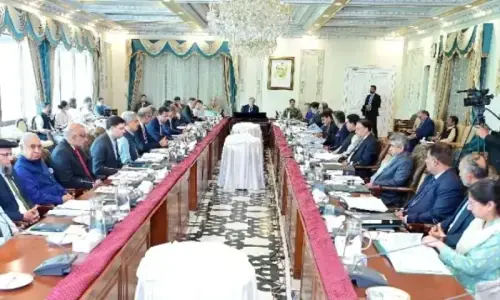
The court, headed by Chief Justice Shaikh Riaz Ahmad, concluded hearing after Attorney General Makhdoom Ali Khan defended the legislation by arguing that the whole idea of promulgating the Article 8AA of the Conduct of General Elections Order, 2002, was to eliminate the politics of patronage.
The AG also made a statement with regard to the legal status of the Legal Framework Order, 2002. Of the total twenty-five petitioners, Javed Jabbar had challenged the vires of the LFO, 2002.
At the very outset, the AG stated that the challenge to the LFO, through additional grounds in Javed Jabar’s petition, had become academic in view of the submissions made by him on Thursday.
Mr Jabbar had stated that part of his petition, challenging the LFO, should be left undecided, as his counsel, Abdul Hafeez Pirzada, was not in good health, and that it should be fixed after the completion of parliament.
The LFO has amended the Constitution, and each of these amendments are now part of the Constitution, the AG stated.
He argued that in 1985, the elections to the national and provincial assemblies were held in February. The Revival of Constitution of 1973 Order, 1985, was promulgated on March 10, 1985, after the elections.
The LFO, he stated, was promulgated on Aug 21, 2002. The general elections were held on Oct 10, 2002, after the promulgation of the LFO.
He said only those provisions of the Revival of Constitution Order, 1985, and other orders amending the Constitution were altered by the Constitutional (Eight Amendment) Act, 1985, which were amended by a two-third majority of parliament. The rest survived. They are still a part of the Constitution.
The AG questioned the maintainability of the petitions, as all the petitioners were seeking redress of individual grievances.
Justice Munir A. Shaikh observed that the Supreme Court’s original jurisdiction under Article 184(3) of the Constitution was always invoked by individuals, provided it affected the public at large.
The AG stated that the scope of the present petitions was confined to individual grievances. Justice Iftikhar Muhammad Chaudhry referred to Malik Asad Ali case in which one petitioner challenged the appointment of Chief Justice of Pakistan.
The AG said Malik Asad Ali had raised the matter which pertained to the independence of the judiciary.
The AG stated that no member of the National or provincial assembly, who together constituted the electoral college for the Senate polls, approached the SC complaining that by adding Article 8AA of the Conduct of General Election Order, 2002, they had been disenfranchised.
The AG said that Mr Jabbar was supported by the Millat Party only to the extent of challenging the Article 8AA of the Conduct of General Election Order, 2002, and not by the National Alliance, which was in a position to get a Senator elected.
The AG held that contesting the election was not a fundamental right, but a statutory one. He added that the condition of possessing a minimum of BA qualification for being elected an MP was also challenged before the SC but the apex court upheld it.
He said there was no element of discrimination in the law, as all the defeated candidates were treated equally. About the permission given to women and non-Muslims to contest for the reserved seats, the AG stated that nomination papers for the general and special seats were filed simultaneously.
The AG stated that women and the non-Muslim citizens were disadvantaged class of society and allowing them to vie for the special seats after losing the general elections was an affirmative action.