



 0
0

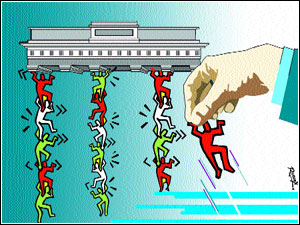 Of late, Pakistan’s public sector has attained propounders proportions specially when it seems to be responsible for nearly all the ills of the country. On the other hand, the military-led government could not take up any development activity that could result in immediate amelioration of the problems of the people.
The mega-projects proposed to be undertaken are inherently different and can be considered of any import in the long-term context only. These projects conjured by the corporations like Wapda, on the other hand, possess at the best a suspect rate of return and in the end may not be really beneficial to the country. Probably, more like the sparsely used Motorway and its losses, which the non-user taxpayer may eventually foot.
The main reason for the then government not to take up public spending was partly the resolve to conserve or to reduce the budgetary deficit in this manner, but it was also the hard fact that as much as Rs184.5 billion had to be under-written by the government in 2000-01 under the heads of direct losses sustained by such public sector giants as Wapda, the KESC, the GCP, the RECP, the Pakistan Railways, the ADBP, the Pakistan Steel, etc., and the implicit and explicit liabilities incurred by these very defaulting establishments. These PSEs — in particular Wapda and the KESC — have eaten up Rs200 billion of taxpayer’s money just to remain afloat during the years 1999-02. The rat pack, however, is led by Wapda because its losses simply outstrip the combined loss of all other PSEs. And out of the blue now emerges the impending Rs12 billion loss of the ADBP. Strangely, this is due to Rs10.89 billion of non-performing loans and advances and the rest because of diminution in the value of investments made by the bank and other assets. Even midgets like PTV never forget to chip in with its own losses, the small six monthly extensions in service its MD gets from the government (he thus remains busy forever in ensuring the next extension), the distinction of having a separate office for the federal minister for information in its HQ precincts, regular intervention from the ISPR, issuance of spurious and bogus TV licences by its own fee collection contractor, ad hoc postings against important positions like director finance and collector of revenue and so on.
The impending World Cup telecast and allied contracts and stuck-up millions with big names further beef up the ante. The losses being and likely to be sustained by the organizations like the NLC working directly under the GHQ are not known — but couldn’t be any better. The combined loss for the FY2000-01 was followed by an even more stupendous figure of over Rs200 billion for the FY2001-2002. The magnitude of these figures can be better understood, when we see that all the much touted mega-projects inaugurated during mid-2002 would only cost a little more than the PSE losses added up for the last two FYs.
What can be the reasons for these losses — indeed an issue needing deep thought. On the other hand it also needs to be understood as to what inhibits those at the helm of affairs to take speedy corrective action. Dilating on the issue we see that the reason for these losses can also be circumstantial sometimes — surely beyond the sway of those heading the public sector or these are due to pure negligence, apathy, inefficiency and corruption. Any set of circumstances, however, always has the possibility of an inbuilt damage-control leading to the minimum possible damage in case the relevant managements possess intellect, vision and the capability to prioritize resources, etc. As such in any set of circumstances, the outcome of things can be different for different managements. As a consequence, the most important of all pre-requisites for the success of any venture remains the management depth and commitment it shows towards running of the enterprise it is required to lead. Similarly, negligence, apathy, inefficiency or the ubiquitous corruption do also have a direct bearing on the quality of the management.
From the foregoing, it is very simple to conclude that besides circumstances like international conflagrations, increasing oil prices, inflation, dollar-rupee parity, etc., the most important of reasons for the continued failure of the public sector has been the quality of its management. With these offending managements continuing, the next big reason has been the lack of reasonable and civilized form of accountability processes in place. Experts are of the opinion that accountability has to be institutionalized and not on the basis of some draconian laws, ordinances, or setups like the NAB, etc. Taking a leaf from the developed world, we see that the era of inquisitionary forms of accountability ended way back some century and a half ago and at present the requirements are fulfilled by normal civil institutions like the audit, the office of the Ombudsman, financial scrutiny setups, the securities and exchange commissions, regulatory bodies and the all important public accounts committees; the decline or the actual deranging of these bodies in Pakistan makes very interesting reading — but simply beefs up the earlier thesis that in fact it is nepotism and cronyism that is the actual culprit. Each successive year saw reduction in the clout and even lesser budgetary allocations for these bodies. Stunted career progression coupled with no training at all further deepened the crisis.
All this took place when those who mattered showed impatience with the results of these setups and then came up with what they accepted as super-checks. During this relegation of the civilized way and setting up of supra-check bodies, we have also seen the gradual sidelining of the ministries — both at the federal and the provincial levels. As a consequence, we have been bequeathed with unchecked working of the PSEs. Those heading these organizations would issue proclamations about great achievements, would issue false figures of progress, even conjure up very balanced balance sheets and then herald profits that hide just around the corner. Here Wapda and the Pakistan Railways take the lead. Purchases and contracting — two issues very dear to the hearts of any management — have led to the creation of another PSE, billed as the Public Procurement Regularity Authority (PPRA). As to why this, one more supra-body, came into being so late is not understood, specially when such activity in Wapda, the Pakistan Railways, the NHA and the PIA remained unchecked during the last four years due to the stunted role of the ministries, etc.
All governments worth their salt would want efficient and better controls on the PSEs and so is the case with Pakistan. However, instead of improving upon the existing and in some cases time-tested setups, the government seems to be dazed by out-of-the-formal se-up experts, who in order to make a fast buck or two (millions in some cases), have come up with strange concoctions. Here in lies the problem, because the existing set-ups need revamping and nothing else. Sardar Iqbal’s ombudsman of the 1980s and the present neglect is an apt example of the situation, where quite an up-to-mark organization is let to rot first and then castigated for being ineffective and inappropriate. The developed world would never ever come up with what we have on our plate at the moment. It too would like quick and surgical accountability, but it understands the fallibility and allied nuisance of setups like our NAB and its most childish logo-depicting a shooting gallery than a serious institution.
Another facet of the loss-making PSEs is its drag on the national economy, which is likely to manifest even more with the passage of time. This drag is surely to reach its apex after 2005, when the WTO is to take effect for Pakistan. With any chances of subsidies receding, our industrial and agricultural sectors can only stay afloat if their inputs are comparatively cheap. And nearly all inputs depend upon the offerings of the public sector with the power, the energy and the communications toping the list. Cheap inputs only depend upon an efficient and dynamic public sector coupled with their private counterparts. The efficiency of smaller PSEs would also come in handy as these would act as damping competition to the rogue private entrepreneurs of Pakistan. It may also be remembered that privatization is not the panacea of the public sector ills and can only be considered in a different context — and as such the public sector needs to be made efficient and the means to bolster the presently sagging economic fortunes of the country. And again as the means to regulate the growing in clout private establishments.
The question which readily comes to our mind would be as to why do we ever end up with inapt managements and then why are these let endlessly to continue with no respite in the losses which resultantly occur. It also comes to our mind as to why then no action ever takes place against any of those responsible. The questions become even more intriguing when on the other hand the curse of ad hocism is seen to prevail. And right alongside is the malady of allowing extensions in service to the blue eyed or the tormenting stopgap arrangement of current or the additional holding of charges. All in all, these tribulations accumulate with devastating effects — ending up with backbreaking deficits. In the end, we identify the problem as unimaginative management, lack of regular and civilized scrutiny/check/accountability, the inter-play of vested interests that let the erring managements stay put and a system which supports and nourishes ad hocism.
How does a particular management come into being? The normal way would be the natural rise with time or on the basis of a special requirement from amongst the predominant cadre of any organization. Lateral entries or simple posting of someone to the top slot can also lead to the creation of a management. As is wont of anybody with even normal intellect, the candidates would fulfil the minimum requirements of that particular office/post, which would include educational expertise and due proficiency and then would the incumbent be required to face the challenges. In case the person so selected is not able to come out unscathed, it would be the time for a change.
In case of the Pakistani public sector, either the minimum possible time is not given or even stupendous losses wouldn’t even budge anyone from the seat where he or she remains enthroned. Here in lies the scourge of batchmatism, caste, creed or sometimes the penchant for the same vocation. It has been camaraderie rather than merit that seems to have clinched many a posting and the rot continues. Probably, this is the thing which inhibits corrective action. It was because of this that the Larkana links, the Gowalmandi group and the now famous night capers prospered and in one way or the other still hold sway. On the other hand, successful private enterprises prosper on merit alone and nowhere would cronyism ever prevail. Even in case some one has to be adjusted and the CEO being the owner is forced to do so, the beneficiary remains away from the centre of things.
What needs to be done. Do we let the rot continue or is there a need to intervene? The first step should be to check the balance sheets and then take up review of each loss-making corporation in the order of quantum of losses. The ministry concerned can then submit its report in a month’s period; apportioning the blame for corrective actions, etc. However, the most needed step is to change the errant managements and not continue with it come what may or the ensuing drag would simply take the country down with it.
(The writer is a former Member Power, Wapda.)





























