0
0

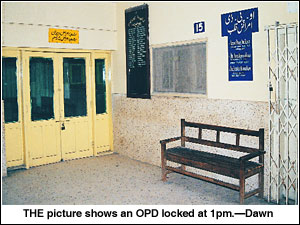 KARACHI, Jan 30: Patients going to the Sindh Government Hospital, Liaquatabad, face great problems because most of the hospital departments close at 2pm. The multi-million rupee facility, which could easily be run round the clock with a small additional expenditure, thus remains grossly underutilized.
This can be attributed to the apathy towards public health care among the senior officials of the City Government as well as the health department.
Moreover, the staff at the hospital’s OPD department usually stop working at about 12.30pm, that is one-and-a-half hours earlier than the scheduled close of work. This further reduces the facility’s utility.
This particular problem may be attributed directly to the staff’s preference for break (for lunch and Zuhar prayer) over their work.
The two factors combine to reduce the hospital — which can easily cater to the general health care needs of the residents of Liaquatabad, Federal Area, Federal B Area and Gulshan-i-Iqbal — to something of a glorified dispensary.
This reporter visited the hospital on Monday afternoon when its corridors wore a deserted look. One of the very few patients present, who had visited the hospital off and on in the recent past, said the hospital’s departments began emptying at about 1pm each day.
“This is because the clerks stop issuing parchees at around 12.30pm. This is done to clear the departments by 1pm,” he told Dawn.
The vendor who sells foodstuff near the hospital’s main gate confirmed this, as did a paramedical staff on condition of anonymity.
Dawn then visited the various departments of the hospital. By 2pm the following departments had been closed down completely and doors either locked or padlocked: ENT Department; Skin Department; Orthopaedic Department; Gynaecology Department; and, Paediatrics Department.
The wards of these departments, however, were open where a handful of doctors and paramedical staff were attending to the needs of the admitted patients.
When approached, the medical superintendent of the hospital, Dr Capt Munawwar Ali, said he did his best to make the staff respect the official timings. “Look, we take serious note of violations of the rules and regulations, if there are any.”
He hinted that some staff members weren’t dedicated enough. However, he didn’t blame them directly. “Our performance has improved.
“The number of OPD patients handled since 2000 has been showing an increase. In 2000, we treated 212,627 OPD patients. In 2001, this number increased to 258,745 and in 2002 to 272,920.”
This showed clearly that the hospital’s performance had been improving, he said.
In response to a question, Capt Ali said the casualty ward and other wards where admitted patients resided were kept open round the clock. However, there was no provision yet of round-the-clock emergency surgery.
He said if the authorities provided him with the resources needed, he would be happy to run the hospital 24 hours a day and seven days a week. “Why would I object to such a proposal.”
Capt Ali agreed with Dawn’s contention that if it was allowed to develop fully, his 21-year-old hospital could meet the health-care needs of people residing in and around Liaquatabad, Federal Area, Federal B Area and Gulshan-i-Iqbal.
The hospital’s MS said it had about a hundred doctors. “The number of nurses stands at 25 and that of paramedical staff at 230.”
The hospital was badly in need of an X-Ray machine, he said. “Our X-Ray machines have grown old. The situation is so bad that the exposures of fat people don’t come out nice enough.”
Answering a question, Capt Ali said on an average the hospital each year got a grant of Rs7 million from the government. “This is not sufficient. You see it costs us about Rs1,000 just to provide medicine for each operation that’s performed here.
“And we undertake about 1,500 major operations every year. This way about Rs1.5 million is spent on operations alone. From the remaining money in this head we cannot even buy important medicines for the patients.”
The hospital’s accounts officer was of the view that it got insufficient funds in all the major heads — namely repairs of equipment, gas bills, electricity bills, diet, telephone bills and miscellaneous expenses. “In all these heads we get funds that are insufficient.”
Capt Ali said the hospital’s labour room and chest OPD had been built recently with the help of various donors. “We are also planning to establish an emergency cardiac unit.”
Meanwhile, an employee of the hospital said expansion was of little importance unless the doctors and paramedical staff became sincere towards their day-to-day duties soon.