



 0
0

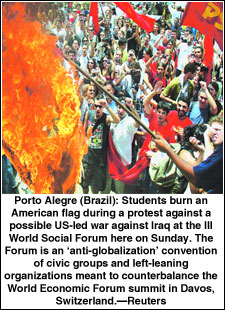 DAVOS, Jan 26: Boogeying poolside was out, bashing America was in at this year’s Davos business summit as angst over war and recession drove out the traditional strut and swagger of the global elite.
The World Economic Forum’s six-day annual meeting returned to the chic Swiss ski resort after decamping to New York last year for the first time in three decades to embrace a city still reeling from the September 11 suicide plane attacks.
But this year it was hard to hear a kind word about a United States now viewed with distrust and skepticism, especially over the superpower’s threats of war against Iraq if it fails to come clean over any weapons of mass destruction.
“It’s very worrying that the Americans could be prepared to act unilaterally. They are playing a very risky game,” Simon Maxwell, head of Britain’s Overseas Development Institute think tank, told Reuters, echoing a common theme in Davos.
US Secretary of State Colin Powell faced pointed questions from the audience on Sunday after a keynote address telling skeptical Europeans the United States was willing to attack Iraq alone if others shrank from disarming President Saddam Hussein.
The theme of this year’s meeting was “Building Trust”, and surveys of WEF members bore out a lack of confidence worldwide in US leadership. One panel discussion was entitled “US omnipotence: What lies ahead?”.
Gone are the days when American businessmen and policymakers showed up at Davos to teach European and Japanese laggards lessons about corporate and economic policy management.
“The feeling of confrontation against the US was very strong, absolutely too strong for my taste,” said Peter Brabeck, chief executive of Nestle SA, the world’s biggest food company and a veteran of Davos meetings.
“The anti-Americanism is profound,” agreed former US State Department official Stuart Eizenstat.
“There used to be disputes between Europe and the US about trade, about bananas, but now we’re being accused of trampling on the institutions that we’ve created.”
ORCHESTRAS, NOT SAMBAS: No Calypso band jammed on a floating stage in the Davos conference centre’s pool this year because organisers axed the customary Saturday night black tie and evening gown soiree.
“A big party is not appropriate at this moment. It doesn’t fit the mood,” WEF founder and guiding light Klaus Schwab said.
There were plenty of long faces among the 1,000 corporate chieftains and two dozen heads of state or government on hand for the 33rd annual WEF gathering that runs until Tuesday.
The mood was definitely downbeat ahead of a looming war in Iraq and with the world stuck in a stubborn economic slump.
“This is just about the hardest year to forecast and it’s difficult to be anything but gloomy,” sighed British American Tobacco Plc Chairman Martin Broughton.
WEF Managing Director Jose Maria Figueres said the subdued tone was “as it should be. That is the global mood. Davos in that respect is a reflection of what our members and different stakeholders are feeling. I think it’s a very healthy change.”
Missing are many of the lavish corporate flings that once filled posh Davos hotels every night. Flaunting wealth and power — once a hallmark of Davos — made way for a more introspective mood.
A youth orchestra played for delegates on Saturday night — a slot normally reserved for a raucous do that went on until dawn.
“Before a potential war and addressing pretty serious issues, it’s time to focus and not to dance,” WEF spokesman Michel Ogrizek said.
The WEF reduced the sprawling attendance list by about 30 percent to 2,000 to make things more intimate. Several of the European ministers who had been due to attend, notably from France, Germany and Spain, dropped out at the last minute.
After the dotcom crash of 2001 and the corporate malfeasance scandals of 2002, many of the past capitalist gurus of Davos were missing.
But Brazil’s new leftist President Luiz Inacio Lula da Silva added a dash of colour, joking that he could head home physically intact despite venturing into a capitalist hotbed.
Meanwhile, Jordan’s King Abdullah said it would take a miracle to find a diplomatic solution to avert a US-led war on Iraq.
“Unfortunately I believe that we’re now a bit too little, too late to see a way out, a diplomatic solution between Iraq and the international community,” the king told the World Economic Forum in Davos, Switzerland.
“Today I think the mechanisms are in place. I think it would be very difficult, it would take a miracle to find a dialogue and a peaceful solution out of the crisis.”—Reuter





























