



 0
0

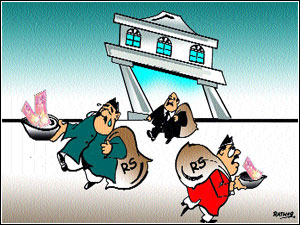 According to a news report appearing in the national press on January 6, the Asian Development Bank (ADB) had warned our economic managers to refrain from issuing financial and sovereign guarantees in favour of public sector corporations and institutions, as doing so could lead to financial instability in the country.
Successive governments had reportedly been issuing such guarantees mainly for loans sought by public sector organizations or to guarantee the rate of return on investments in certain businesses, specially oil refineries. According to an official of the government of Pakistan, both national and foreign banks had asked for sovereign or financial guarantees from the government, when a corporation or institution seeking loans or investment had lost its credit-worthiness.
The ADB warning had come after accumulated losses of state-owned corporations and institutions had increasingly burdened the federal budget of the government, which happened to be the guarantor of the loans and the minimum rate of return in respect of such corporations and institutions. Sovereign and financial guarantees had been provided to both national and foreign banks for obtaining loans worth billions of rupees for the state-owned corporations to enable them to meet their financial losses.
The banks lent the money only after receiving firm commitments from the ministry of finance that in case the state-owned corporations and institutions failed to pay back loans and the mark-up the government of Pakistan itself would pay back the amount.
According to the above-mentioned Press report, the National Development Registration Authority obtained a Rs4 billion loan from banks only after the finance ministry had offered guarantee to a consortium of banks. The loan was reportedly obtained at 16-17 per cent against market rate of 14 per cent.
According to the same report, four banks were asked to provide short-term loan of Rs4.7 billion to the PIA, with the commitment that the entire mark-up would be picked up by the government. Required guarantees were provided to the banks in this regard. This was done to enable the PIA to buy Boeings.
Similarly, the government provided a sovereign guarantee to a Chinese bank to enable Pakistan Railways to buy railway engines and coaches from China against a $30 million loan.
The Karachi Electric Supply Corporation (KESC) and WAPDA were among those institutions which could not repay their loans and billions of rupees were converted into equity, while repayment was made to the banks from the tax-payers money. The IMF team, currently on a visit to Pakistan, had observed that government’s fiscal deficit had increased due to operational inefficiency of WAPDA and that WAPDA was not making any serious effort to reduce its line losses.
As laid down in the ADB report on Pakistan Economic Update, the increasing drain on the public exchequer had highlighted the need to improve operational efficiency of public institutions. At the same time, the situation also required to government to exercise restraint and refrain from issuing sovereign guarantees.
It must be said that the ADB warning, referred to in the preceding paragraphs, was well-timed. Providing guarantees to enable inefficient state-owned corporations or government institutions to seek further bank borrowing amounted to patronising inefficiency. The remedy lay in asking such organisations to improve their operational efficiency in the shortest possible time or, alternatively, in privatizing them at the earliest opportunity.
This is not the only instance showing lack of good governance on our part. In the past, also, successive governments never cared to cut their coat according to their cloth. They never sincerely tried to control their fiscal and current account deficits, with the result that both the domestic and foreign debt multiplied and the country gradually moved into the debt trap.
While there was no control on expenditure, successive governments also failed to increase their revenues by inculcating a tax culture in the country. Tax collection still remained about 13 per cent of the GDP in Pakistan, as against 16 to 18 per cent in other developing countries.
Due to the growing public debt burden, our debt servicing liability had been consuming a large chunk of the federal budget. Therefore, in order to meet our non-development expenditure, the size of the development budget had to be reduced year after year. As a result, the government could not take effective steps to deal with growing unemployment and poverty in the country.
Even financial assistance from donor agencies had failed to bail us out, due to lack of good governance on our part. A few years ago, the Social Action Programme (SAP) had been launched with the objective of improving educational and health facilities, sanitation and availability of potable water, etc, in the country. The World Bank had committed massive financial assistance for the above-mentioned scheme. However, both SAP I and SAP II had terribly failed in achieving their objectives. As a result, the World Bank had withdrawn a certain per centage of its assistance committed for the SAP on the plea that it did not want the funds to be wasted through corruption and inefficiency. Ironically, Pakistan had been very good in preparing plans, but it could not successfully implement those plans due to lack of good governance, rampant corruption, inefficiency and structural weaknesses in its economic and social system. In five-year plans launched in the country from time to time, lofty objectives were set and ambitious targets were fixed. For instance, these plans envisaged that universal literacy would be achieved at the primary level, the share of the manufacturing sector in the GDP would be raised from 18 per cent to 25 per cent and that dependence on external assistance would be done away with by a certain date. However, none of these objectives could so far be achieved.
The track record on governance had remained mixed during the last three years. The government had, no doubt, succeeded in improving the balance of payment position, stabilising the exchange rate of the rupee vis-a-vis the dollar, bringing down the rate of inflation and reducing fiscal deficit to some extent. However, the government had failed on a number of fronts. For example, it had neither been able to privatize those state-owned corporations running at a loss nor had it been able to turn them into profitable organisations.
At the same time, it had failed to attract investment and accelerate growth. It had, also, not succeeded in removing corruption from the CBR, with the result that, despite some increase in government revenues, the tax receipts could not exceed 13 per cent of the GDP. Due to the inability of the government in attracting investment, boosting GDP growth and substantially raising tax-GDP ratio, the expenditure on economic and social services remained low and the problem of unemployment and poverty could not be dealt with effectively.





























