0
0

KARACHI, Jan 22: The Sui Southern Gas Company has increased the strength of its security personnel to stand guard over natural gas pipelines that have lately been attacked by terrorists.
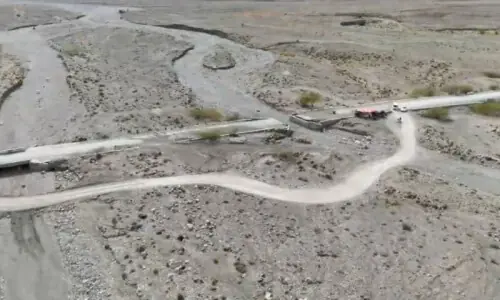
Well-placed sources told Dawn on Wednesday that the number of security personnel engaged by the gas utility had been increased to 400. “At the same time, the SSGC is also trying to reduce the exposure of its gas pipelines to the minimum. As a rule, a pipeline is preferably laid underground, but in some cases — such as rivers, etc — it has to go overland.”
They added that it was extremely difficult to stand guard over the transmission pipelines network of the SSGC which was spread over 2,782 kilometres.
The Sui Northern Gas Pipeline on Tuesday stopped supplies to 700 big industries in Punjab and the NWFP after two of its four main supply lines on the Punjab-Balochistan border were sabotaged. This was the second attack on the pipelines during the last one and a half months.
The pipelines supplying gas to the SSGPL in the area were also attacked on Dec 10.
The sources said the previous year the SSGC pipelines had been attacked by terrorists three times. “Terrorists tried to blow up the SSGC pipelines three times. It was also speculated that those blasts were internal explosions. But the way the pipelines were ripped open indicated that they had been blown up externally by attaching explosive material to them,” they explained.
The sources added that all the three blasts had occurred in Balochistan. From the right bank of the Indus river, the SSGC receives natural gas from Sui field (PPL), Hassan field (PPL), Zamzama field (BHP), and Bhit field (Lasmo). From the left bank of the Indus, the SSGC receives natural gas from Miano field (OMV), Kadanwari field (Lasmo), Sawan field (OMV), Daru field (OGDC) and Badin field (UTP).
The SSGC sources said that in all these areas security personnel from outside could not be employed. “The SSGC has reason to believe that apart from terrorist activities, the gas pipelines are also attacked because of tribal feuds, so common in these areas. That is why the gas utility engages guards from within these communities.”
They said that at times the tribal leaders of these areas were appointed as caretakers who, in turn, engage their own people to stand guard over the pipelines. These tribal leaders were paid a certain amount by the SSGC on a regular basis, they said.