0
0

 KARACHI, Jan 21: Since 1948, when it was upgraded to its present status from a district-level institution, the Civil Hospital Karachi has seen a ten-fold increase in the number of beds made available to patients. In 1948 it had a capacity of 200 beds. Today, that is 55 years on, its capacity is almost 2,000.
In the intervening five decades, the hospital saw all kinds of changes. New wards were built and old wards were refurbished. Successive groups of doctors made way for newer batches. However, what didn’t change was its drainage system.
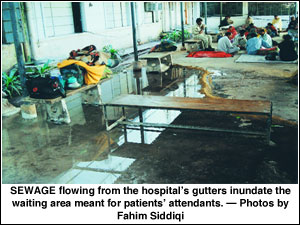
Back in 1948, the hospital had a six-inch drainage system. Today the size of the drainage system is exactly the same. As a result, hardly a day goes by when one patch or the other on the hospital premises doesn’t get inundated with sewage. The toilets too present an extremely shoddy picture.
To resolve the perpetual problem, the hospital administration last year requested the government to sanction funds with the help of which the sewerage system could be improved and toilets repaired or rebuilt as the case may be.
The authorities have sanctioned a sum of Rs20 million for the project. But, according to a well-placed source, the hospital administration is not happy with the way the work is being approached.
The source said the hospital didn’t want the Public Works Department, which has been entrusted with the work, to be involved at all in the project. “But still the work has been given to the PWD,” he told Dawn.
“So even in the planning stages a difference of opinion has cropped up between the administration and the authorities.” The source claimed that the PWD was largely to be blamed for the situation.
“It’s their record. The hospitals and schools don’t have much confidence in their ability as well as willingness to produce good quality work.”
When contacted, the Civil Hospital’s medical superintendent refused to be drawn into the controversy. “I don’t want to comment on the issue,” said Prof Noshad A. Shaikh.
“But what I can say is that we have been facing a lot of problems because of the old and rickety sewerage system. And yes, the PWD has been given the task of repairing and refurbishing the system.”
Prof Shaikh said under the old system all waste matter fell into the sewage mains on the road in front of the Dow Medical College. “Under the new system the waste matter is proposed to fall into the sewer on the Chand Bibi Road, which is bigger in size.”
Almost all the toilets, meant for staff as well as patients, were also proposed to be rebuilt. He said there were about 300 sweepers in the hospital.
“Out of this figure about 40 are not actually working as sweepers.” The 40-odd employees were Muslims and didn’t want to work as sweepers, he said.
Answering a question, Prof Shaikh said the 40 people mentioned had pulled various ‘levers’ to get a job but having failed in landing a “respectable” one accepted that of a sweeper. “But now they don’t want to work as sweepers.”
He said he was trying to shift these people to other departments. “Then we will induct proper sweepers.”
Prof Shaikh said a total of 100 posts lay vacant in his hospital. “But since there’s a ban on recruitment we cannot do anything in this regard.”
The Civil Hospital’s medical superintendent said more than 3,000 people visited his hospital’s various departments every day. “But we don’t have proper security arrangements.
“Our watchmen are old and poorly trained. That’s why we feel that law and order problems can erupt here anytime.” Prof Shaikh was of the view that authorities should deploy police and rangers personnel on the hospital premises.
He hinted that the hospital administration was thinking in terms of entrusting the task to a private security firm.