



 0
0

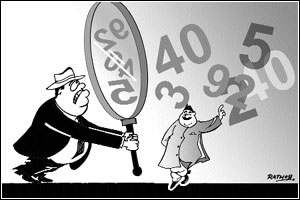 The compilation of controversial figures and various important data by the Federal Bureau of Statistics (FBS) has started souring government’s relations with donor agencies, as the officials have been accused of firming up exaggerated figures relating to social indicators and ignoring new details provided both by public and private sectors.
The publication of the report, “Pakistan Poverty Assessment: Vulnerabilities, Social Gaps and Rural Dynamics” by the World Bank did not go well with senior officials, as the WB officials, maintained that it was prepared in the light of information provided to them by the FBS, specially about poverty and other social indicators relating to health, education and nutrition. There was an exchange of hot arguments between the WB officials and the Pakistani officials, including Prime Minister’s Advisor on Finance Shaukat Aziz at a seminar organised by the WB last week to discuss its report on poverty.
The main point of discord was the WB’s assertion that there was 36 per cent poverty till 1998 and the belief of many officials of the donor agencies— including the Asian Development Bank (ADB)— that poverty continued to increase beyond 1998. Ms. Tara Wiswanath, the author of the report, has been saying that she has not written any thing on her own and that the report was based on figures provided by the FBS.
“The drought situation and 9/11-related events have caused more poverty and there should be no embarrassment about it”, she said. When contacted, she added that it was incomprehensiblee why people criticised the report, specially when it did not contain anything which had been suggested by her team on its own. “We relied on the information and the data provided by your government agencies”, she maintained.
Insiders claim that officials of the ministry of finance wanted to discredit the work done by the FBS statisticians. “This bureau is conducting flawed surveys which cannot be accepted”, said a senior official of the ministry. He said people often alleged that there was no local and foreign investment during the last three years and that this perception was correct to an extent. “Again the FBS is to be blamed for not incorporating in its data Rs42 billion domestic investment made by the textile industry last year”, another official said.
On the other hand, officials of the FBS rejected the findings of the ministry on various issues. They said that figures complied by them were almost the same as of the Social Policy Development Centre (SPDC), Karachi, and the Pakistan Institute of Development Economics (PIDE). “But we can accept some of our weaknesses. For example, we pay Rs20 per day to a person who is asked to conduct a household survey for determining various economic indicators and under these circumstances “ how can you expect any quality work”, asked an official.
The government is considering to set up a task force, comprising officials and independent economists to prepare economic indicators. The purpose, insiders claim, is to withdraw the exclusive authority to collect and compile economic data from the ministry of finance.
It is said that the World Bank is not ready to accept the household survey which says that economic indicators have improved. “The bank is ready to accept that health-related indicators have improved but not those related to education, nutrition and population growth”, says an official.
The government admits that over 35 per cent people in Pakistan are living below the poverty line. However, it is not ready to accept that poverty is still increasing. The government claims that poverty has diminished during the last three years. Nonetheless, many donors do not accept it and are calling upon the government to increase development funds and make sure that these funds are spent judiciously.
Generally, the World Bank and the ADB had been critical of Pakistan’s previous $8 billion prestigious Social Action Programme (SAP). According to them, most of the money allocated for SAP was wasted in corruption and that this was the failure of previous governments who did not play their due role in this behalf. The donors had in fact withdrawn their $200 million dollars from the SAP and diverted them for education and drought purposes.
The World Bank report says that Pakistan faces challenges and opportunities unprecedented in its history. The level of poverty in the country has not appreciably changed in the ten years preceding 1999. The educated and well-off urban population lives not so very differently from their counterparts in western countries. However, the poor and rural inhabitants of Pakistan are being left far behind. This is evident from many social indicators. Unless their condition is sharply improved,Pakistan will fall further below other countries’s performance in the future, the report concludes.





























