



 0
0

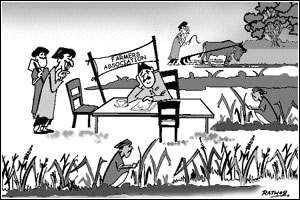 THE major reason behind Pakistani’s poor progress in poverty alleviation is the decline of the share of the working population in agriculture, from 71 per cent in 1951 to about 64 per cent at present.
However the share of agriculture in the gross domestic product (GDP) has dropped from 56 per cent to 25 per cent. In other words, 25 per cent of the GDP has to take care of 64 per cent of Pakistani labour which, in turn, shows the rising income inequality.
Agriculture is basically a private unorganized sector. It is the hands of some 12.5 million farming families, of which 75 per cent are marginal farmers holding one hectare or less. Most of them continue to follow the rice-wheat crop rotation, with the world prices of these two items going down.Thus the odds are pitted heavily against farmers. Cashing in on the difference in domestic and international prices of these commodities, multinationals for their gains are increasingly resorting to exports of wheat and rice. The result is that the burden on marginal farmers is becoming increasingly unbearable.
Farmers know what profit is all about but they fail miserably when they come for marketing their produce. Prices offered for products grown by the subsistence farmers are generally lower than the minimum support price.This has resulted in a very dangerous situation in Pakistan and don’t be surprised. There is every likelihood that the farmers may not go in for diversification in the near future as they have a bitter experience of growing potato, onion, etc.
Pakistani policy makers, therefore, need to learn some lessons from the past experiences. The global role of Pakistan can only be best served by a focus on agriculture and agro-processing. Instead of focusing all its attention on the individual sector, the government should also take steps to integrate the farm sector with global agriculture. Our policy planners would have to think very seriously how well India integrates her agriculture with world markets.
Globalization can become a real threat if farmers are left to fend for themselves against global food majors. The time has come for some major modifications in our agricultural strategy. Before restricting wheat and rice areas to alternate crops, we must study the future requirements. The international Food Policy Research Institute in its paper “Prospects for Pakistan’s supply and demand 2020” projected that the cereal gap would be about 45 to 65 million tonnes if the country becomes a “tiger economy” with 6 per cent growth in per capita income each year. Even if Pakistan’s economy slows down to more historical rates of growth, the cereal gap could grow to as much as 15 million tonnes by 2020, the report cautioned.
So ensuring self-sufficiency in food grains, the country has to widen the scope of its business to include agriculture. We see an opportunity in the new world order into an opening for our farmers. What is needed for agriculture to receive a boost is to replicate what was done for the information technology sector for everyone to come together, including government, scientists, managers and farmers. This can be achieved through a farmer entrepreneurs association (FEA) like the Federation of Pakistan Chambers of Commerce and Industry.
To begin with, we should make entrepreneurs out of farmers. Under this organization, the farmer not only merely grows but also sells his produce at the farm gate like industrial production. The FEA should also aim at teaching him some basic value addition at his level, which will increase the shelf life of his produce which, in turn, will fetch him a better price for his goods. This will work in two ways for the country — as a producer the farmer will meet the cereal requirements of his countrymen and as an entrepreneur, he will compete in the world market.
We realize that marketing is a major hurdle for the farmer. Like the FPCCI, he has no access to finance or to the equally critical component, marketing enterprise. We must involve banks and other financial institutions to help the FEA in meeting its financial requirements. On the marketing front, the FEA should tie up with institutes of management of the country so that the farmers may pick up proven successful agricultural management quickly.
In fact, the Applied Economics Research Centre (AERC) of the University of Karachi can start an extensive course on agricultural management to pool the trained talent which will do the extension work of taking it from the laboratory to the farmers’ field. Agricultural universities should also lend support in this venture.
An agricultural expert Syed Ashraf Wasti of AERC says: “If you are searching skill for agricultural management, then the children of farmers should be trained in farm management.”




























