



 0
0

 SEOUL/BEIJING, Jan 11: North Korea on Saturday escalated a nuclear crisis with a threat to end a moratorium on missile testing on the day it became the world’s first country to withdraw from a treaty preventing the spread of atomic weapons.
Pyongyang has caused alarm across the world since expelling UN nuclear inspectors last month, raising the stakes with ever more bellicose statements in an attempt to win concessions, recognition and security guarantees from the United States.
“The moratorium on our missile test firing will be of no exception, now that the United States has rendered all agreements reached between the United States and North Korea invalid,” North Korean Ambassador to China Choe Jin-su told a news conference.
Such a move was essential to counter possible US attack, Choe said, blaming the United States for failing to maintain talks and move towards establishing diplomatic relations.
“I’d like to reiterate as follows — the development, test, deployment and export of our missiles entirely belong to our sovereignty,” Choe said.
He spoke a day before US Assistant Secretary of State James Kelly is due in Seoul on the first leg of an Asian tour.
Pyongyang stunned its neighbours in 1998 by firing a medium-range ballistic missile that arched over Japan. The following year, the North announced a self-imposed moratorium on missile flight tests to last until the beginning of this year.
The crisis may have spiralled after last year’s speech by President George Bush, bracketing North Korea with Iraq and Iran in an “axis of evil”, convinced Pyongyang it was under threat. The brief detention at US behest of a ship exporting missiles to Yemen late last year heightened its anxiety.
In Friday’s announcement of its immediate withdrawal from the nuclear Non-Proliferation Treaty (NPT), with notice of a single day, Pyongyang blamed Washington’s “hostile” policy but said it had no intention of developing nuclear arms.
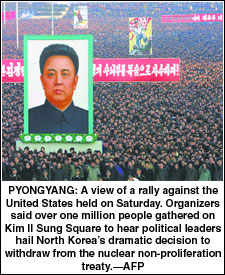
HUGE RALLY: Voicing “burning hatred” for the United States, more than one million people massed in the North Korean capital on Saturday to support their government’s decision to quit a key treaty preventing the spread of atomic weapons, the official news agency said.
Senior officials joined the huge demonstrations in Pyongyang and Premier Hong Song Nam spoke to the crowds to give details of the government’s decision on Friday to pull out of the nuclear Non-Proliferation Treaty, the Korean Central News Agency (KCNA) said.
“People from all walks of life thronged to Kim Il-sung Square and other parts of the city, the meeting places, with burning hatred for the US imperialists,” KCNA said.
“If the US brings dark clouds of war to hang over this land, the army and the people of (North Korea) will remove the land of the US from the earth and root out the very source of evil and war,” the agency quoted one of the speakers as saying.
The communist state’s ruling party daily called on South Koreans to side with the North against the United States.
“All the Koreans should see through the US trite trick to perpetuate Korea’s division and turn out in an anti-U.S struggle for independence and demonstrate the strength and mettle of the Korean nation,” the Rodong Sinmun said in a commentary.
North Koreans waving colourful paper flowers turned out in their tens of thousands along the streets, for example, to greet South Korean President Kim Dae-jung when he visited in 2000.
More than one million Pyongyang residents gathered in the city’s squares, plazas and streets on Saturday, KCNA said.
Speakers at the mass rally voiced full support for the decision to withdraw from the treaty, describing it as a legitimate measure of self-defence by their government, KCNA reported.
“The participants are fully determined to use every means and method and fight a life-and-death battle against those who try to infringe upon the nation’s sovereignty and right to existence without any slightest compromise and concession,” KCNA said.
North Korea became on Saturday the first country to withdraw from the nuclear Non-Proliferation Treaty, triggering alarm around the world and intense diplomatic efforts to defuse the crisis.
Making the announcement of its immediate withdrawal, Pyongyang blamed what it called Washington’s “hostile” policy, but said it had no intention of developing nuclear weapons.
Pyongyang expelled UN nuclear inspectors last month, in the latest move of its brinkmanship style of diplomacy.
Tensions have been rising on the divided Korean peninsula since a visiting US official said in October that Pyongyang had admitted it was pursuing a nuclear arms programme in violation of a 1994 agreement.
Those tensions were heightened this month when North Korea disabled UN nuclear monitoring equipment and threatened to reactivate a nuclear plant capable of producing weapons-grade plutonium.—Reuters





























