0
0

ISLAMABAD, Jan 8: Prime Minister’s Advisor on Finance, Shaukat Aziz, said here on Wednesday that a record amount of Rs161 billion was being spent during the current financial year for development of the social sector.
“We have increased the development budget from Rs116 billion to Rs161 billion to considerably improve social indicators specially to alleviate poverty,” he added.
He pointed out that Rs134 billion had been allocated for Public Sector Development Programme (PSDP) alone during 2002-03.
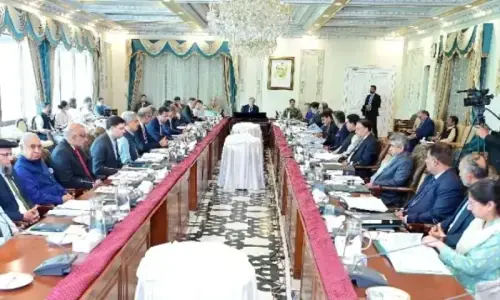
Concluding a one-day seminar on “Pakistan Poverty Assessment” organized by World Bank, he said poverty was a serious issue which needed to be tackled with the support of the international donor agencies.
The government, he said, was raising the development budget by 0.2 per cent of the Gross Domestic Product (GDP) due to which 0.1 per cent poverty would get reduced every year.
Aziz said that there has been 36 per cent growth in development activities during the first three months of the current financial year compared to corresponding period of 2001- 02.
Through the devolution programme, the advisor on finance said, more funds would be spent to reduce poverty in the urban and rural areas.
The seminar was arranged to discuss the recent World Bank report entitled, “Poverty in Pakistan: Vulnerabilities, Social Gaps and Rural Dynamics,” which received a lot of criticism by the government officials for exaggerating poverty-related figures.
He said a task force was being set up which would include prominent government/private experts and economists to compile various statistics and data to determine the extent of poverty and other social sector indicators.
“Efforts to alleviate poverty is a challenge and people need to be sensitized to it,” Aziz said. He also said: “Wisdom is not the exclusive property of the donors who cannot commit mistake,” he said calling up the donor agencies to verify their facts before coming out with reports on Pakistan.
He said that the government had allocated substantial funds for development purposes due to reduction in the amount of debt servicing. “A lot of fiscal space has been made available to reduce poverty due to decrease in the amount of debt servicing.”
The government, he said, was eradicating poverty also through increased Zakat allocations and micro credit. The macroeconomic stability, he pointed out, was essential to meet challenges like poverty alleviation, spending more on health, education and malnutrition.
Aziz said that the government was hoping to have 4.5 per cent GDP growth in 2002-03 due to removal of drought and the better performance of the agriculture sector.
The Acting Resident Director of World Bank in Islamabad, Abid Hussain, said poverty was a serious problem which needed to be removed on priority basis. “I think we should accept that there is a lot of poverty in Pakistan and we all should make efforts to remove that poverty,” he added.
Secretary Planning Commission Dr Mutawakkal Kazi, Economic Advisor to the Ministry of Finance Dr Ashfaque Hasan Khan, and President of Pakistan Institute of Development Economists (PIDE) Dr A.R. Kamal differed with the World Bank on various poverty-related issues. They appreciated the report but called upon the World Bank officials to cross-check their facts before coming out with any report.
The author of the report and Senior World Bank Economist, Ms Tara Wishwanath, in her presentation said economic development had been stagnated in Pakistan due to drought conditions and 9/11 events which was why overall growth rate could not be improved.
She said that poverty was multidimensional in Pakistan. She said over 50 per cent of the rural population was landless, out of which 40 per cent of them were poor. Similarly, 42 per cent of the population living in households with illiterate heads was poor, compared to 2 per cent of those in other households.
“There was a poor access to health care and basic infrastructure,” Ms Tara said adding that the poor were less likely to access health facilities. “Twenty-four per cent of the poor rely on unsafe sources for drinking water, compared to 19 per cent of the non-poor”.
She was of the view that social indicators with few exceptions had stagnated during the 1990s, due to inadequate social spending, inefficiency in spending allocated amounts and poor quality in delivery of services linked to incentives.