0
0

Pointless rhetoric
MORE controversy has been kicked up than one had expected over President Musharraf’s purported warning, during the recent standoff with India, that a war, if forced, would be “unconventional”. The president himself has clarified that he was misquoted and did not imply the use of nuclear weapons during his address at an army corps reunion in Karachi. The statement has drawn considerable flak from India, where the “hawks” referred to a nuclear war talk as “nonsense”. Washington has also taken note of the controversy but declined to comment on it. One reason for the controversy is the lack of an authentic version of what the president had actually said. If the Inter- Services Public Relations Directorate had quickly come up with the text of the speech, it would have served to remove the misunderstanding surrounding the speech.
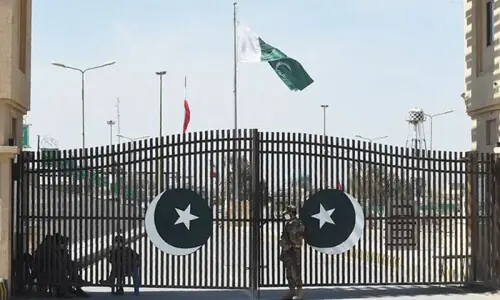
The controversy over the president’s speech came in the wake of “victory” claims by the two sides. Both Islamabad and New Delhi assert that they had won the war without fighting a battle. That being the case, each side should now show the “victor’s” magnanimity and offer the “vanquished” honourable peace. Regretfully, that is not the case, for Islamabad and New Delhi continue to maintain a bellicose stance and exchange angry rhetorics. This merely serves to defeat the purpose of the troop pull-back and maintains tension between the two sides. The air, rail and road links between the two countries remain suspended and diplomatic representation in the two capitals is still at the level of charge d’affaires. The summit conference of the South Asian Association for Regional Cooperation could not be held in Islamabad this month because of India’s prevarication, forcing Pakistan to cancel it. Yet, amazingly, informal trade continues on a large scale. Why not legalize exchanges by restoring all transport links?
Last week, the two sides exchanged data on nuclear installations. This is done every year as part of a bilateral agreement. Why confine it to that formal level? Why not talk on more substantive nuclear matters — like averting a nuclear war by accident and establishing a hot line? Unless tensions are lowered and angry polemics stop, there is a real danger that even a stray incident on either side could escalate tension and the two sides could find themselves locked once again in a face-to- face military confrontation. This brings us back to the overriding need for resuming a dialogue. India’s stubborn refusal to talk to Pakistan is morally and diplomatically untenable. If the issues between the two are not to be resolved through talks, what else is the choice — an indefinite military stand-off that could even lead to war? The two governments should know that there are extremists on both sides. These elements would love nothing more than to see a continuation of the present diplomatic stalemate, which they could exploit to spread hate and antagonism between the two peoples. The recent elections in Pakistan and Gujarat have shown how extremists profit from inter-state tensions. These hate mongers pose a threat to both regional peace and civil societies in the two countries. It is to avoid such possibilities that Islamabad and New Delhi need to stop their pointless war or words and move toward a full resumption of diplomatic, trade and communications links — and most of all, a political dialogue.
Less return on savings
FOR the second time during the current fiscal year, the government has slashed the rates of profit on the national savings schemes. Earlier, the cut was made effective from July 1 while this one came into effect on January 1. The reduction this time ranges from 13.6 per cent on defence savings certificates to 28.7 per cent on savings accounts. Cumulatively, the rates have been brought down by over 40 per cent since it was decided to cut interest rates in order to reduce budget deficits and lower the cost of investment and production. This was not possible until the profit rates of national saving instruments were lowered as these were competing directly with the commercial banks in the mobilization of deposits.
The interest rate plays an important role in harnessing resources, promoting investment and determining the size of the budget deficit. The economy has been going through a recession for a long time and the major reason, according to the government, is the high cost of investment. Whether the reduction in interest rates will stimulate private sector investment remains to be seen. The investment climate has been affected more by the security environment in the region and the political uncertainty and law and order situation in the country than by other factors. Even the restoration of democratic rule in the country has not yet brought about any visible improvement in the climate affecting long-term investment and economic recovery.
There is, however, a distressing aspect of the cut in profit as well, particularly affecting pensioners, widows and small savers for whom national savings schemes were originally meant. Their incomes have been slashed by more than 40 per cent because of rising prices and unemployment. Their plight deserves special consideration. While announcing the reduction in profit rates the government indicated that a special savings scheme for pensioners and widows was under consideration, which, hopefully, will include small savers as well. The promise, one hopes, will be fulfilled soon.
Burn care
THE rising number of deaths because of inadequate burn care facilities underscores our apathetic attitude towards a pressing humanitarian problem. The Progressive Women’s Association (PWA), which issued its annual report in Islamabad on Friday, disclosed that the four major hospitals of Rawalpindi and Islamabad received 294 burn victims last year out of which 217 died either due to lack of facilities or hospital-acquired infections. The victims, many of them young women, could have been saved if proper burn units were in existence. As it is, even victims with 30 per cent burns could not survive. The PWA chief pointed out that in Bangladesh, with a high number of acid burn cases, a victim of 60 per cent burns could hope to survive because of professional handling. This highlights the critical role of well-equipped facilities manned by medical staff properly trained in treating burn victims.
Although successive governments have been making commitments for setting up burn units, progress in the matter has been very slow. Reports suggest that a project for the construction of burn units was approved by the Executive Committee of the National Economic Council in 1995 at a cost of Rs 322.5 million with a foreign exchange component of Rs 292.5 million. During 2001-2002, Rs 300 million were allocated for the project. Under the Public Sector Development Programme, an allocation of Rs 7.50 million was made. However, till December 2001, only Rs 0.75 million had been released. Burn units were scheduled to be completed in Islamabad, Lahore, Karachi and Peshawar in 1997, but non-availability of funds has hampered the provision of equipment necessary to make them operational. Delay on this score must not be tolerated and especially funds given by foreign donors should be utilized at the earliest. Since major city hospitals have to deal with referral cases from surrounding areas and since the cost of running a burn unit is high, they should be given freedom to utilize funds they generate according to their own priorities.