



 0
0

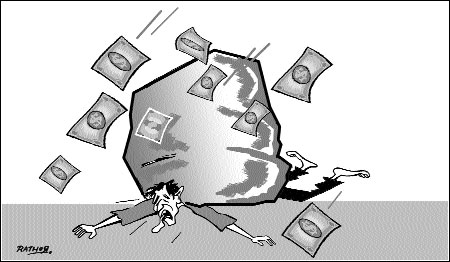 “Despite the implementation of very tight macroeconomic policies, that have already led to compression of imports and falling current account deficits, Pakistan’s external capital requirements remain large. Current balance of payments projections indicate that through 2003-2005 Pakistan will need over $5.7 billion to finance reform under the Interim- Poverty Reduction Strategy Paper”, says a 2002 document of the World Bank Group.
Talking about 2003-05 lending programme and implementation challenges, the document says that Pakistan remains a heavily indebted country despite the Paris Club rescheduling. Pakistan’s total external public and publicly guaranteed debt stood at $31.4 billion, or 53 per cent of GDP, at the end of June 2001, and is expected to rise to $31.7 billion (35.8 per cent of GDP by June 2005.) Debt service as a share of foreign earnings is estimated to fall as a result of debt rescheduling from 29 per cent in 2001 to under 22 per cent in 2005.
The present value of long-term public and publicly guaranteed external debt to exports fell by 30 percentage points to around 230 per cent in fiscal 2002, and will reach to a level close to 210 per cent in 2003-04 — still above the indicative level of sustainable debt (150 per cent) for Highly Indebted Poor Countries (HIPC). The debt service to the World Bank as ratio of exports of goods and service at 3.5 per cent in 2001 is below the 6 percent guideline recommended for the Bank lending is projected to fall significantly to 2.6 per cent by 2005.
The preferred creditor ratio (debt service to preferred creditors as a ratio of total public debt service) - 45.3 per cent in 2001-02 - is well above that recommended by the Bank exposure guidelines. This is the result of recent bilateral debt reductions and past initial non-multilateral lending to Pakistan. At this level, Pakistan is only marginally creditworthy for the Bank and the government has refrained from borrowing on Bank terms for 2000-01 and is expected to borrow at those terms in 2002-03”, the Bank said.
It said that given the strength of the government’s I-PRSP, its implementation record to date, poor prospects for higher private capital inflows particularly, given the current regional tensions, the large financing requirements, and high indebtedness and poverty incidence, the government of Pakistan has requested an increased access to IDA13 allocation to finance the comprehensive federal and provincial reform programme. The Bank’s level of financial assistance over the next three years is a key element of this Country Assistance Strategy (CAS).
Given various consideration and the likelihood of an increase in demand for the bank’s assistance from the provinces, Special Drawing Rights 1.0 billion (equivalent to $400 million per year), International Development Association (IDA) allocation has been set for the base case and SDR 1.4 billion (equivalent to US $600 million a year) for the high case over 2003-05. The Bank will resume lending only under the high case and starting from 2003-04.
According to the Bank, the lending scenario will be guided by two sets of triggers; (1) entry and exit triggers linked to provincial reforms; (ii) global triggers linked to each of the three pillars of the assistance strategy, macroeconomic stability and governance, enabling environment for private investment, and human development. In addition, the Structural Adjustment Credit (SAC-2) and following adjustments operation, include detailed short-and-medium-term triggers for each of the three pillars of the assistance strategy, macroeconomic stability and governance, enabling environment for private investment and human development.
These triggers should be interpreted as indicating the key areas of deep reform:(1) macro stability, (ii) governance, (iii) enable environment and private investment, (iv) human development, and (v) portfolio management. Within those, the bullets are indicators that will be used to assess progress in each of these areas. These indicators are not intended to represent prior actions. The implementation of some of these reforms can only be done over the medium term. Significant progress in each of the above areas will be needed for the high case. “Failure to show progress in any of the five areas above will move Pakistan to the low case”, the Bank warned.
It said that Pakistan’s provinces face a fiscal crisis - itself the result of poor governance and poor economic management - which had crippled their ability to deliver on their mandate. Since a significant volume of the Bank’s lending programme is linked to structural reforms to improve the provinces’ fiscal performance and strengthen their capacity to deliver basic services, the Bank’s lending programme will take place under the high case scenario and will be regulated by the following entry criteria:
There is a reforming government at the provincial level with committed “reform champions” at the top and capable reform leaders with the administration.
The provinces would have already indicated a number of reforms to restore good governance and improve their public finances and public service delivery. This includes: Fiscal discipline translated into reduced short term borrowing for deficit financing; improved performance of financial management committees and Public Accounts Committees; initiation of civil service reform including pay and pensions adjustments, rightsizing by eliminating positions as key skills requirements at the provincial and in autonomous and semi-autonomous bodies; enforcement of location-specific teacher and health worker contracts, control of staff absenteeism; and implementation of performance-based remuneration and teacher training programmes.
Correspondingly, the bank lending to the provinces will be guided by the following criteria: reappearance of substantial short term borrowing to finance the budget deficit; expansion of public sector contingent liabilities (through off-budget financing of public enterprises and other entities); and deterioration of reversal of reforms to improve social service and governance improvements.





























