



 0
0

 HOW fragile is the so-called New Economy was amply evident when after seeing off its peak (1995-2000) it finally burst, eroding investors’ confidence in it; the media has since renamed it the Bubble Economy. It was not the economy that was at fault, its key players and the beneficiaries were blinded by euphoria.
How unsafe is the architecture of the new technology can be judged from the nervousness the corporate sector is currently showing. It suffers as much from the fear syndrome as does America’s political establishment. There is an endless wait for Osama’s next terror attack, possibly more disastrous than the 9/11, and there are no two opinions about that. The question is not if, but when.
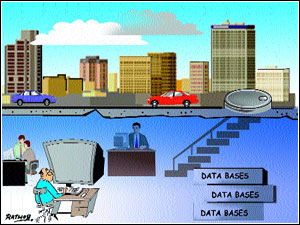
As a result, several corporate giants in countries such as the United States, Britain and Germany are seeking safe havens for their web of digital technology that fuels today’s economy. Many companies, according to reports appearing in the western media, are now putting their most valuable computer databases in a bunker, about 30 meters deep, in Britain to guard against the risks of terror attacks or nuclear explosion, chemical and biological warfare or some natural disaster.
The nervous business firms are from media, finance, telecommunication and biotechnology. They have placed their servers in hermetically sealed environments, protected by pressured air locks, sophisticated electronic detection systems, steel doors with a thickness of about 18 inches, security personnel and barbed wires.
A special report carried by International Herald Tribune last month concluded: “While all this may appear extreme, it seems to offer something that ordinary computer virus protection does not: peace of mind.”
In the forefront is a data-storage and security software company based in London, called A.L. Digital. It houses customers’ data in an old Royal Air Force installation near Kent in southeastern England which the company got in auction from Ministry of Defence. Set on 18 acres, the bunker, measuring 60,000 square feet, includes three backup power systems, dedicated telecommunications lines, a fire station, massive fuel and water storage tanks and a battalion of security cameras monitoring corridors and server racks.
An executive of the company says: “It is amazing to walk around the bunker and imagine the level of fear and paranoia that the cold war had induced to enable such a facility to be built in the first place.”
Among the clients are banks and financial companies that are prepared to take whatever measures are necessary to protect the physical integrity of their data. It goes without saying that in a knowledge-based economy, information is power. One can have all the virus protection and fire walls in the world but they are completely useless if security for the server box itself is not reliable. The fact remains that there is always some information that is vital and worthy of the highest levels of security.
Usually, the most common reasons for loss of data are human errors, employees’ sabotage and viruses. The argument that why such a huge and sophisticated security regime is essential is that natural and regional disasters do happen. And World Trade Centre attack did happen. But to ensure continuity of the business a well-planned and fool-proof data protection strategy is imperative.
In Germany, a security firm has constructed a 2,200 square meter electronic fortress in Frankfurt specially designed to ensure business continuity for some of the largest German banks and financial institutions in the event of a terrorist attack or natural disaster.
In the United States, a similar measure was undertaken by a security firm last year by opening its storage facility 25 meters underground in an abandoned gypsum mine in Michigan. And the British firm, A.L. Digital, opened another nuclear storage centre at an undisclosed location near London last year and one more is to be opened soon at Newbury in southwestern England.
The cost of hosting a server in the bunker is comparable to the prices for a standard data centre in London — anything from 195 dollars a month for a single server on a shelf to hundreds of thousands dollars a year for renting larger storage spaces.
The IHT report poses question: Is such a high level of security really called for? It may be more advisable for the companies, it says, to concentrate on, for instance, the robustness of their networks or the reliability of their power supply and backup systems. Then, it argues, not all companies can afford the huge expenses involved. Not only can most companies not afford them, they simply don’t need them. Besides, the underground approach is not the right approach for the medium-sized enterprises.
When the New Economy was at its peak, billions of dollars were invested in it in the US from all over the world even by those coming from the developing world who saw in the magic of internet a great promise of transforming not only their economies back home but also improving common man’s life which had never been less miserable. One of the causes of failure of the New Economy was the belief that because of globalization, deregulation and the new technology, the old rules need no longer apply. Suddenly bribes became incentive-based compensation, lies became aggressive accounting and conflicts of interests became “synergies”. As long as everyone was making money, people were willing to overlook things. According to The Washington Post, “Now it is clear that the bubble was neither real nor enduring. Twenty months after the world’s largest economy tipped into recession, it is barely growing despite rising productivity. Stock prices are back where they were nearly five years ago... Since its peak in March 2000 the technology-laden Nasdaq market has lost more than 75% of its value. And nobody is confident of how much of the revenue and profit growth during the bubble was real and how much was accounting fiction”.
How real is the threat to technology that has caused shivers among its leading players is, however, difficult to determine. There is no gainsaying the fact that insecurity is on the rise. There are more and more attacks even on the security mechanisms. The element of theft and sabotage is also on the rise. Those firms which have not suffered attacks are equally scared. At an annual security conference held in October in Paris a top executive referred to an experiment carried out in a California firm. A lone computer was installed on a network and left idle to monitor any intrusive activity. The first attacks on the machine began within eight hours and there were more than 20 exploits of the machine a few days later. Within a few weeks, the system was completely compromised.
Banks undergo frequent electronic robbery — with annual losses in the billions — but they simply write them off to the cost of doing business. For every bank robbery the banks know about, there are about a dozen they don’t know about.
And such stories of “digital bleed”, the experts executives and critics at the Paris conference seem to be trying to put a tourniquet on a situation that is getting “worse” as software gets “better.”
There is no doubt that each time one tries a new cell phone service or upgrades a PC operating system, it is a security trade-off. Unlike toasters, bikes or cars, computers can be transformed by way of a simple download into a wholly different type of product with completely different vulnerabilities.
Some experts consider the poor state of information security as a natural byproduct of the internet industry’s modus operandi: craze for newer, better, faster and more. Usually it is observed that first priority of the companies that make the software is to sell their products with more features to stamp on the side of the box. Security? And in many cases the security is often an afterthought when it comes to consumer products. The hard fact is that even after the revelation of significant vulnerabilities and attacks, there is little motivation among the companies to give high priority to security.
According to a survey, about 59% of the IT companies that suffered a catastrophic fire, flood or earthquake either never reopened or closed within two years. It is so because in most cases, the business firms had never thought about a plan to meet emergencies. The disaster recovery was focused on the IT side. September 11 reminded everyone to think about the people too.




























