0
0

An admiral’s viewpoint
FORMER Indian Navy Chief, Admiral (Retd.) L. Ramdas, could not have been unaware of the thinking in New Delhi about the future of India-Pakistan relations when he visited Pakistan last week. He may also have had the benefit of an official briefing before he undertook the journey.
The admiral’s visit was primarily in his capacity as the head of the Indian chapter of Pakistan-India People’s Forum for Peace and Democracy (PIPFPD), a non-official peace initiative, with which he has been associated almost since its inception in 1995. He may not have carried any message from his government for the authorities in Pakistan, but his speeches and exchanges during his stay in Pakistan did provide some broad as to how New Delhi would want to move towards the objective of defusing tensions in the region and more specifically with Pakistan. May surmise on the basis of he said while visiting Karachi that the reactions he came across were on the whole positive.
Adm Ramdas did not provide any specific information about his informal exchanges with his friends in Islamabad, But on the whole he appeared cautiously optimistic about the possibilities of improvement in the atmospherics now that the troops massed on the two countries’ common border are being pulled back to their peacetime locations.
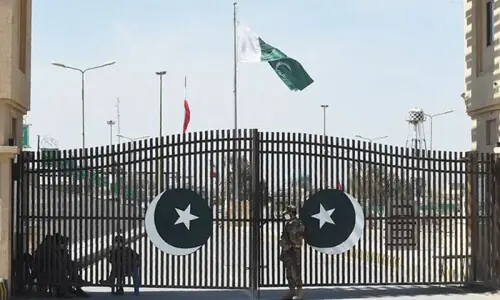
He also seemed hopeful that India would not now delay much longer the re-opening of the rail and road links between the two countries.
Indeed, he frankly admitted that the Indian government had acted rather hastily in deploying troops along the border shortly after the terrorist attack on the Indian parliament building in December last year.
Talking to a group of Pakistani writers, journalists, lawyers and doctors at a meeting arranged by the Karachi chapter of PIPFPD last Sunday and to media representatives at the Karachi Press Club the following day, Adm Ramdas sounded confident that India-Pakistan talks at the level of officials could begin within the next two or three months, if nothing untoward happened meanwhile. However, he ruled out a summit-level meeting in the immediate future.
If New Delhi would like to see what kind of government takes over in Islamabad following last month’s elections and its policy stance on the question of peace and normalization with India, it is quite understandable. Part of the reason is that certain politicians and groups that now expect to have a berth in the new government in Islamabad are known to be opposed to any form of normalization with India. Some of them would even want Pakistan to declare a jihad in support of the freedom fighters in Kashmir. If such elements come to acquire a powerful role in critical areas of policy making, any improvement in relations with India would be out of the question.
However, President Pervez Musharraf has stressed that he expects his policies, particularly in regard to the country’s political stability and economic development to be continued even after a civilian government takes over.
The general may cease to be the chief executive after an elected prime minister assumes office, but as president he will be in a position to influence decisions in key areas of governance and policy formulation. The Indian government can be expected to be duly aware of this fact and should not need any further assurance.
The prospect of a nuclear exchange between India and Pakistan is too horrible even to contemplate and no sane person on either side would want that to happen. In the words of Adm Ramdas, nuclear weapons are totally indefensible. However, his suggestion of an agreement on a “nuclear ceasefire” between the two countries is somewhat inscrutable. The admiral did not elaborate what he actually meant.
If he was suggesting some sort of an agreement on mutual nuclear restraint, Pakistan has more than once offered the same. The reluctance has been on the Indian side as New Delhi maintains that its nuclear programme is not necessarily Pakistan-centric.
To expect that either Pakistan or India would agree to the dismantling of their nuclear arsenals is altogether unrealistic, especially against the backdrop of their history of mutual hostility and an adversarial relationship.
In saying what he did about India’s nuclear explosions, Adm Ramdas seemed to slur over the fact that India is known to cherish the ambition to be the dominant military power in South and South-East Asia, and in that it considers itself to be a rival of China.
However, this is not to say that Pakistan and India should not want to come to grips with the problem and try to work out some mechanism for mutual nuclear restraint. There has to be a long-term programme for peace and co-existence and that assumes that the two countries must also come to grips with the disputes which stand in the way. There has to be, to quote the admiral, a radical change in the mindset on both sides.
Adm Ramdas touched but briefly on the Kashmir problem. However, he apparently recognizes the primacy of the issue for he has gone on record (in an article published in The Hindu) saying that there is need to develop “a process for ascertaining the wishes of the people of Jammu and Kashmir regarding their future.”
It is obvious that his views on the Kashmir problem significantly differ from the official Indian position. He seems to believe that the Kashmiri people have to be involved in the search for a way out of the impasse.
This is in contradiction with the line pursued by ranking BJP-led government leaders like L.K. Advani and George Fernandes who believe — and say so endlessly — that the trouble in Kashmir is largely the result of incursions of militants into that territory. This more than anything else explains the decades-old deadlock and conflict over the future of the disputed state.
Why Now?
“The UN can meet and discuss, but we don’t need their permission (to attack Iraq),” said White House chief of staff Andrew Card only days after the United Nations Security Council finally passed a resolution sending the weapons inspectors back into Iraq. “I think regime change will be the result of disarmament, and regime change may have to be the means of disarmament.”
‘Regime change’ means replacing Saddam Hussein with a pro-American regime, a goal that can only be accomplished by a US invasion of Iraq. And if the Bush administration is still determined to do that, then why did the Security Council members just go through two months of intense haggling to agree on a resolution re-starting the inspection process that was suspended in 1998?
The answer, unfortunately, is that everybody does still assume that the US is going to attack Iraq. The Security Council resolution is really just designed to give everybody legal cover when it happens. The US can claim that it is responding to some Iraqi obstruction of the inspectors — and the friends and allies of the United States who disapprove of an American attack can at least claim that the US is acting within the letter of the law, without actually having to vote in favour of the attack.
That’s important because nobody wants to turn the US into an international outlaw. However unhappy they may be about current US policy, the long-term interests of the world require that the United States remain fully engaged with the United Nations; the alternative is a world where the rule of law has broken down entirely. If the US is absolutely determined to do something, it must be declared legal, or the UN dies.
But why is the US determined to attack Iraq NOW? That is a question that even worries Richard Butler, the tough Australian who led the previous arms inspection team in Iraq, Unscom, and was widely vilified at the time as a US stooge.
“I believe the case against Saddam Hussein is utterly proved,” Butler said in a recent interview in Sydney with David Fickling of the ‘Guardian’. “The man should be tried for crimes against humanity. But what I’m unconvinced by is the question of why it was inconvenient to deal with the problem two or three years ago and now, today, it’s imperative. What actually is motivating that?”
A small industry has grown up in Washington to manufacture tendentious answers to that question. Its core, as was revealed last week by the ‘New York Times’, is the team that was put together last year by Defence Secretary Donald Rumsfeld and his deputy, Paul Wolfowitz, to dispute the Central Intelligence Agency’s conclusion that there are no links between Saddam Hussein and terrorists who target the United States. The task of the ‘B team’ is to scour the intelligence data for anything that can be bent to support Rumsfeld’s insistence that such a link exists.
CIA director George Tenet fights back without openly defying the administration by getting members of Congress to ask him questions that let him state the CIA’s position in public. As a senior defence official interviewed by the ‘Times’ put it: “There is a complete breakdown in the relationship between the defence department and the intelligence community.”
But back to the main question: if a US attack on Iraq is not about terrorism, then what is it about? Only two answers hold any water: Israel and oil.
However far Iraq may now be from acquiring nuclear weapons, it remains the only Arab state that has even tried to get them, and therefore the only real threat to Israel’s regional nuclear weapons monopoly. Even if Iraq did eventually acquire a few nuclear weapons, it could not threaten a first strike against Israel (which has hundreds of them), but it would substantially narrow Israel’s military options by creating an Arab deterrent to an Israeli first strike.
For those like Rumsfeld and Wolfowitz, who see Israel’s interests and those of the United States as identical, that is a sufficient motive for spending American lives to destroy any possibility of Iraq’s acquiring nuclear weapons in the future. —Copyright
The difference between Europe and the US
ALTHOUGH I have visited England dozens of times, I have never spent more than one or two weeks at a single stretch. This year, for the first time, I am in residence for almost two months at Cambridge University, where I am the guest of a college and giving a series of lectures on humanism at the university.
The first thing to be said is that life here is far less stressed and hectic than it is in New York, at my university, Columbia. Perhaps this slightly relaxed pace is due in part to the fact that Great Britain is no longer a world power, but also to the salutary idea that the ancient universities here are places of reflection and study rather than economic centres for producing experts and technocrats who will serve the corporations and the state.
So the post-imperial setting is a welcome environment for me, especially since the US is now in the middle of a war fever that is absolutely repellent as well as overwhelming. If you sit in Washington and have some connection to the country’s power elites, the rest of the world is spread out before you like a map, inviting intervention anywhere and at any time. The tone in Europe is not only more moderate and thoughtful: it is also less abstract, more human, more complex and subtle.
Certainly Europe generally and Britain in particular have a much larger and more demographically significant Muslim population, whose views are part of the debate about war in the Middle East and against terrorism. So discussion of the upcoming war against Iraq tends to reflect their opinions and their reservations a great deal more than in America, where Muslims and Arabs are already considered to be on the “other side,” whatever that may mean. And being on the other side means no less than supporting Saddam Hussein and being “un-American.”
Both of these ideas are abhorrent to Arab and Muslim-Americans, but the idea that to be an Arab or Muslim means blind support for Saddam and Al Qaeda persists nonetheless. (Incidentally, I know no other country where the adjective “un” is used with the nationality as a way of designating the common enemy. No one says unSpanish or unChinese: these are uniquely American confections that claim to prove that we all “love” our country. How can one actually “love” something so abstract and imponderable as a country anyway?).
The second major difference I have noticed between America and Europe is that religion and ideology play a far greater role in the former than in the latter. A recent poll taken in the United States reveals that 86 per cent of the American population believes that God loves them. There has been a lot of ranting and complaining about fanatical Islam and violent jihadists, who are thought to be a universal scourge. Of course they are, as are any fanatics who claim to do God’s will and to fight his battles in His name. But what is most odd is the vast number of Christian fanatics in the US, who form the core of George Bush’s support and at 60 million-strong represent the single most powerful voting block in US history.
Whereas church attendance is down dramatically in England, it has never been higher in the United States whose strange fundamentalist Christian sects are, in my opinion, a menace to the world and furnish Bush’s government with its rationale for punishing ‘evil’ while righteously condemning whole populations to submission and poverty.
It is the coincidence between the Christian right and the so-called neo-conservatives in America that fuel the drive towards unilateralism, bullying, and a sense of divine mission. The neo-conservative movement began in the 1970s as an anti-Communist formation whose ideology was undying enmity to Communism and American supremacy. “American values,” now so casually trotted out as a phrase to hector the world, was invented then by people like Irving Kristoll, Norman Podhoretz, Midge Decter and others who had once been Marxists and had converted completely (and religiously) to the other side.
For all of them the unquestioning defence of Israel as a bulwark of western democracy and civilization against Islam and Communism was a central article of faith. Many, though not all the major neo-cons (as they are called), are Jewish, but under the Bush presidency they have welcomed the extra support of the Christian right which, while it is rabidly pro-Israel, is also deeply anti-semitic (that is, these Christians — many of them Southern Baptists — believe that all the Jews of the world must gather in Israel so that the Messiah can come again; those Jews who convert to Christianity will be saved, the rest will be doomed to eternal perdition).
It is the next generation of neo-conservatives such as Richard Perle, Dick Cheney, Paul Wolfowitz, Condoleeza Rice, and Donald Rumsfeld who are behind the push to war against Iraq, a cause from which I very much doubt that Bush can ever be deterred. Colin Powell is too cautious a figure, too interested in saving his career, too little a man of principle to represent much of a threat to this group which is supported by the editorial pages of The Washington Post and dozens of columnists, media pundits on CNN, CBS, and NBC, as well as the national weeklies which repeat the same cliches about the need to spread American democracy and fight the good fight, no matter how many wars have to be fought all over the world.
There is no trace of this sort of thing in Europe that I can detect. Nor is there that lethal combination of money and power on a vast scale that can control elections and national policy at will. Remember that George Bush spent over $200 million to get himself elected two years ago, and even Mayor Michael Bloomberg of New York spent 60 million dollars for his election: this scarcely seems like the democracy to which other nations might aspire, much less emulate. But this is accepted uncritically by what seems to be an enormous majority of Americans who equate all this with freedom and democracy, despite its obvious drawbacks. More than any other country today, the United States is controlled at a distance from most citizens; the great corporations and lobbying groups do their will with “the people’s” sovereignty leaving little opportunity for real dissent or political change.
Democrats and Republicans, for example, voted to give Bush a blank check for war with such enthusiasm and unquestioning loyalty as to make one doubt that there was any thought in the decision. The ideological position common to nearly everyone in the system is that America is best, its ideals perfect, its history spotless, its actions and society at the highest levels of human achievement and greatness. To argue with that — if that is at all possible — is to be “un-American” and guilty of the cardinal sin of anti-Americanism, which derives not from honest criticism but for hatred of the good and the pure.
No wonder then that America has never had an organized left or real opposition party as has been the case in every European country. The substance of American discourse is that it is divided into black and white, evil and good, ours and theirs. It is the task of a lifetime to make a change in that Manichean duality that seems to be set forever in an unchanging ideological dimension. And so it is for most Europeans who see America as having been their saviour and is now their protector, yet whose embrace is both encumbering and annoying at the same time.
Tony Blair’s wholeheartedly pro-American position therefore seems even more puzzling to an outsider like myself. I am comforted that even to his own people he seems like a humourless aberration, a European who has decided in effect to obliterate his own identity in favour of this other one, represented by the lamentable Mr. Bush. I still have time to learn when it will be that Europe will come to its senses and assume the countervailing role to America that its size and history entitle it to play. Until then, the war approaches inexorably.—Copyright 2002, Edward W. Said
Alas, Microsoft wins again
THE slap on the wrist that U.S. District Judge Colleen Kollar-Kotelly in Washington gave Microsoft last week should trouble you if:
You tried to use your laptop’s hot new wireless card to check your e-mail and Windows crashed because your Internet service provider hadn’t been able to pay Microsoft enough to get the latest coding.
You scrambled to download music from a neighbourhood garage band but were out of luck because the tracks were recorded in software written by Real Networks and every time you tried to play them, Microsoft’s Media Player came on the screen to scold: “unsupported format.‘
You lust for a new palmtop, the one with the full-colour screen and cut-rate price, but your company’s computer administrator rolls her eyes condescendingly because only one model will work with the company’s Outlook server.
You live in the 21st century.
Like the woefully ineffectual verdict that the Bush administration worked out with Microsoft last year, Kollar-Kotelly’s ruling does next to nothing to rein in future abuse by the big-dog corporation, which controls 96 percent of the world’s Web browser market and 93 percent of the world’s home computer operating system market.
Kollar-Kotelly could have, and should have, strengthened the settlement by requiring Microsoft to disclose the operating system coding that independent programmers need to fit their programmes, like Velcro, onto Windows —Los Angeles Times