0
0

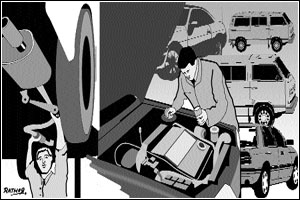 The Japanese automobile industry which is the No 2 in the world after America had started literally from scratch.
And the main factors behind its progress are two tragedies: World War II the and the great earthquake in Kanto in 1923.
Now the Japanese car manufacturers, who first make cars for themselves and then export them to various markets all over the world. To compete with the giants like the USA they introduce new designs and styles in their environment-friendly fuel-cell vehicles. In fact, Japan by now has dazzled the world with its massive production of quality and affordable cars.
The earthquake-ridden country’s economic structure is strange but simple. It has no natural resources and it imports its lifelines oil, iron, and gas. To buy them and food it is making money by exporting value added products and its largest exports are its cars.
Last year, Japan sold 5.9 million units: Germany 3.7 million, Italy and France 2.6 million each, Britain K 2.5 million and China 2.1 million units, said Mr Tetsuo Kitagawa, Toyota Motor Corporation Project General Manager, International Communications Department, in an interview with Dawn in Tokyo.
“Many foreign investors came here and did their best to independently set up factories. But there was no success even in a single case as they found Japanese manufacturers extremely competitive and its people quality conscious, buying only the best,” Mr Kitagawa said.
As a result, the foreign investors managed to take part in the car industry only on equity basis. At present, there were 12 car manufacturing companies in Japan but none of them was owned by a foreign investor. Of them, four have 100 per cent Japanese ownership while the remaining nine have foreign equity ownership. The Toyota Group of Companies, including Toyota Motors, Hino and Daihatsu and Honda were the two major Japanese ownership companies, he said. At present, Toyota is manufacturing automobiles at four assembly plants in North America. It produced 1.7 million units there while imported another 700,000 units from Japan last year, he added.
“Every technology was imported from the USA and the Europe and our engineers were sent there to learn car-making. After World War II and the atomic bombing of Hiroshima and Nagasaki, Japan decided to shun war forever and began maintaining its economy without it. The answer was in establishing more and more industrial units, he said.
He said, Japan suffered a very severe earthquake in 1923 in Kanto. It destroyed everything, mainly its aeronautical industry and railway in Tokyo, Yokohama and the surroundings areas.
“The collapse of the railway system made us realize how convenient were the automobiles. This realization enabled us expand the automobile network. Road conditions were improved and then came the age of motorization. By the late 1960’s, everybody in Japan owned a car,” he said.
Mr Kitagawa said, Japan came to the world automobile scene in the 1960s. It organized the Olympics Games in 1964 and to welcome everybody it had to build a very good infrastructure including rapid expressways, motorways and bullet trains.
He said it was not easy for the Japanese car manufacturers to sell their products in the world market as they had been growing only locally before 1960.
“There was no room for us to export. During those days our products were strong enough to attract global market. It was realized that if Japan wanted to export its cars it would have to design and produce strong units.
“The first exports of Toyota units to America was a disaster as these were taken as toys. The reason was that our products were not faster. We decided to withdraw, learning many things from this mistake. We knew that we had to introduce strong, attractive models the re,” he said.
After three years the company redesigned new models which were a big hit. It later gradually expanded its sales in the US but soon led to sharp trade friction with the local investors which continued till the 80’s.
“So we decided to control the number of cars for the US. They were saying you are exporting unemployment to the US and if you want business, start manufacturing in our country. We finally decided to establish a factory there, a joint venture with General Motors in California, employing local workers and using local parts. We soon started producing many cars, producing 10 million units in 1986. We have 10 million customers who bought Toyotas made in North America,” Kitagawa said.
He said now the company had four plants in North America, one each in California, Kentucky, Canada and Indiana and an engine factory in West Virginia, preparing to open another in Alabama and to increase the 1.45 million production capacity.
Mr Kitagawa said Japan was no more a car exporting country and was in the process of globalization. The highest ever exports from Japan were in 1985 when it sold 1.98 million units abroad. But this figure dropped to 1.67 million units in 2001.
“In fact, sending units abroad from Japan has become very costly and that is why our overseas production has increased. We produced just 68,000 units abroad in 1999 but this increased to 1.78 million last year and still their number is growing,” he said.
When asked about the special features of Japanese cars, he said they were initially appreciated for their reliability, high quality and affordable prices and were suitable for entry level purchasers.
Afterwards, Japan started producing fuel-efficient cars in view of the oil crisis in the 1970s. Introduction of stringent emission regulations by California which was the main market focus, and the Japanese government also encouraged the invention of this new technology.
“In fact, we tried thousands of possibilities to work under the new atmosphere and luckily enough we found some technological solution and that was the catalyst converter system which cleans the exhaust. This technology increased car prices but we had no other option but to adopt it,” Mr Kitagawa.
He said his company tried to control internal engine combustion, more precisely controlling the mixture of petrol and air. And now this technology was making the Japanese cars more popular,” he continued.
Mr Kitagawa said right now Japan was moving towards greener and cleaner cars. At present, there was a stiff world competition to first produce such cars and “we are trying every technological aspect like the use of natural gas, electricity, hybrid technology and fuel-cell.
He said many hoped that the fuel-cell car would be marketed by the year 2010. “It costs a great deal of money and we have decided to market it on a limited scale in Japan and the US by the end of the year.”
Mr Kitagawa said the life of the fuel cell will be 10 years and the energy to be released by it would not be emitted in the atmosphere. It would rather be consumed internally to recharge the car battery. “Initially, we will be leasing them to people as their prices are really high,” he concluded.