



 0
0

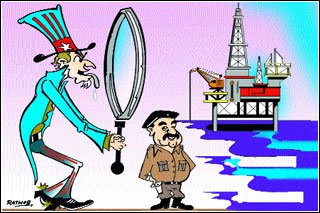 AS President Bush appears close to imposing a war on Iraq to effect a regime-change in Baghdad, the raison d’etre he has advanced for his controversial use of naked force is alleged acquisition of weapons of mass destruction by the government of Saddam Hussein which, it is argued, now poses “a major threat to world peace” and, therefore, he must go. But there is more to it than meets the eye.
It is Iraq’s oil. And almost all western oil companies have set their eyes on it. Iraq has 11 per cent of the world’s known oil reserves, the second biggest, most of which remain unexplored. Only Saudi reserves are greater. A Dublin-based oil company says: “No mineral has better economics than oil and no country has better oil economics than Iraq.”
Although there are numerous factors why Americans nurse a deep hatred for Saddam Hussein, recent developments in Washington suggest that once he is removed it will be oil, not weapons nor democracy that will loom larger in American calculations. America needs Iraqi oil badly because its consumption of oil has been rising significantly in the recent past and the sources of supply are a few and unstable, mostly located in Muslim countries whose leaders American policy-makers tend to trust less and less because it is in these countries that hatred of America is too visible and still growing.
So, Iraqi ruler’s ouster can ease the situation to a large extent for Washington and also open a bonanza for its oil multinationals which had left Iraq in late 1980s. Some of them have already begun manoeuvring for a stake in the country’s proven reserves of 112 million barrels of crude oil.
In a letter to the current UN General Assembly, President Saddam Hussain has pointed out: “The US administration wants to destroy Iraq in order to control the Middle East oil and consequently control the politics as well as oil and economic policies of the whole world. If it succeeded in that, God forbid, it would dictate on you what each country needs for its economic development, what quantities of oil it is allowed to buy, and at what prices, along with other conditions...”
According to “Washington Post”, Iraq’s oil has become Bush administration’s “biggest bargaining chips” in negotiations to win support of western allies. All the five permanent members of the Security Council have multinational oil companies and each of them has a stake in a change of regime in Baghdad.
For the West, an access to Iraqi oil has always been a cherished dream. However, much will depend on how war takes its course and also on the nature and intentions of the new government — whether it still remains an Opec member or opts for an independent role — although the US administration would like it to adopt the latter position. An interesting development in recent weeks, after President Bush made his intentions clear, has been frequent meetings between the representatives of many foreign oil concerns and leaders of the Iraqi opposition, the so-called shadow government living in exile on US expenses, to discuss the companies’ cases for a future stake. Ahmed Chalabi, the leader of Iraqi National Congress (INC), went even further, saying he favoured the creation of a US-led consortium of oil companies to develop Iraq’s oil fields.
Meanwhile, Anthony Sampson, author of “The Seven Sisters”, the most outstanding work on politics of oil, has posed a significant question in a recent article: “Would toppling Saddam safeguard Iraq’s oil for the West?” After all, both previous American presidents — Clinton and George Bush Sr. — had chosen not to overthrow Saddam because the alternative could well be a more dangerous power vacuum. “That danger remains”, says Sampson, “If Iraq were to split into three parts, as many expect, the new oil regions in the south might become still less reliable, as this region is dominated by Shia Muslims who have their own links with the Shias in Iran.”
The long-term potential for peaceful Iraqi development is enormous which is the primary reason why France and Russia have been reluctant to appease Bush and adopt a hostile posture towards Baghdad. Former CIA director James Woolsey, a leading advocate of regime-change, said recently: “France and Russia have oil companies and interests in Iraq. They should be told that if they are of assistance in moving Iraq towards a decent government, we’ll do the best we can to ensure that the new government and American companies work closely with them.”
The chances of a smooth transition in oil sector appear highly problematic. Rival ethnic groups in Iraq’s north are already squabbling over the giant Kirkuk oil field which Arabs, Kurds and Turkmen tribesmen are eying in the event of Saddam’s fall. Although reduced to insignificant volumes in recent months, the United States was still importing nearly one million barrels of Iraqi oil at the start of the year.
Iraq had turned to non-American companies in the 1990s for repair of oil fields which were damaged in the Gulf War and Iran-Iraq war. Russia’s Lukoil, having significant presence in Iraq, had negotiated a four billion dollar deal in 1997 to develop the 15-billion-barrel West Qurna field. However, work on the project could not begin yet because of UN sanctions.
The fact remains the US has always considered oil a security concern. Rand Corporation’s briefing to Pentagon in early August, which soured Washington-Riyadh relations, had described Saudi Arabia as “the kernel of evil” and asked the US to have a showdown with its key Arab ally by “if necessary, seizing its oil fields.” So, if the stability of Saudi Arabia as a major source of energy comes under doubt, gaining access to Iraqi oil becomes all the more imperative for the American government and companies.
And, as Sampson points out, western policies towards Iraq have always been “deeply influenced by the need for its oil, though they tried to be discreet about it.” The nation of Iraq was created in 1920, after the First World War and, as Lord Curzon put it, “the allies had floated to victory on a sea of oil.” But the British and the French and now the Americans had usually preferred to conceal their dependence on it. Whenever they talk about Arab interests they know what really matters is oil. Iraqi oil became more desirable after the 1973 oil crisis which made the West hostage to Arabs for a while. Discovery of new oil in Iraq gave it importance of a rival to Saudi Arabia.
But West’s dilemma stems from the fact that it still depends on mostly Muslim countries for much of its energy needs even after September 11, although American policy-makers call some of them either “rogue” states or forming “axis of evil.” In the recent past, Washington’s attitude towards Iraq has been more hostile. There had been a sense of outrage (against Arabs in particular) about September 11, the fear of terrorism that Saddam may unleash, and an anxiety over Israel’s worries that Iraq may soon become a potent rival.
The International Energy Agency’s latest study released last week says the global economy will become more dependent on oil from the Middle East for at least next three decades. In view of the uncertain political situation in the Middle East, the study says, the “security of supply (for the West) has come back to the top of the agenda ... and the markets will remain sensitive to actual or feared swings or disruptions in supply, whether political or technical.” Hence, an invasion of Iraq by the US, whether UN-approved or unilateral, is the need of the hour for the West as a whole.





























