



 0
0

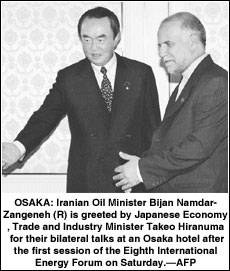 OSAKA, Sept 21: Delegates from 47 countries on Saturday urged closer cooperation in shoring up global energy sources ahead of a possible conflict between the United States and Iraq.
Japanese Trade and Industry Minister Takeo Hiranuma was reassuring, telling the International Energy Forum, that Opec and the International Energy Agency were swift to stabilise markets in the wake of September 11.
The terrorist attacks on the United States in September last year shocked people througout the world. At the same time, those involved in energy policy... recognised once again the importance of energy security, he said.
This view was reinforced on several fronts.
Kuwait announced an agreement with Japan to ensure oil supplies. Saudi Arabia reassured it was not about to enter an energy battle with Russia, while European delegates said they had a plan to centrally manage their own oil stocks.
French Industry Minister Nicole Fontaine said European oil stocks had to be harmonised and he intends to meet with European Energy Commissioner Loyola de Palacio over his strategy.
Palacio’s plan to centralise EU oil stocks would provide the 15 member states with 2.7 times the equivalent of US oil stocks.
There are certain measures with which we are not completely in agreement and we would like to have discussions with the (European) Commission about those, Fontaine said.
Oil is currently trading around 28 US dollars a barrel, the high end of the $22-28 price band targeted by the Organization of Petroleum Exporting Countries (Opec).
However, the EU maintains the price of oil should be nearer to $20 a barrel with market fundamentals dictating the price as opposed to speculators trading on the prospect of war.
The price includes a three to four dollar war premium, sparked by the prospect the US will lead a coalition force and invade Iraq.
The forum, conducted by the International Energy Agency, also declared the world contained abundant energy resources for the next 30 years but said the pivotal problem was access.
For the nearer term, Bill Brocato, an oil analyst with energy news service Platts, said the forum must focus on forecasts of an oil shortage.
He said the possible conflict with Iraq was underpinning fears that current global supplies, pegged at 21.7 million barrels of oil a day, could fall short by up to 700,000 barrels.
In the overall markets we know the war premium exists and unless the price comes off by one or two dollars then it appears to be that war is still very likely, Brocato said.
Kuwait’s deal with Japan would reinforce and deepen the relationship between the two countries even more rapidly and ensure stable oil supplies to Japan, Kuwaiti oil minister Sheikh Ahmed al-Fahd al-Ahmad al-Sabah said.
In return, Japan would continue its efforts to develop strategic water supplies for Kuwait while Kuwaitis would be accepeted by Japanese companies and other institutions so they can learn Japanese corporate culture.
In his address to the forum, Saudi Arabian Oil Minister Ali al-Naimi also reflected the friendly tone by rejecting claims his country was about to enter an energy battle with Russia.
Al-Naimi said Saudi Arabia, the dominant member of Opec was working towards harmonising relations between Opec and non-Opec members.
Articles that speak of some coming energy battle between Saudi Arabia and Russia, or statements about the reliability of Saudi Arabia as an oil exporter or media reports about perceived dangers of reliance on Middle East oil, are just manifestations of either confusion or outright misinformation, he said.
Russia is not a member of the Organization of Petroleum Exporting Countries (Opec) but remains the world’s second largest exporter of oil. —AFP




























