0
0

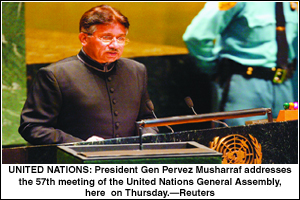 UNITED NATIONS, Sept 12: Describing South Asia as “the most dangerous place on earth today,” President Gen Pervez Musharraf on Thursday urged the international community to help resume a dialogue between the region’s two nuclear states, India and Pakistan.
“Peace in South Asia is hostage to one accident, one act of terrorism, one strategic miscalculation by India,” the president said while addressing the 57th session of the UN General Assembly.
“In this dangerous situation, crisis management cannot afford to become a substitute for conflict resolution,” Musharraf said as he outlined his three-point proposal for reducing tensions in the region: 1) Mutual withdrawal of forward deployed forces by both states, 2) observation of a ceasefire along the Line of Control in Kashmir, and 3) cessation of India’s state terrorism against the Kashmiri people.
He said the structure for such a dialogue should be based on the formula agreed upon in his meeting with Indian Prime Minister Atal Behari Vajpayee in Agra in July 2000.
The people of Kashmir, he said, should be fully associated with the dialogue process and should be allowed to travel freely in Pakistan and Azad Kashmir.
To ensure sustainable peace and stability in South Asia, Musharraf said: “A Kashmir solution should be accompanied by agreed measures for nuclear restraint and a conventional arms balance between India and Pakistan.
“India’s ongoing massive military build up reflects its known desire for domination over South Asia and the Indian Ocean. In the interest of regional and global stability, this must be discouraged,” he added.
“Misusing the rationale of the war against terrorism, India has sought to de-legitimize the Kashmir freedom struggle, tarnish Pakistan with the brush of terrorism and drive a wedge between it and its coalition partners,” he said.
President Musharraf said India, boasting its coercive capability, had deployed about a million troops in battle formation against Pakistan. “Such threatening and aggressive posturing will not resolve disputes. We cannot be frightened into compromising our principled position on Kashmir,” he reiterated.
The president reminded the world leaders that the conflict in occupied Kashmir was being waged by the Kashmiris.
“No amount of external assistance could have inspired the Kashmiri people to sacrifice the lives of 80,000 of their youth and to sustain their struggle for decades against India’s occupation army.”
He warned that India’s planned elections in Kashmir would once again be rigged. “Such elections, under Indian occupation, will not help peace; they may set it back.”
FANATICISM:Strongly criticizing India on the recent killing of Muslims in Gujarat, Musharraf said: “India’s belligerence also reflects the chauvinistic ideology of Hindu extremist parties and organizations.”
“Rising Hindu fanaticism has targeted Muslims, Christians and Sikhs and even untouchable Hindus,” he pointed out.
He urged the international community to oppose Hindu extremism with the same determination it displayed in combating terrorism elsewhere.
TERRORISM:Reflecting upon the root of terrorism in today’s world, Musharraf said: “It is not religion which impels a terrorist act; it is often a sense of frustration and powerlessness to redress persistent injustice.”
Terrorist acts must be condemned, he said, but warned that “the just struggle of a people for self-determination and liberation from colonial or foreign occupation” cannot be outlawed in the name of terrorism.
Musharraf called upon the world to urgently secure the “reversal of the recent reoccupation of Palestinian territories”and the revival of the Middle East peace process on the basis of the Security Council resolutions and the principle of land for peace.
The president said Pakistan was in the forefront of the fight against terrorism. “We have made major sacrifices in this war. We have interdicted infiltration by Al Qaeda into Pakistan. We have arrested and deported foreign suspects found on our territory.”
He vowed that Pakistan would not allow anyone to use its soil for terrorist acts inside or outside the country.
AFGHANISTAN:Pakistan, he said, fully supported Afghan President Hamid Karzai and appreciated UN efforts “to bring hope and peace to the long suffering Afghan people”.
He said reconstruction of Afghanistan and the establishment of multi-ethnic armed forces, police and bureaucracy were essential for strengthening peace and security in that country.
DEMOCRACY:He reminded the UN General Assembly that in 30 days his government would hold national and provincial elections, “completing the process of restoring democracy in Pakistan”.
Defending his government’s economic reforms, Musharraf said: “Today the most important war, we must win, is the war against poverty.”