



 0
0

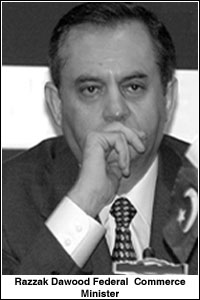 KARACHI, Sept 10: There had been advantages and disadvantages of September 11, 2001 terror attack on America but generally Pakistan received a lot of favours that are greatly helping to improve the economy of the country.
This was stated by the Minister for Commerce Abdul Razak Dawood in an interview conducted on the eve of first anniversary of 9/11.
“Mainly the negative point of 9/11 is that we lost our $1 billion exports but the positive points are that we received substantial foreign remittances, achieved $600 million cash budgetary support and the US allowed market access to our exports”, he further stated.
Minister for Commerce Abdul Razak Dawood who is also the Minister for Industries and Production said that the fiscal space provided by the United States followed by another $300 million assistance from Japan were very important for improving the economy.
He said there was $10 billion export target for the last financial year, which fell short of $1 billion and as such the country could achieve $9 billion exports in 2001-2002.
“But then we have had good favours including new market access from the European Union,” he said adding this access will offer roughly an additional $400 million to Pakistan annually. Had there been no 9/11 Pakistan would have achieved $10 billion export target in 2001-2002, he claimed.
The minister for commerce said hosiery was the badly hit item as far as exports were concerned in the last financial year.
Responding to a question, he said he was not satisfied with the market access so far offered to Pakistan by the United States in the wake of 9/11. He said he was leaving for the United States for a three-day visit to discuss bilateral issues including greater market access for Pakistani exports in America.
In reply to a question the minister for commerce said that the overall economy grew at 3.6 per cent against the post-9/11 revised target of 3.3 per cent and original target of 4 per cent. “I believe this is a very good performance in view of immense problems that Pakistan had faced last year,” he said.
Even in the regional context, he pointed out, Pakistan has done better than Thailand and Malaysia which had registered a growth rate of 2.7 per cent and 3 per cent respectively. “Perhaps you know that on the global basis the growth rate was 2.8 per cent in 2001-2002 and from that point of view we are much better off.”
He said that 9/11 was not the only problem as Pakistan had also faced persistent drought conditions but still, “we managed a positive growth of 1.4 per cent in agricultural against a negative of 2.9 per cent in 2000-2001.”
He said there were consequential developments of 9/11, which included cancellation of orders, difficult buyer contract (because of travel advisories on the one hand and visa restriction for Pakistani exporters on the other), imposition of war risk insurance, disruption of airline services, and an overall situation where Pakistani goods could be sold only at a low prices as the buyers perceived Pakistan to be an ‘unreliable’ source of supply.
Nonetheless, he said, the large scale manufacturing sector maintained its growth momentum by registering a growth rate of 4 per cent in 2001-2002, and this was an impressive performance given the higher base in view of exceptionally high growth of 7.8 per cent it achieved last year and the economic slow down that was faced in the immediate period after 9/11. Industries that took lead in this performance were cotton cloth with 15 per cent growth, sugar with 10 per cent growth and record production at more than 3.3 million tons and petroleum products at 18 per cent.
In reply to a question he said that the government has very sincerely tried to help the business community specially the importers and exporters to manage their affairs after having faced hardships and difficulties due to the events of September 11 last year. The new trade policy, he said, has been carved in such a manner that it could offer maximum benefits to both the importers and exporters.
To a question he said that the ministry of commerce has developed a five-year road map or a vision in respect of four major products which included textile, leather, horticulture and rice. “We have now carried out a mid-term review of these visions,” he said. The minister for commerce also said that the government managed to remove trade deficit by 21 per cent to bring it to $1.2 billion which was the lowest in the last 25 years. “Our imports were lower by 4 per cent.” This was largely a function of softer crude oil and tea prices and the much lower sugar imports — only $23 million compared to $252 million of last year. Imports of textile machinery were up by another 10 per cent. There was an encouraging growth of 43 per cent in import of construction and mining machinery, including that used for oil and has exploration. The 20 per cent increase in import of iron and steel was an indicator of increase in construction activity, as also, to a certain extent, revitalisation of the engineering industry. Overall steel consumption during the preceding year grew by about 10 per cent.
“Usually I imagine things kept improving for Pakistan despite difficulties arising out of 9/11,” the commerce minister said.




























