



 0
0

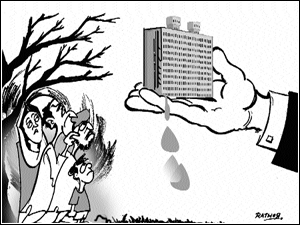 At a recent seminar organized by the Council of Works and Housing Research on the “Role of R&D Institutions for Introduction of Appropriate Technologies for Low Cost Housing// Shelter in the Saarc Region” (Aug 5-7), the chairman of CWHR revealed that there are 44 units engaged in housing research in Pakistan.
The MD, Pakistan Housing Authority, wondered aloud why new products and techniques of low cost housing were not coming up for low income groups.
The question needs to be asked whether this is because researchers have not come up with innovative, low cost materials and technologies or because what they have come up with is not being applied by builders and the authorities? In some cases, these materials have not become popular for lack of adequate publicity, or inappropriate methods have been used for their promotion.
What blind impositions on the end user can lead to, is illustrated by the recent failure of the city government to sell its version of low cost houses to the DPs of Lyari Expressway Project. (Dawn, Aug 22,- 28, 2002). They thought the poverty-stricken people of Lyari riverbed would grasp anything they would be offered, but as it turned out, the low cost house developed by the “overseas investors’ group” has failed to impress the users. One reason is stated to be that there are three houses in one compound, which is unacceptable to the users because of lack of privacy.
The builders’ idea of reducing cost was to sacrifice privacy by eliminating compound walls. The precast concrete roof panels are likewise considered not strong enough by the users to raise another storey in future. If the design caters for two storeys, this should have been made clear to the DPs. Low cost housing should not be taken to mean unsuitable or low quality housing that does not satisfy even the basic technical and socio-cultural requirements. Perhaps the government needs to subsidize housing for the people displaced by the Lyari Expressway project to a greater extent than at present.
The MD PHA’s suggestions included the oft-repeated demand that housing should be taken as an ‘economic activity’ and not merely as government’s social obligation — a needless repetition because housing is both, and already regarded as such. But the demand that housing be treated exclusively as a ‘private sector’ activity is unacceptable because unless government steps in, housing would become too expensive an activity for the poor to be able to afford housing at all. In fact, government can and should help by providing inexpensive land to the poor, and devise regulations in such a manner that builders/developers do not exploit the situation and profiteer at the expense of the poor. Government’s injecting more land in the market at appropriate times can contribute to lowering the price of land. By instituting schemes specifically for low income groups, consisting only of small plots, speculative activities catering to higher income groups can also be minimized.
Not that the above policies have not been followed by successive governments; only the measures have lagged behind the demand. Upto the 1960s, government policy was the construction of houses in the public sector and the provision of serviced plots that benefited, respectively, the government employees and higher and middle income groups. The evidence of the inadequacy of the measures was the popularity of the land mafias, that provide land to the public, cheaply but illegally, often in connivance with officials. Once entrenched, it becomes a mammoth task to shift these settlements, the only solution that remains being to legalize and upgrade them, on ‘self help’ basis.
Unfortunately, the wave of ‘privatization’ has made the bureaucrats see everything in terms of the ‘profit’ as reflected, say, in a ‘profit and loss statement’ whereas the payoffs of healthy housing go beyond this, are intangible, and ultimately impact all sectors of the economy. The dividends of investment in housing come in the form of improvement of overall public health, not merely as monetary profits that accrue to builders and / or development authorities. Merely increasing street width from a minimum of 6 m to 8 m. (26 ft), for example, goes to greatly reduce congestion and enhance public health and quality of life of residents, the slight increase in the cost of development being more than offset by benefits to society at large.
The past government policy has thus been, and rightly so, intervention in the housing market. It has provided developed plots of land as well as, in some cases, actual built low cost flats and houses for specific low income groups, quite the opposite of what the MD of Pakistan Housing Authority would like the government to adopt: confining its role to that of a “promoter, facilitator and monitor.”
What he probably means is that the government’s role in housing should only be regulatory. Experience has shown that one great problem for the poor has been to approach the ‘bara sahebs’ of the bureaucracy. So the real question is, who will facilitate the poor to approach the facilitator? The realistic way would be for the government to facilitate the poor to obtain affordable housing.
Real estate boom of the sort that characterized the 1980s and 1990s curtails housing options for low income groups. What is the solution? Should we just leave things to the informal sector and the NGO’s? If things are left entirely at the mercy of the market forces, the poor would be consigned permanently to slums and the government left to improve and upgrade those slums.
Only the state has the resources to tackle and alleviate the enormous problem of housing the poor on a large scale. The aim of the official policies should be to prevent slums from arising in the first place.
Components of housing cost: include the following:
* land: government has a contribution to make here, by providing land at low cost.
* materials: government can reduce cost of materials by reducing taxes on the building material industry. The pro rata reduction in revenue can be compensated by higher volume of use and production of building materials. It can otherwise help by disseminating the results of public sector research in low cost housing, ranging from new materials and methods to general recommendations for reducing cost without appreciably impairing the strength, durability or function of housing.
* labour: Cost can be reduced by eliminating middle-men and contractors, [building houses under personal supervision rather than letting them out on contract.] and by urging low income people to use, if possible, their own labour. Cooperative ventures can also help.
In kutcha abadis, participation of the people results in improvements in infrastructure, such as sewerage and water supply systems, at low cost, since conventional methods of carrying out such development through corruption-riddled government agencies are costly and wasteful. The OPP is the most well known example of such approach that has had astounding results.
Private sector has a role to play, certainly, but its insatiable greed for profit means that cost reduction is almost never on its agenda and it seldom opts for new technology, unless it is profit enhancing. It is also shy about hiring qualified personnel for improved design and construction.
Credit should be given to ZA Bhutto’s government for being the pioneer in initiating policies to provide housing on a mass scale. In the early 1970s: they launched the Peoples’ Planning Projects (PPP) under which community projects like local roads, drains, irrigation channels etc. were carried out. Salient features of the housing policy were:
* provision of plots in site and services schemes aimed at middle and low income groups.
* acquisition of private land by the government for housing purposes at a fixed rate of Rs. 20000 per acre, and * kutchi abadi improvement programmes.
* creation of bodies like the Awami Rehabilitation Tanzeem [ART] in Lahore in 1973 to activate kutchi abadi residents for improvement of their living conditions.
By the time Gen. Zia ousted the PPP government, the issue of housing for the poor had become so important that he had to establish kutchi abadi departments to upgrade these settlements, even though he scrapped ART. But he entrusted the implementation of housing policies to the bureaucracy.
Under the 5th Five Year plan [1978-1983], 75 per cent of the 425,000 plots to be developed were of 200 sq. yds or less for low income people. Under the 6th Five year plan [1983-1988], the government decided to assume major responsibility for low income housing, and develop another 500,000 residential plots of 60-150 sq yds in the public sector, apart from providing house building loans and construction materials at reasonable rates to low income groups, even relaxing house building regulations in certain areas for low income groups to build houses according to their requirements.
The Junejo government (1985-8) tried to take housing away from the bureaucracy by providing development funds of Rs. 5 and 3 million respectively to MNAs and MPAs, 50 per cent of which was to be spent on housing. A national housing authority (NHA) was established and national housing policy developed. The NHA was also entrusted with the preparation of ‘standard house’ plans of 5 and 7 marlas for urban and rural areas respectively, along with construction methods, techniques, and building materials, to keep the cost between 20-25,000 in rural and 20-27,000 in urban areas. Pilot projects, to provide 300,000 houses, including 75000 nucleus houses for the destitute, were developed. Local authorities were entrusted with developing plots of 3 and 5 marlas in cities.
When the Nawaz Sharif government announced its public housing scheme that envisaged the construction of half a million units in three years, they said there was a backlog of 6.3 million housing units, but the prices belied the claim that they were mainly for low income groups.
If the government concentrates on, say, developing the infrastructure of the long standing low income schemes like Surjani and Shah Latif Towns, —that contain thousands of plots for low income groups still lying largely undeveloped—and middle income schemes like Gulistan-e-Jauhar, considerable private house building activity would be generated. Availability of infrastructure — provision of utilities and an efficient and cheep transport system, for instance — is essential for the success of the low cost schemes. Thousands of low income units in Karachi are unoccupied for want of infrastructure facilities.
Experiences of NGO’s in Pakistan, as indeed all over the Third World, indicates that people prefer land being given to them at affordable rates, to develop houses according to their own convenience and budget. The main problem has been lack of resources and access to credit. The suggestion, that loans be made available for house building on low interest rates, is therefore a reasonable one and commercial banks should come forward to provide loans with a minimum of hassle. The local building authorities can also help by selling pre-approved building plans for small houses in approved schemes at nominal rates.
The government can also, like the council housing in the UK, build flats and small semi-detached houses and rent them out. Regular payments for a predetermined period should be adjusted against the cost of the house and ownership rights transferred to the ‘tenants.’ Maintenance could be the responsibility of the tenants, who would be encouraged to keep the houses well maintained because of the prospect of eventual ownership.




























