



 0
0

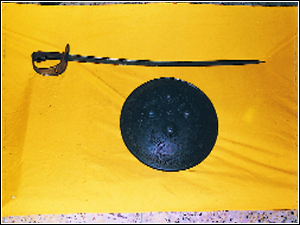 KARACHI, Sept 4: The National Museum of Pakistan has put on display a Persian sword and a shield in its series of “object of the month”, says a press release.
The press release adds that the sword has a straight blade which is damascened. “Hilt is broad to protect the hand and a star crescent is stencilled on it. The shield bears four Persian couplets in Thulth script on the inner border in relief. The round shield in with pronounced lips and with floral patterns.”
It says that from ancient times the people of Persia favoured a light, tough shield made of withies or cane. “Herodotus describes the soldiers of Xerves ‘who carry targes of wicker. Large and deeply convex shields built up of concentric rings of cane or withies are carried by the Scythian guards in the relief from the great staircase of the Achaeimenid from the palace of Persepolis.
When Alexander the Great invaded India from the Northwest in 327 BC he was confronted by large armies which at first appeared very formidable but turned the Indian forces in demoralized retreat. The Indians were without defensive armour except for shields, which for many centuries is the only protection shown in Hindu scriptures.’”
The press release says that the Gandhara sculptures of the first and second centuries show round shields and suggest a convex surface. “It may be said that these semi-circular shields were already of buffalo or rhinoceros hide the chief material for Indian shields until the 7th century when the iron shield was probably made to compete the Indo-Persian equipment. Also the history of sword in India continued with the examples illustrated on sculptures of Kushan Kings in the region of Gandhara.”





























