0
0

 Pakistani investors who know their country and its economy better and can anticipate future policy trends rather more accurately than foreigners presume that foreign investors know better the investment prospects on the basis of the advice they received from their governments and their intelligence agencies. They also rely on the forecasts of western investment institutions.
That kind of western initiatives, real or feigned, also influences Pakistani investment on the Pakistani stock exchange and causes a minor stampede on it. The investment overall has been low since 1995 except in the oil and gas sector and to a lesser extent in the IT sector. And that has very valid reasons. Its not a freak or passing phenomenon.To begin with:
1) there was grave political uncertainty after 1995 particularly after the fall of Benazir Bhutto as prime minister and the varied charges of corruption she faced.
2) Along with that several foreign companies in the power sector faced allegations of corruption and particularly the mammoth Hubco in which the World Bank, the IFC and many other international companies are investors. So the uncertain fate of HUBCO for a long time had very wide ramifications.
3) Then came the nuclear explosions in May 1998 with the economic sanctions that it invited.
4) That was followed in October 1999 by the imposition of military rule and further sanctions on the charge of throttling democracy.
5) Then came September 11th 2001 and the war on terrorism which followed, which made Pakistan a front line state and forced Pakistan to reverse its Afghan policy. Things were never the same in the country or around it after that.
6) Then the India-Pakistan relations worsened and a million armed forces of the two countries have been facing eyeball to eyeball from the end of the year.The tension has eased some what but the situation has not improved significantly. The international community could not ignore these vital and far-reaching developments with its deep impact on the internal security of Pakistan and the violence, which emanated from that.
That is what has made Paul Chabrier, advisor to the Managing Director of the World Bank, say that foreign investors are not attracted solely by debt relief or the foreign exchange reserves. There are certain factors like the regional peace, which are beyond the economic sphere which influence their decision to invest in any particular country.
Economic reforms are important and that has been under-scored by the officials of the IMF and the World Bank.Their continuation is a pre-condition for extended economic assistance. But the success of the reforms and their continuity alone are not a guarantee for substantial foreign investment, which was $485 million in 2001-02. The governor of the State Bank, Dr Ishrat Hussain, says in an interview to Reuters that real economic indicators had shown some improvement but there were no signs of improvement in the investment climate.
He says, our internal and external security situation should also improve, unless that happens investors will not be forthcoming. He is also underscoring the transitional nature of the present times when “investors are waiting for the new government to take over”. They would carefully watch the policies of the new government. If these policies are credible then the people would invest and such credible policies are essential to achieve an economic growth of 4.5 per cent this year compared to 3.6 per cent last year.
He has also noted that the global economy is in recession and despite that we are trying to get a decent growth rate. As a result of the recession in the USA our textile exporters are getting a lower unit price of 28 per cent. In fact our problem because of the recession is more exports and less earnings. The government has come up with a ten-year engineering policy with a total investment of $12 billion.
We need that kind of development and exports instead of exporting more and more of our sweat as through rice, wheat and cotton and that can be achieved only if more of our brains and skills go in to the engineering industry along with the large funds to be invested.Above all we have to make the best use of the money invested in the heavy engineering industries over a period of 30 years.
Paul Chabrier wants the economy to be liberated from political control to realize its full potential and that is absolutely essential in this period of globalization. But that should mean true liberalization and not the engineering sector going from the control of one group to that of another,after spending almost a billion dollars each year after year for the next twelve years.
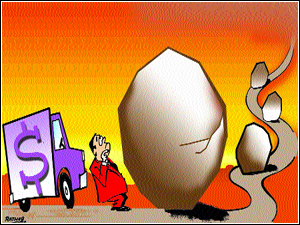
How can foreign investors come when embassies are recalling wives of their diplomats, shedding the non-essential staff and closing their visa offices in Karachi? How can foreign investors come when the travel advisory of foreign countries to their nationals is not to visit Pakistan or where the church missions and schools are attacked along with their consulate generals. This is not the climate for foreign investors to walk in with a large kitty.