0
0

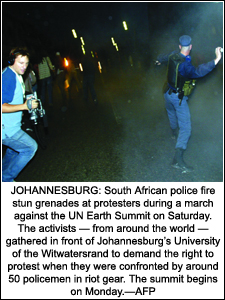 JOHANNESBURG, Aug 24: South African police fired stun grenades on Saturday at around 500 protesters during an unauthorized march in Johannesburg against the upcoming UN Earth Summit as diplomats held last-ditch talks in a bid to resolve disputes that threatened to disrupt agreement on key issues.
In the south of the country, Greenpeace commandos unfurled banners at Africa’s only nuclear power plant to highlight their call for clean fuel.
Police arrested all 12 activists involved in the protest at the Koeberg nuclear plant, 20 kilometres north of Cape Town. They were released later in the day and are due to appear in court on Monday.
In Johannesburg, the march, involving protesters from around the world, was proceeding peacefully when the police fired three grenades without warning claiming that the march was an illegal gathering.
The marchers were chanting slogans against globalisation, the summit and the South African government.
One man, believed to be a journalist, was arrested.
The demonstrators, who claim the summit promotes globalisation, lit candles and placed them around the policemen’s feet after the grenades were fired, and burnt official summit pamphlets before retreating into the campus of the University of the Witwatersrand.
Dale McKinley, spokesman for the marchers said: “They can control a few hundred. This is just a symbolic march, but watch what happens when the masses come.”
According to South African law, demonstrators must obtain permission to take part in a legal march. Nine permits have been granted so far for summit-related protests.
“We decided to retreat so we can mobilise another day,” one organiser told the crowd.
Police arrested more than 100 landless people on Wednesday and Thursday after they marched in Johannesburg to protest against evictions from squatter camps. Some complained they were beaten up.
The World Summit on Sustainable Development is aiming to reduce poverty around the globe while protecting the environment, but crucial disagreements remain between rich and poor countries and between the United States and Europe.
The diplomats in Johannesburg, who represent more than 30 key countries, met behind closed doors in a bid to resolve crucial disagreements on following up Agenda 21, a plan for the 21st century produced at the first Earth Summit in Rio de Janeiro in 1992.
It aims to reconcile economic development, social progress and protection of the environment, seen as the three pillars of “sustainable development”.
The diplomats’ meetings could continue until Tuesday, alongside the official summit, officials said.
The three main groups — Europeans, the United States and the G-77 developing nations — set up two working groups to study the most explosive issues.
One is looking at differences between industrialised and developing nations on increasing official development aid and Third World countries’ access to markets in developed countries.
The second is studying governance, including efforts to combat corruption and respect for human rights.
A major disagreement is over objectives for poverty relief, which the European Union says are indispensible but which the United States refuses to endorse, in line with its reluctance to enter into any new multilateral deals.
The aim of the plan is to reduce by half by 2015 the number of people who lack access to clean drinking water, to slow the rate of loss of natural resources and to phase out energy subsidies and boost the global share of renewable energy sources to at least 15 percent by 2010.
One source close to the talks told AFP that the final document might exclude all references to official development aid and trade because of a lack of agreement between rich and poor countries.
The source said the developing countries realised they would not be able to get Europe and the United States to go further than the promises on aid made at a conference in Monterrey, Mexico, in March: to increase their assistance in 2005-06 to 32.4 and 15 billion dollars respectively (from 25 and 10 billion dollars in 2000.
The developing countries are resisting efforts by the United States to link the aid to good governance.
Both the Americans and the Europeans meanwhile reject calls by developing nations for them to reduce their huge subsidies to their farmers, saying that would ruin their agriculture.
They argue that subsidies can be discussed only at the World Trade Organisation.—AFP