0
0

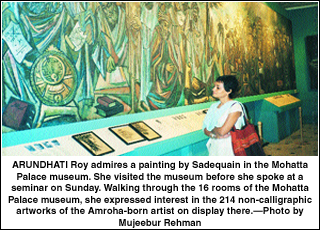 KARACHI, Aug 18: Award-winning author and social activist Arundhati Roy criticized on Sunday the Indian government for using the Kashmir issue as a device to divert the people’s attention from more pressing issues, such as the state-sponsored pogrom in Gujarat.
Speaking at a seminar which was held to mark the formal launch of a newspaper, Daily Times, Ms Roy also took the Pakistan government to task. “What right does the government of Pakistan have to say that it wants freedom for Kashmir when it cannot give freedom to its own people?”
Ms Roy, whose novel The God of Small Things catapulted her to stardom when it received the Booker Prize in 1997, said: “Successive governments in India have not sought to resolve the Kashmir issue at all. It is their perennial solution. It is a rabbit they pull out of their hats whenever they want to distract attention of the people from major issues.”
As thousands of people hung on Ms Roy’s every word, she said that following a military standoff between India and Pakistan some months back, when foreigners had flown out and war correspondents had flown in, a lot of people had asked her whether or not she would leave the country. She said: “I used to wonder where I would go. I used to think where I could buy a new life. I am certain that the reason why war talk started in India was that the government wanted to take world attention away from Gujarat.” She observed that the Indian government shamelessly supported Narendra Modi “who oversaw the genocide in Gujarat.”
She said: “In India very, very often I am denounced by religious extremists who, I have to say, bear a strong affinity with the ideals held by religious bigots here in Pakistan. Religious bigots are more interested in bigotry than their religion.”
She said: “As I watch the bigots increase their religious rhetoric against women, I just want to tell them, ‘You don’t know what you are missing, boys.” As the crowd broke into peals of laughter, she added that “they do not know what joy there is in equal companionship.”
Ms Roy noted that all those who spoke against social justice and displacement of 33 million people by dams were labelled as anti-national in India.
In a voice cracking with emotion, she said that if she received prior information that India was going to fire a nuclear missile at Pakistan, she would come here to receive it.
Ms Roy underlined the need for scaling up interaction between the peoples of India and Pakistan. She also read out excerpts from her essay The End of Imagination.
Earlier, the editor of The Hindu, N. Ram, deplored the rise of the Hindu right in India. “The first act of the BJP-led coalition after coming to power was to hijack India’s nuclear policy, obliging Pakistan to follow suit.”
The editor of The Indian Express, Shekhar Gupta, regaled the audience with his lighthearted comments. He said: “While India is an imperfect democracy, Pakistan is an imperfect dictatorship. India has not been able to achieve the level of prosperity a genuine democracy would have acquired. Similarly, Pakistan has not sunk into the depth of chaos a genuine dictatorship would have got a country into.”
HE SAID: “After the Kargil episode, the Bhartiya Janata Party leaders looked like fools. They were rescued by Sonia Gandhi.”
Shahrayar M. Khan, Pakistan’s former foreign secretary, enumerated the factors “which have restricted freedom in Pakistan and India.” He said: “First, extreme poverty. We have 50 million people living below the poverty line. Second, the legacy of history. Third, the exploitation of religion for political and other narrow purposes.”
He said that both Pakistan and India could resolve these issue only if there was peace on their borders.
The president of the All Pakistan Newspapers Society, Hameed Haroon, said that the club of South Asian activists was not as large as it should be. He said: “We should enlarge this club — not necessarily into a movement because most of us are too refined to join a movement.”
He stressed the need for taking into account the aspirations of the Kashmiri people while formulating policies which governed relations between India and Pakistan.
The editor of the Daily Times, Najam Sethi, read out the mission statement of the newspaper. Former politician Salman Taseer also spoke on the occasion.