0
0

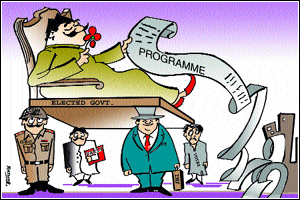 One of the key concerns of the World Bank (WB) indicated in reports on the Country Strategy Assistance (CAS) and Pakistan Development Policy is whether the current economic reforms would stay on course after October elections.
Included on the CAS agenda is a policy dialogue with the newly elected government. For this, it intends to prepare a policy paper.
The World Bank does not subscribe to the present government assertion that the changes introduced by it, would be irreversible. WB officials feel that “such claims cannot be fully creditable.”
The WB rightly believes that “the nature of democracy requires that an elected government should be able to alter course.” Representatives are elected with a mandate from the voters which , they are required to carry out during the tenure of their office. If government leaders agree with IFIs’ programme and policies, they can pick and chose the timing and the sequence of the various parts of the reforms for execution, so as to dovetail them with peoples’ mandate.
The governments cannot ignore the voters mandate without endangering their own image as well as political stability. As it is, reforms carry heavy social costs. And the World Bank fears populism and corruption that it says need to be avoided while restoring democracy.
Research analysts at the HBL reckon that with the domestic political environment changing as the country edges towards parliamentary elections,” domestic political risk is possibly the single largest unmitigated risk factor for Pakistan”.
In its CAS report, the World Bank also foresees that “return to democracy may increase the risk facing the implementation of the assistance strategy.”
Despite the risks, the World Bank wants restoration of democracy.”It would not be an answer to this risk to abandon the intention to restore democracy”.
Given the importance that the international community nowadays attaches to the principles of democracy, the World Bank warns any deviation from the course of democracy would “jeopardize further trade concessions and abnormal aid of the type that Pakistan has received.” Europeans place high priority to democracy and pluralism as it is a necessary condition for the growth of the market. Currently, the US administration is too preoccupied with war on terrorism to focus on democracy beyond paying lip service to it.
The WB is pinning hopes on the politicians that they would be persuaded to continue the reforms. It expects that the politicians would acknowledge that the reform programme in many respects carried further the programme that they themselves had begun to implement in the 1990s.
The IMF entered into nine different kinds of agreements with Pakistan during 1988-2000. Most of them were not fully implemented. But reversal of action taken by political governments was very rare, admit WB officials.
Why did not successive governments opt for IMF programmes and why they deviated from the path of reforms? There are differing points of view of which three major ones have been dealt by the governor of the State Bank in a paper “Pakistan and the IMF:1998-2002.”
Pakistan had nine different governments during 1988-2001 and each of them entered different kinds of agreements with the IMF. These governments were prompted to obtain financial resources to shore up the balance of payments position.
Dr. Ishrat Husain poses the question: Why did success in implementing these programmes prove so elusive ?
And he says that there is a view that Pakistan’s poor track record (on IMF reforms) can be ascribed to the uncertainty and discontinuity caused by frequent changes in the government. There is no difference of opinion among the two major political parties who alternated power in the 1990s as far as the nature of reforms was concerned. Economic managers of dismissed governments share the view that even if they had gone off the track temporarily, they would have been back on the track if there has had been no disruption of the political process. Whether the continuity of elected governments and completion of their full term would have made any significant difference is the moot question.
Dr. Ishrat Husain however does not share this view.He believes that the main motivation of successive political governments underlying these programmes was not long term transformation of the economic structure but short-term injection of liquidity to avert foreign exchange shortages and to replenish reserves.
During the civilian rule, he says, the political leadership remained preoccupied mainly with the challenges of retaining power in the face of a vigilant military oversight and in building coalition and alliances to preserve political power. Dr. Ishrat Husain spells out the third hypothesis which he terms as “Blame the IMF syndrome.” The proponents of this hypothesis argue that the diagnosis of the economic problems by IMF officials is partial and incomplete. Fund officials do not have any grounding in the specific political realities or awareness of institutional capacity.
More damaging is the indictment that the design of the programme is driven too much by dogmatic and ideological agenda of Washington consensus.
The IMF insistence on prior actions and conditions is widely perceived in Pakistan as an infringement of its national sovereignty. So even desirable policy reforms are opposed and resisted on this ground. And Dr. Ishrat concludes that” it would be preferable if there is a minimalist approach in the specification of conditions by the IMF and more reliance is placed on the actions proposed and initiated by the governments themselves.”
But the World Bank has assigned triggers to help the bank group manage the political uncertainty.WB assistance and its volume is linked to the quality and scope of reforms that the political governments will carry out.
With the foreign exchange reserves well over $7 billion and targeted probably in the range of $10-12 billion, much of the leverage that IFIs enjoyed in the past would be lost. The external vulnerability has been reduced in the past 2-3 years.
The WS Country Assistance Strategy also indicates the areas of reforms are vital for economic and social progress which the governments need to focus. The two key areas dealt by the CAS are pre-requisites for consolidation of democracy, without which the country can have constitutional and civilian rule but not federal democracy. These relate to fiscal federalism and highly skewed pattern of land distribution.
The CAS report says: “ Inequity in land ownership also explains why overall agricultural yields remain below those of other countries with similar resource endowments.The impact on productivity can occur in many ways. First there is evidence from developing countries, and Pakistan that as farm sizes increases, productivity falls.”
“ Second, while land rental markets increase access to land, the form of tenure can have significant impact on productivity, the incomes of the tenants and investment incentives. Share tenants are likely to be less productive than owner or fixed rent tenants, since any productivity gains must be shared with the landlord. Also the prevalence of share tenancy, especially in Sindh, reduces the incentives to invest in land improvement and resource conservation.”
In modern economies, the crop-sharing by tenants with the farm lords has been replaced by the wage-labour or cash contract system and by modern corporate farming. All the government needs to do is to replace the share-cropping by wage-labour system and provide legal title to the owner of the land. The landed aristocracy is a drag on democracy and modernization of the economy.
Yet another issue raised in the CAS report is concentration of tax authority at the federal level.This is the first time that the World Bank has raised this issue and indicated the direction in which things need to move.
Contrary to the experience of other federal states, the WB reports points out that tax authority is concentrated at the federal level. The federal government revenue transfers account for as much as 84 per cent of the provincial resources. This has weakened the accountability of the provincial governments to the tax payers, as expenditures and revenue decisions are made at two different levels. The provinces account for 80 per cent of the total government spending on health, education and irrigation.
As a result and like the country as a whole, Pakistan’s provinces have been facing a crisis of public finance, public service delivery and public institutions and governance.
Though difficult to implement, there is some thinking that one of the three major taxes, income-tax, customers duty and sales tax may each be apportioned to three tiers of government, district, province and federation.
The National Finance Commission meeting held in Islamabad on Thursday discussed at length the legal complexities and the constitutional amendments involved in altering the present system of tax collection.
To quote press reports, the Nat ional reconstruction Bureau had invited comments on a proposal whether collection of some of the taxes could be left to the provinces as part of the official plan for fiscal devolution plan.
The predominant view in the meeting was the objective could achieved without much tinkering with the Constitution.
In the centralized tax collection system, the federal government fixes the tax rates and the provinces have no say, though the changes in volume of tax revenue as a result of adjustment in tax rates, impacts on them significantly.
Democratic accountability is major issue that needs to be tackled. Provincial governments are not accountable to tax payers,corporates are not responsible to the shareholders outside the managements, representative governments are not accountable to the voters and are dismissed by the army. The basic ingredients for good governance are missing. The reforms can only move at an slow pace at heavy social cost.