



 0
0

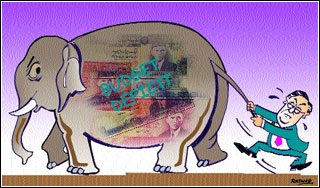 THE BUDGET deficit in FY02 has gone up to 7 per cent of GDP from 5.3 per cent in the FY01, against the initial budget target of 4.9 per cent of GDP, as shown in the table. The most striking feature of the budget statistics perhaps, is that primary budget (excess of expenditure net of interest on domestic and foreign debt, over revenues), which had been in surplus for the last four years, has now gone in deficit revealing a serious problem in the economic management.
However, government claims that the underlying budget deficit is much lower and is in line with the original estimate i.e., 4.9 per cent of the GDP. And whatever is the discrepancy in the budget deficit, it is either because of some unforeseen events or due to certain expenditures are of a one-time nature.
Among the unforeseen events, the most important reason put forward is the unexpected increase in defence expenditure due to the huge deployment of armed forces on the border; which is to the tune of Rs20 billion. One-time expenditure includes around Rs35 billion of investment under the head of ‘net lending to others’, which is a part of capital receipts. KESC alone, stood as a major beneficiary of that investment. In the last, but not least, come the income tax refunds of Rs22 billion. Collectively, the amount comes as Rs77 billion which is equivalent to the excess of the revised budget deficit over the budgeted figure. So, apparently, the government seems right in claiming that the underlying budget deficit is still 4.9 per cent. However, a closer scrutiny of all these claims offers a somewhat different picture.
If there were certain negative factors adding to the budget deficit, there were onetime positive factors as well contributing towards the overall revenues. First of all, the increase in defence expenditure of Rs20 billion has been more than compensated by the excess receipts from defence services to the tune of Rs23 billion, which are part of the non-tax revenues.
On further probe, it was revealed that this amount is the compensation received in return of offering military services and logistical support to the coalition forces. Second, the saving accrued, because of debt rescheduling, by as much as Rs10 billion. Third, there was an increase in the profits of the State Bank by as much as Rs3 billion.
And fourth, there were additional petroleum surcharges to the tune of Rs7 billion. The positive impact of these four factors comes as Rs43 billion, which has been ignored completely. The net budget deficit hence, comes as Rs223.1 billion. However, this deficit figure is based on the tax collection of Rs414 billion, which turned out to be Rs 402 billion finally. After incorporating this revenue shortfall, the budget deficit would be Rs235 billion which is 6.3 per cent of the GDP. As all the positive and negative factors now have been taken into account, therefore, this budget deficit is the true underlying budget deficit; far higher than the claimed budget deficit of 4.9 per cent of the GDP. (Table)
For next year, the budget deficit has been set at four per cent of GDP, implying a budget deficit of Rs162.5 billion. However, the target seems unrealistic given the performance during the outgoing fiscal year. After discussing the true budget deficit for the outgoing year, now come the factors responsible for the divergence of expenditures and revenues from their stipulated targets.
Divergence in expenditures: A detailed analysis shows that the divergence of budgeted over the revised fiscal deficit was because of an excess of current expenditures. Development expenditures however, more or less, were kept intact at their targeted level. Current expenditures were higher than their stipulated limit by around Rs27 billion. The largest source of increase was in defence spending worth Rs20 billion, followed by grants, which were higher by Rs17 billion. The grants were higher because of higher income tax refunds of Rs22 billion and for which no provision had been made in the budget initially. To make up for this increase, some other grants such as for ‘banking sector reforms’ were reduced. Subsidies were also higher by as much as Rs4.9 billion. Out of the total increase, around Rs 1.0 billion was for Wapda, Rs2 billion for Wapda AJK arrears, and the rest for others. Debt servicing, including domestic and foreign, was slightly reduced by Rs3.77 billion in the FY2001-02; thanks to the rescheduling of foreign debt and a decrease in the interest rate on domestic debt.
For the next budget, however, they are projected to decrease by a much higher amount of Rs30 billion. Defence spending and grants and subsidies are also expected to decrease. Perhaps because of these measures, current expenditures are projected to decrease by 6.3 per cent.
Divergence in revenues: Net revenue receipts have grown by Rs4 billion, though, tax revenues have had a large shortfall of Rs43.5 billion. The surplus has been generated through an increase of Rs7 billion in petroleum surcharges and more so, because of the surplus in non-tax revenues of Rs25.6 billion. Interestingly, it is the higher receipts in defence of Rs26 billion against the target of Rs3 billion, which have generated a surplus in non-tax revenues. Thereby, defence has made up for its increased expenditure by generating excess receipts. For the next year also, an amount of Rs20 billion has been targeted to be collected under this head.
As regards the CBR related taxes, it appears that their performance is not quite satisfactory and a lot remains to be done. Sales tax revenues are depended on heavily for additional revenues, which is not always realistic and more importantly, not equitable. Similarly, there has been an increased reliance on surcharges, especially on petroleum products, which is also regressive and inflationary in character as it causes the cost of production to rise rapidly. They have grown by 11 per cent from Rs18 billion in FY01 to Rs39 billion in FY02. For the next year also, they are projected to grow by 16.6 per cent. However, the actual increase may be more than that. CBR revenues, on the other hand, are expected to grow by 11 per cent, surcharges by 12 per cent and non-tax revenues are surprisingly envisaged to decrease by 6.6 per cent. Gross revenue receipts thus, are expected to increase by 6.7 per cent next year.
Overall, the current expenditure is projected to decrease by 6.3 per cent and net revenue receipts are envisaged to grow by 5 per cent, thus, curtailing the revenue deficit by 34 per cent. As a result, the overall fiscal deficit is hoped to be reduced to four per cent of the GDP. Whether this target is achieved or not, one thing is for sure, that next year too, would not be any easier from the economic management point of view. Increase in tax revenues would be a major barometer for the performance of the economy.





























