0
0

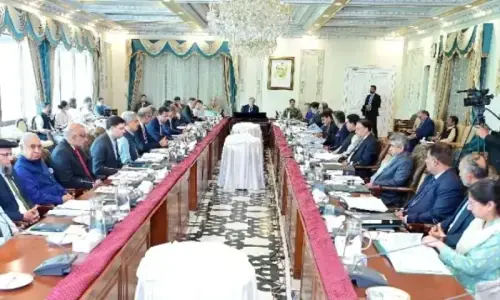
ISLAMABAD, July 23: President Pervez Musharraf continued his consultative process on the constitutional packages on Tuesday, holding separate meetings with the GDA party heads and six other politicians, majority of whom rejected the proposed amendments.
Almost all of the leaders questioned the right of the military regime to amend the Constitution and called for leaving the job for the future parliament, political sources said.
“We told the president point blank that Constitution can only be amended in the manner given in the Constitution itself,” PML(C) chief Hamid Nasir Chattha who led a nine-member delegation of the Grand Democratic Alliance, told Dawn.
Mr Chattha said that they had discussed different provisions of the packages without prejudice to their stand that Constitution could only be amended through an elected parliament.
The National Security Council, power of the president for dissolution of parliament, procedure for the nomination of prime minister, and the election procedure for Senate figured prominently at the president’s talks with all the groups.
Those accompanying Mr Chattha were Fatehyab Ali Khan, Manzoor Bhatti, Dr Nasir Khan, Pir Fazle Haq, Allama Zubair Ahmed Zahir, Dr Saleem and Rafiq Pushtoon.
Other leaders who met the president were Pakistan Tehrik-i-Insaaf chief Imran Khan, Aftab Ahmed Khan Sherpao, Rasool Bakhsh Paleejo, Ghinwa Bhutto, Sahibzada Mohsin Ali Khan, and Allama Tahirul Qadri.
Imran Khan called upon the president to leave the job of constitutional amendments for the future parliament. “Mr Khan in his meeting with the president said that the future prime minister should have the authority to implement his or her agenda,” PTI spokesman Akbar S. Babar said.
Imran Khan welcomed the electoral reforms, including the lowering of voting age and introduction of joint electorate, but opposed the packages, the spokesman added.
The PTI leader opposed the proposed power of the president to nominate any member of the national assembly to from the government and the president’s power to remove the prime minister.
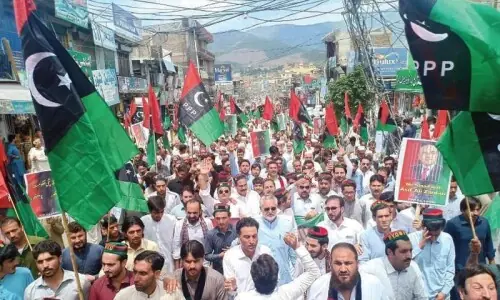
The PTI chief demanded lifting of ban on political activities and lodged complaint about the police baton-charge on a rally recently held by his party in Rawalpindi.
Mr Sherpao, Mr Paleejo and Ms Ghinwa, who met the president in one group, demanded award of fiscal powers to the upper house of parliament with a view to ensuring equal rights to the small federating units.
Mr Paleejo, who focused his formulation on provincial autonomy, said that the Senate should have the same power as available to the senate of the USA.
Talking to Dawn by phone, Mr Paleejo said he had apprised the president that “it is not Pakistan which was founded by the Quaid-i-Azam.”
He said there were imbalances between the minority provinces and the majority province. He held generals responsible for most of the ills confronting the country. “I said at the meeting that army generals have been behind most of the political problems and now it is their responsibility to rectify these.”
Mr Paleejo raised the issue of less representation of people from smaller provinces in defence forces, particularly from Sindh, on which the president gave him a detailed reply.
Asked about the president’s response to his point of view, Mr Paleejo said the president listened with patience and later gave detailed explanations on most of the points.
Mr Sherpao said he had called for increasing the powers of Senate during his meeting with the president. He said he had opposed the proposed right of president and governors to nominate any member as the prime minister and chief ministers, respectively.
“We advocated the old process that the leader of the majority party should be asked to form the government,” he said. On the proposed NSC, Mr Sherpao said, its recommendations should be of advisory nature.
Mr Sherpao said that he had asked the president to restore the special seats for minorities and transfer all the subjects on the Concurrent List to the provinces, except for railways.