0
0

ISLAMABAD, July 12: The federal government is expected to introduce in the next few days a couple of constitutional amendments to remove the gaps in application of fiscal laws to the provinces, Azad Kashmir, and special areas like NAs, Fata and Pata.
The amendments would drastically change schedule of the constitution, particularly the federal legislative list, the concurrent list and the rules of business.
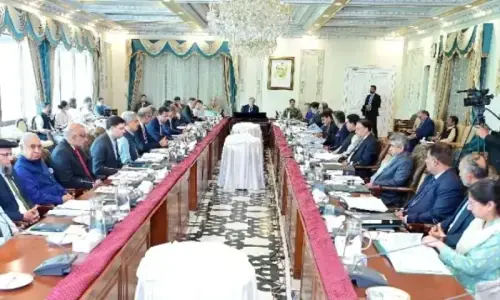
The broad parameters of the amendments were agreed to at a meeting presided over by President Pervez Musharraf last month. The amendments are currently being vetted by the law ministry.
Sources in the chief executive secretariat told Dawn that the major portion of the amendments would deal with the practical difficulties and awkward position being faced with regard to general sales tax (GST) on services and it would be made a direct federal subject.
The second portion would empower the Central Board of Revenue to directly extend fiscal laws to the Northern Areas and to Azad Kashmir through AJK assembly.
The third part would bring the federally administered tribal areas (Fata) and provincially administered tribal areas (Pata) at par with other parts of the country and all fiscal laws applicable in other parts would be applicable in those areas as well.
Documents provided to Dawn suggest that provincial ordinances relating to imposition of GST would then be recalled. At present, the authority to levy taxes on the sales and purchase of goods is derived from item No. 49 of the Federal Legislative List under the Constitution.
Only the federal government is competent under article 142(a) to legislate imposition of taxes on sales and purchase of goods. It has done so under the Sales Tax Act, 1990.
However, the federal government cannot levy sales tax on services because ‘services’ are neither mentioned in the Federal Legislative List nor in the Concurrent List. Therefore, under article 142(c), the provinces have the jurisdiction to legislate for taxes on services.
For this reason, enactments for levying sales tax on services have been made by the respective governors through ordinances. This mode of provincial legislation in the nature of ordinance imposing sales tax on services is a very cumbersome legal arrangement.
For example, such ordinances apply federal statute of sales tax ‘mutatis mutandis’ to the levy and collection of sales tax on services. Thus all federal SROs and subordinate legislation gets applied to a province under a provincial ordinance. On the administrative side the entire tax collection machinery of CBR, a federally-controlled entity, operates under the umbrella of separate provincial statutes.
Sales tax on services, though by provincial authorizations, is actually being collected by officers appointed under federal enactment and drawing powers under yet another federal enactment (Sales Tax Act, 1990).
One inherent difficulty is that a provincial government can tinker with the tax rate or give an exemption, etc. That will completely destroy the system which is of VAT type. The sales tax on goods and services is an integrated whole which must have one legal cover and unified tax administration.
Now an amendment would be made in item No.49 of the 4th Schedule of the Constitution by adding words “and services provide or rendered” after the word “consumed”.
In this way, without incurring further costs on tax collection infrastructure, the tax would be competently levied by the federal government and collected through the existing machinery.
Areas Outside Pakistan (AJ&K, NAs)
Article 1 of the 1973 Constitution defines the territories included in Pakistan. Azad Kashmir and Northern Areas are not included in it. Therefore, any act of Parliament that extends to the whole of Pakistan does not extend to these areas.
Entry (3) of item 19 of the Schedule II of the Rules of Business, 1973 (Annex-A) empowers KANA division to make laws for northern areas. In order to extend any law to the northern areas a request needs to be made to KANA division.
Similarly, Azad Kashmir has its own legislative assembly for making laws. It is the sole prerogative of that assembly to adopt any law applicable in Pakistan. Entry (4) of item 19 of Schedule II of the Rules of Business, 1973, empowers KANA division to maintain relationship between the Azad Kashmir Council and Azad Kashmir government.
In order to extend any law of Pakistan to Azad Kashmir a request has to be made to KANA division. Apart from the sheer time-lag, fiscal laws are frequently not extended to these areas owing to a variety of complex reasons.
In the case of AJ&K, for instance, at times the rates of CE duty on cigarettes are different from those in Pakistan. In several cases of import of machinery at Karachi destined for AJ&K, temporary injunction was given by courts on whether customs duty was leviable.
The matter is before the SC and an aggregate amount of almost half a billion rupees is held up. The new mechanism would ensure that all the existing and future legislations of the Majlis-e-Shoora (Parliament) and the rules made thereunder, on items of the Federal Legislative List of the 4th Schedule to the 1973 Constitution, stand automatically extended to Northern Areas and Azad Kashmir in real time and without hassle.
For this purpose the following three amendments are proposed in the Rules of Business:
(iv) In entry (3) of item 19 of Schedule II to the Rules of Business, 1973, after the word “Areas” and before the full stop the words, comas and figures “except laws for the implementation of Acts of Majlis-e-Shoora (Parliament) on item Nos. 43, 44, 47, 48, 49, 50 and 52 of the Federal Legislative list” may be inserted.
(v) In entry (4) of item 19 Schedule II to the Rules of Business, 1973, after the word “Kashmir” and before the full stop the words “except relations on fiscal laws” may be added.
(vi) After entry (5) of item 27-A of Scheduled II to the Rules of Business, 1973 the following new entries may be added: “6. Making laws for Northern Areas relating to Acts of Majlis-e- Shoora (Parliament) on item Nos. 43, 44, 47, 48, 49, 50 and 52 of the Federal Legislative List. 8. Maintain relations with Azad Jammu and Kashmir Council and Azad Jammu and Kashmir Government on fiscal laws”.
The proposed amendments will empower the Revenue Division to make legislations for fiscal matters of the northern areas directly thereby enabling it to extend all fiscal laws to the northern areas.
In the same way it will be able to take up with Azad Kashmir Council and Azad Kashmir government matters relating to the adoption of fiscal laws in Azad kashmir.
Issue of PATA and FATA
The Majlis-e-Shoora (Parliament) derives its authority to levy duties of customs and export duties, duties of excise, taxes on income, taxes on corporations, taxes on the sales and purchase of goods, taxes on capital value of assets and taxes and duties on production capacity under item Nos. 43, 44,47,48,49,50 and 52 of the 4th Schedule to the 1973 Constitution.
However, under clause (3) of Article 27, no act of Majlis-e- Shoora (Parliament) applies to any Federally Administered Tribal Area unless the President so directs. Similarly, under the same clause (3) no act of Majlis-e-Shoora (Parliament) applies to any Provincially Administered Tribal Area unless the Governor of the province so directs after the approval of President.
The governors of the NWFP and Balochistan have, in several cases, not invoked clause (3) of Article 247 of the Constitution for application of tax laws passed by Majlis-e-Shoora (Parliament) to the Provincially Administered Tribal Areas.
Notwithstanding anything contained in the Constitution the President has the exclusive power under clause (4) of article 247 ibid with respect to any matter within the Legislative competence of Majlis-e-Shoora (Parliament) to make regulations for the peace and good government of a Provincially Administered Tribal Area.
It appears that due to the failure of Provincial Governors to apply certain tax laws to the Provincially Administered Tribal Areas the President has exercised his power under clause (4) of Article 247 and has applied the Customs Act, 1969, to the Provincially Administered Tribal Areas of the NWFP and Balochistan vide Regulation III of 1975 and Regulation I of 1977 respectively.
In spite of the application of the Customs Act, 1969, to the Provincially Administered Tribal Areas its implementation there has not yet been achieved because of the persistent reluctance of the Provincial Governments to establish the writ of this law in the Provincially Administered Tribal Areas.
This has defeated the objective of peace and good governance i.e. the two requirements for which the President applied this law to the Provincially Administered Tribal Areas under Article 247 (4) of the Constitution. The mockery of the writ of this law can be seen from the fact that thousands of smuggled vehicles move freely in the Provincially Administered Tribal Areas of the NWFP without any challenge from the law enforcement agencies.
All other legislations on taxation covered under the 4th Schedule referred above are not extended either to the Federally Administered Tribal Areas or the Provincially Administered Tribal Areas.
This dichotomy in application of fiscal laws has created economic distortions and is defeating the objective of providing a level playing field for the business community besides providing safe havens for tax evaders.
For example, a number of cosmetics manufacturing units have been shifted to Swat and other Pata areas to avoid payment of excise duty. The situation is compounded further by a lump-sum being taken by CBR-federal government from the group of manufacturers operating in Pata. The initiative will bring the Federally Administered Tribal Areas and the Provincially Administered Tribal Areas at par with the rest of the country.