



 0
0

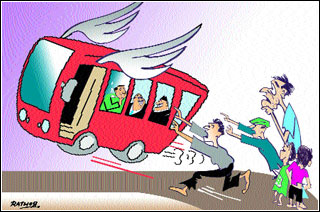 THE CORPORATE barons, the mill owners, the stock brokers and the rest of the well-fed fortunate are falling over one another in their acclamation of proposals made in the federal budget 2002-03.
Finance Minister himself was pleased to be present at one of such post-budget seminars held in the comfort of a five star hotel, in Karachi on Monday, where speakers were hearty in their approbation and lavish in their praise over the numerous ‘incentives’ for the capital market and for those who do earn enough to be able to pay taxes. Yet, in the midst of all the celebrations, there was no noticeable thought for the poor. Did anyone for instance, plead for a robust increase for social sectors: education and healthcare?
Notwithstanding all the fanfare about the poverty reduction strategy and the World Bank sponsored poverty alleviation programme, the budget 2002-3 would do nothing but to add to the sum total of miseries of the poor of this land. Millions of dispossessed, who toil from dawn to dusk, in agricultural fields, in factories, in mines, at construction sites and others who do at all sorts of petty jobs to sustain life well below the poverty line of $2 a day, would end up poor, for while the financial wizards have thought it appropriate to reduce duties on cars so as to make more of imported cars available, they have slapped sales tax on cooking oil— the basic item of every household: rich or poor. And what measures do the budget propose for those willing but deprived of a gainful regular employment or for those who continue to join the ranks of the unemployed in the face of zero indusrilaization and increasing privatisation?
The finance minister in his budget speech announced a princely raise of Rs 17 billion in the poverty alleviation programme that would now touch the mark of Rs 136 billion for the fiscal 2002-3. He said that the government is working through a programme whereby almost all social and governance policies would be integrated in a holistic manner to improve the economic lives of the country’s poor. To substantiate his statement he mentioned all those sacred-sounding policies: Khushhal Pakistan programme, food support programme, Zakat, micro credit, regularization of katchi abadis and land distribution.
He also mentioned the Interim Poverty Reduction Strategy Paper 1 of Pakistan in this regard that is supposed to provide a comprehensive outline of the strategy. It is not that the poor altogether escaped the attention of the Finance Minister for he did acknowledge that the teeming majority of poor in the country are not only deprived of financial resources but they lack access to basic needs such as education, healthcare, clean drinking water and proper sanitation.
But saying is one thing and delivering another. The Finance Ordinance, (the most significant economic tool in the hands of the government that reflects its priorities) defies the concerns expressed by the honourable minister. It seems that the government treats poverty reduction as an objective divorced from its mainstream economic strategy. If the government does really mean to reduce poverty should it not avoid measures that hurt interests of poor people? Does the current budget not go against the proclaimed commitment of the government to help poor fight poverty?
In the current budget, the OCAC has been allowed to revise oil prices fortnightly during 2002-3 as well (past experience is that oil prices are mostly revised upward but during periods when political cost of upward revision outweigh its economic cost). The government has also imposed 15 percent GST on edible oil and vegetable ghee. Even if one were to ignore the rest of the burdens, the impact of these two measures on poverty are not difficult to guess. Any increase in petrol price goes to raise the cost of transport which in turn increase the cost of production and has a multiplier price affect on all consumer items. Will it not burden the household budget of the poor? Again increase in edible oil and vegetable ghee prices by Rs10 or so per kg is bound to affect all households but the poor would be pressed the greatest as they spend largest proportion of their income on food.
For all those who hailed the budget there must be something to be pleased about, but numbers can hardly impress an ordinary Pakistani. If the country has record stockpile of dollars in reserves, so much the better. But for the poverty ridden individuals, it would have been more of a good news if he could get an extra pint of milk for his undernourished children or some hope in form of cheaper health or education, some respite in form of decent living conditions or at least some sort of job security. In a country marred by stark disparities, where population of poor is not only increasing in absolute numbers, it sadly is also increasing in proportion, pressurizing the downtrodden cannot be termed fair or justified.
The current economic survey indicates the continuation of catastrophic drought conditions and acute shortage of irrigation water has adversely affected the performance of Pakistan’s rural economy. It is not difficult to anticipate in what way this must have affected the small peasants and landless wageworkers.
The government has adopted the official poverty line three years back in 1998-99 as Rs 650 per capita per month. In an average Pakistani family comprising of three children and two adults to emerge above poverty line, the family income needs to be Rs. 3,250 per month. It hardly requires much research to conclude that average size of a poor family is much larger. Whereas amongst urban poor the earning capacity is much less than Rs 3,250 per month, it ought to be worse in rural areas where their social status and the bargaining position is weaker in feudal or tribal set up. In absence of any other independent source to verify the authenticity of data with more realistic definitions there is no option but to depend on official statistics.
According to 1998-99 headcount ratios, about 30 per cent people in Pakistan live below poverty line. There is no reason to believe that situation has improved over the last three years. The performance of the economy has certainly not improved in terms of any significant betterment in real sector performance reflected in average growth rate. As the gap continues to widen between the rich moving ahead and poor falling behind— the resulting instability can only breed discontent and discord.
There is no quick fix solution to problem that has assumed the proportion of spectre in this country of several millions less fortunate souls. It would, however, be more appropriate if poor of the country are treated not like a liability that has to be endured, but as an asset. If they are treated at par with other stakeholders in the economy and government avoids measures in its mainstream economic policies that would hurt their interest, I believe, it would better serve the objective of poverty alleviation.
There is a need to make mainstream economic policies of the country and poverty alleviation programme complementary to each other. As long as these run in opposite direction, it would be hard to consolidate the gains of a poverty alleviation programme no matter how expensive that be.
It is very much in the interest of all sectors that are more resourceful and vocal to integrate the interests of masses in defining their respective demands for if we were able to lift our people out of poverty it will bring more than an answer to hunger. It will revive the hope; it will make this society more productive and therefore more peaceful, prosperous and secure. The gist of all this is that if the government claims that it has held out a helping hand to alleviate poverty, that should not merely appear in numbers on the paper, but should travel down so as to radiate from the faces of fully nourished, properly cared and well educated children of the poor of this land.




























