



 0
0

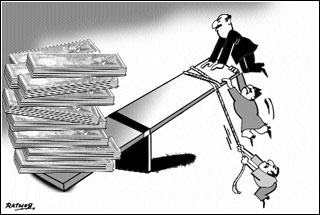 WHILE THE federal budget 2002-03 embodies numerous measures to meet the new challenges, it has also taken a long term view of the fiscal maladies plaguing the economy.
One such malady pertains to the emergence of sizable deficit in the revenue account of the country for the last 17 years. The finance minister, in his budget speech, has highlighted the urgency of tackling serious problem through the fiscal responsibility law (FRL) which would be enforced in the near future.
The essential feature of the law relates to putting limits on government borrowing so that only the development expenditure is financed through public debt, while the current expenditure would be met through domestic resources comprising tax and non-,tax revenues. This implies that public borrowing could not be used to fund the non-development expenditure of the government.
An in-depth analysis of the micro-level constituents of the budgetary system highlights the significance and the relevance of fiscal responsibility law in the context of Pakistan’s growing budgetary imbalances.
The need of having this law is clearly established when we cast a critical look at the basic budgetary parameters such as revenue receipts, current expenditure, development expenditure, the overall fiscal deficit and the surplus/deficit in the revenue account of the country for the period 1980-81 to 2001-02.
The revenue receipts of Pakistan on consolidated basis rose from 16.9 per cent of GDP in 1980-81 to 19.1 per cent in 1991-92 but dropped to 16.8 per cent in 2001-02.
The current expenditure as the ratio of GDP rose from 13.6 per cent in 1980-81 to 20.3 per cent in 1992-93 but came down to 18.9 per cent in 2001-02. The overall budgetary deficit which was 5.3 per cent of the GDP in 1980-81 reached a peak of 8.7 per cent in the year 1990-91 but came down to 5.7 per cent in 2001-02.
Pakistan had a large surplus in the revenue account equivalent to 3.3 per cent of GDP in 1980-81 which dropped to 0.1 per cent in 1983-84 but from the year 1984-85 it has remained continuously in deficit. In 1984-85, the revenue deficit was 1.3 per cent of the GDP which rose to 2.3 per cent in 1991-92 and for the year 2001-02, it estimated at 2.1 per cent of the GDP.
With a view to emphasizing the importance of revenue surplus as a source of financing development expenditure, the author has developed a parameter called resource base co-efficient (RBC) which is defined as the ratio between revenue surplus/deficit and the public sector development outlays for a given period of time.
The RBC can be interpreted either on ‘ex ante’ or ‘ex-post’ terms.
The basic use of the concept of Resource Base Co-efficient (RBC) is that it serves as one of the reference parameters to measure the overall efficiency of the fiscal system overtime in terms of its resource generating capacity to finance development outlays.
In the budgetary system, it may be pointed out that revenue surplus is the first source of financing the development outlays followed by net capital receipts, self-generated funds of autonomous bodies and external loans and grants. Making use of the concept of RBC, the author has put forward, the hypothesis of fiscal efficiency which postulates:
“If the resource base co-efficient of a country, after incorporating the effect of new budgetary measures, remains below the critical minimum limit of 20 per cent for a given period, that country would fail to meet one of the basic conditions of fiscal efficiency. By implication, the magnitude of the resource base coefficient which is defined as the ratio between the surplus in the revenue budget and the public sector development outlays would reflect the relative efficiency of the fiscal system of a country”.
The critical minimum limit assigned to the RBC equivalent to 0.20 per cent is the focal point of the hypothesis which in its essence, symbolizes one of the methods which emphasize that the proposed development outlays in the public sector must bear some relationship with the availability of domestic resources or internal savings of the country.
Under sound fiscal conditions, we would expect that a country would finance 40% - 50% of its development expenditure in the public sector from the revenue surplus, supplemented by the net capital receipts, self-generated funds of autonomous bodies and foreign loans and assistance This would be a case of an “ideal” resource base.
Under less then ideal but progressive conditions, the development outlays would be financed from the revenue surplus to the extent of say 30 per cent— 40 per cent, supplemented by the capital receipts and external resources, implying a “strong” resource base.
The range of resource base co-efficient between 20 per cent and 30 per cent could be considered as “reasonable” and coming down the scale, the RBC between 0-20 per cent could be considered as “viable”.
However, a negative RBC would indicate a weak resource base which would reflect either of the conditions such as relative under-development of economic structure, general fiscal indiscipline in the economy or some uncontrollable economic imbalances necessitated by unwarranted exigencies forcing heavy non-development expenditure on sub-heads like defence, debt-servicing, public administration etc.
The significance of the hypothesis as a tool of evaluating budgetary policies cannot be over-emphasized.
The data indicate that the RBC which was positive in early eighties had turned into a negative figure from 1984-85 onwards. It remained negative for all the years till 2001-02 except for the year 1991-92.
The magnitude of the RBC has fallen very significantly from -4.73 per cent in 1985-86 to -65.42 per cent in 1997-98 which is preceded by the lowest RBC of -83.12 per cent for 1996-97. For the year 2001-02, the value of RBC comes to -60.5 per cent.
During the Eighth Five Year Plan (1993-98) the fiscal performance has been quite poor especially when evaluated in terms of the mode of financing total development outlays in the Public Sector. Whereas target for the 8th Plan was fixed at Rs49 billion for the revenue surplus at constant prices of 1992-93, the actual outcome has been a revenue deficit of Rs143 billion showing a steep decline in resource mobilization and larger dependence on net capital receipts, bank borrowing and external resource.
The large but negative value of RBC is an indicator of serious budgetary imbalances which have dominated the macroeconomic developments from mid 1980s onwards.
The primary reason for the large negative value of RBC is the disproportionate growth in current expenditure which has risen from 13.6% of GDP in 1980-81 to 18.9% of GDP in 2001-02 as pointed out above.
The steep decline in the development expenditure (PSDP) clearly shows that phenomenal growth in the current expenditure is crowding out the development expenditure — an outcome which becomes quite significant from 1992-93 onwards with the development expenditure falling from 5.7 per cent of GDP in 1992-93 to 4.5 per cent in 1993-94 and 3.4 per cent in 1996-97.
The reduction in the budget deficit from the peak of 8.7% of GDP in 1990-91 to 5.7 per cent of GDP in 2001-02 cannot be identified as major achievement in fiscal management because it camouflages the steep decline in the development expenditure in the public sector.
The negative value of RBC for many years indicates that government has been financing from debt not only its development expenditure but a part of its current expenditures. Consequently, the economy has become a debt-driven rather a saving-driven economy.
In the historical perspective, over-dependence on debt-financing has led to emergence of a huge stock of public debt which itself generates the large annual flows of debt-servicing.
Debt servicing is now the main element in the matrix of current expenditure followed by defence and other sub-heads such public administration, grants, subsides, etc. The economy is badly caught in a whirlpool of a debt trap.
The passing of Fiscal Responsibility Law would be a fundamental step to wean the perennial propensities of fiscal managers to finance not only the development budget but also their current expenditures through debt.
Once the steps are adopted to eliminate the deficit in the revenue budget by meeting all the current expenditures through the revenue receipts, this would pave the road towards raising a resource surplus in the subsequent budgetary exercises so that ultimately the critical limit of 20 per cent of RBC is met.




























