0
0

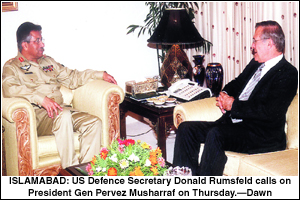 ISLAMABAD, June 13: US Defence Secretary Donald Rumsfeld said here on Thursday the United States did not have any evidence of Al Qaeda men being active in Kashmir.
Speaking at a press conference with Pakistan’s Foreign Minister Abdul Sattar, at the close of his visit to the region, he said: “We do have a good deal of intelligence from people who say they believed that Al Qaeda men were in Kashmir, or were in various locations.”
“However,” he hastened to add, “it tends to be speculative, it is not verifiable, it is not actionable.”
Mr Rumsfeld was replying to questions relating to some of his reported statements during his stay in New Delhi.
He explained that his observations on the issue came in response to some questions put to him by the media (in India).
He said he had explained the situation in his official discussions in Islamabad and believed that in the event of any actionable intelligence, Pakistan would have taken necessary action, being a close and cooperative partner in the global coalition against international terrorism.
Asked whether he could define the difference between a freedom fighter and a terrorist, the US defence secretary said anyone who went around killing innocent men, women and children was, in his view, a terrorist, regardless of “what may be rattling” in his head as to why he did that.
The world has noted in recent days some reduction in the tensions, Mr Rumsfeld said, “although the ground situation in large measure still remained one of high alert.”
He believed the Indian move to reopen airspace to Pakistan’s national flag carrier and withdrawal of Indian warships from waters close to Pakistani coast, were positive measures. However, foreign minister Abdul Sattar interjected at this point, saying, “we welcome the steps taken (by India)...but there is no change whatsoever in the capability of the Indian forces massed on our borders and the Line of Control in Kashmir. Therefore, there is no real reduction in effect.”
The United States defence secretary said that as a former businessmen he knew full well that in an environment of tension and conflict the business and investment were lost. He emphasized that this imposed hardships on people because it was business which moved a country and a nation.
He also claimed that the state of high alert of long duration tended to lower the standard of alertness of the forces over time and proved hard on soldiers, sailors and their families.
Mr Rumsfeld urged both the countries to talk to each other on such issues as restoration of air, rail and road links; the needs of the families living on opposite sides of the Line of Control in close proximity, which could be sorted out, and about reappointment of high commissioners in each other’s capitals.
AFP ADDS: “My impression is that we’re at the point where instead of having these tensions continue to go up, we’re beginning to feel the pressures of high alert.”
“One would hope that the pressures of those stresses would result over time in a — whatever way it might be manifested — somewhat reduced alert status for those forces if each side measures and calibrates and decides it can afford to do that.”
Rumsfeld said the two countries must learn how to communicate, and that lobbing shells across the Line of Control is “not the appropriate method of dialogue”.
“There is no magic wand in this world. In the last analysis people and countries sort out their own problems. They can do it with some help... but problems get sorted out on the ground.
“There is no question but that countries need to talk to each other.”
The envoy also said he had no grand plan for de-escalating the stand-off after it was reported he would propose a system of ground sensors to monitor movements around disputed Kashmir’s de facto border, the Line of Control (LoC).
“I did not bring proposals,” said Rumsfeld. “Others have raised that question (of sensors), it has come up as a question to me and it has also come up in the meetings.”
“Settlement of Kashmir issue in conformity with international law and principles of justice will ensure durable peace and establishment of normal relations between Pakistan and India,” he said.
Mr Sattar described Mr Rumsfeld’s visit to the region as a “noble mission,” saying his meetings with the Pakistani officials were held in a very cordial atmosphere.
During Musharraf-Rumsfeld meeting the situation in Afghanistan and problem with India were discussed besides mutual expression of satisfaction over the US-Pakistan cooperation in fight against terrorism.
In his brief statement, Mr Rumsfeld remarked that Pakistan extended “superb” cooperation to the United States and international coalition in the global war on terrorism.
“I thanked President Musharraf for superb cooperation the US has received with respect to the Operation Enduring Freedom,” he said.
The US, he added, valued growing political, economic and military-to-military relations with Pakistan, and was looking forward for strengthening of relations in the days to come.
AFP ADDS: Mr Rumsfeld expressed the hope that India and Pakistan would in time ease their forces off high alert but said both sides needed to find ways to talk to each other.
After meeting with President Musharraf, Mr Rumsfeld praised the leaders of both countries for taking steps to defuse tensions.
AFP adds from Manama: US Defense Secretary Donald Rumsfeld said here on Thursday that he believed the danger of a nuclear confrontation between India and Pakistan had passed.
“I’m not going to talk about nuclear weapons. I think the elevation of that subject (nuclear confrontation) is past us. Both of those leaders are managing their affairs as people responsible for weapons of that power,” he told reporters flying with him back to Washington from Islamabad.
Rumsfeld’s plane made a refuelling stop in Manama.