0
0

ISLAMABAD, June 5: The Azad Jammu and Kashmir government has refused to pay electricity tariff of higher bulk and disputed arrears of Rs1.2 billion to Wapda and has demanded uniformity in the tariff.
At a meeting, held here on Wednesday, AJK Electricity Secretary Sardar Mushtaq Khan told the federal government and Wapda authorities that the AJK government would have no objection if the jurisdiction of the Wapda Act 1958 was expanded to Azad Kashmir.
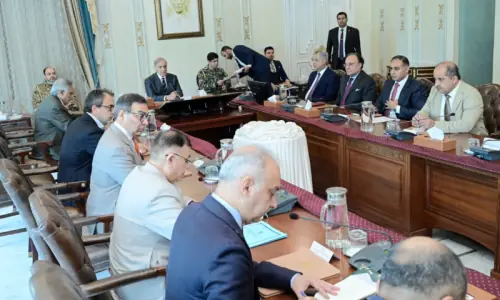
The meeting, convened by the fiance secretary-general, to reconcile electricity arrears between the Water and Power Development Authority and the AJK government, considered setting up an electricity company on the pattern of the eight power distribution companies of Wapda operating in the four provinces so that the tariff could become uniform in the provinces and Azad Kashmir.
A senior AJK official told Dawn here on Wednesday that the bulk tariff being charged by Wapda from Azad Kashmir consumers was in violation of the 1971 agreement signed between the governments of Pakistan and the AJK.
He said the AJK government had also told the authorities in Islamabad that any unilateral increase in the tariff by Wapda would not be acceptable, and demanded that Wapda be warned against issuing disconnection notices to the state government unless cleared by the federal government.
According to the official, under the 1971 agreement, the AJK government was charging the rates at par with the same categories of consumers in other provinces which was around Rs1.90 per unit because most of the consumers were of domestic category.
On the other hand, Wapda was charging the AJK government bulk tariff rate (around Rs3.24 per unit) that was applicable to commercial housing societies and industrial zones, he said, adding that of the Rs3.24 per unit, the federal government was bearing around Rs0.92 per unit as subsidy under the 1971 agreement, while the remaining Rs2.32 per unit was being born by the Kashmir government. The Kashmir government, he said, was charging around Rs1.90 per unit from its consumers.
The official maintained that when individual consumer tariff across the country was already in vogue in the AJK as well, there was no justification for charging the Azad Kashmir government the bulk tariff. The federal government officials supported the interpretation and agreed that for all practical purposes, the AJK was to be treated like the provinces.
The meeting held that the National Electric Power Regulatory Authority had no jurisdiction over the AJK — a point that Wapda had been quoting time and again because there was an agreement between the two governments.
The also meeting agreed that even if the principle of the Nepra tariff determination was applied to the AJK, the domestic consumers in the AJK and those in Karachi, Peshawar or Quetta must be the same.
The disputed arrears of Rs1.2 billion, however, could not be reconciled. The authorities agreed to seriously look into the possibility of another electric supply company for Azad Kashmir, or to expand the Wapda Act to the area.