



 0
0

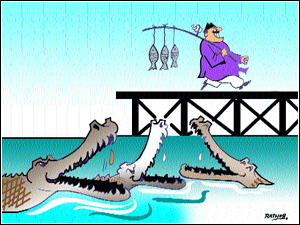 The National Accountability Bureau (NAB) has, off and on, been claiming that it has recovered banks’ defaulted loans to the extent of Rs90-100 billion. The purpose of this article is to examine in depth whether the NAB’s claim in this regard is a reality or merely a myth.
As per the figures published on page 5 of the State Bank of Pakistan (SBP) fortnightly news-bulletin, of 16th March, 2002, the aggregate amount of the non-performing loans of the banking sector, as on 31st December, 01 was Rs308.5 billion out of which Rs194.6 billion pertains to the commercial banks, and Rs 114.0 billion pertains to the Development Finance Institutions (DFIs) and specialised banks.
There is a difference between the “defaulted” and the “non-performing” loans. In cases where the borrowers fail to service the debt or to repay the instalment of the loan for a period of one year after the respective due dates, the loan becomes “non-performing”. If such a default continues for yet another one year, the loan has “defaulted”. Some commercial bankers do not worry about non-performing loans, because if a borrower cannot service the loan or repay the loan instalment for one year, for some genuine reasons, he fulfils his obligations in the subsequent periods and the relative loan becomes “regular”. This opinion is not wholly representative of the truth because if this happened in the majority of the cases, the amount of the non-performing loans would either decrease with time or at least remain static. However, clearly this is not happening, since the amount of non-performing loans continues to rise. Thus, from a common man’s point of view there is hardly any distinction between the “non-performing” and the “defaulted” loans, even though for the purpose of Prudential Regulations of the SBP, such distinction exist.
In the SBP’s fortnightly news-bulletin, referred to in the above paragraph, it has been stated that the reporting procedure of the non-performing loans has also been changed. The banks now report the net amount of the non-performing loans i.e. total amount of the loans less (i) the amount of interest charged on such loans and debited to the borrowers’ accounts and transferred to the “suspense” account (instead of taking it to the “interest income” account) because of non-recovery from the respective borrowers and (b) the amount of the provisions made in the balance sheets against the bad and the doubtful debts. The purpose of this new reporting procedure seems meaningless, unless the intention is to show the volume of the defaulted loans in very much reduced amounts. The practical side of the picture however, is that the volume of the defaulted loans will come down only by (a) repayment by the borrowers or by (b) write-offs. It has, however, been contended in the aforesaid news bulletin of the SBP that the new procedure is in line with international practices.
One can recall that half-hearted efforts were made by previous democratic governments to recover the defaulted loans. And some of the political parties made the recovery of the defaulted loans a part of their election manifesto. Towards this goal, immediately after assumption of the office of the Prime Minister, Mian Muhammad Nawaz Sharif, arranged certain amendments in the State Bank of Pakistan Act, 1956 and the Banking Companies Ordinance, with a view to granting autonomy to the SBP in the matter of monetary policy, governing the banking sector and quick recovery of the defaulted loans.
After attaining autonomy, the then Governor of the SBP, announced in June, 1997 the policy for recovery of the defaulted loans which was highly concessionary to the borrowers. The policy envisaged waiver of the 95 per cent interest amount where the loans were in default for 7 years or more, a waiver of 80 per cent interest amount where the loans were in default for more than 3 years, but less than 7 years and a waiver of 25 per cent interest amount where the default was for less than 3 years. This highly concessional package failed to move the defaulters to make repayments. At one stage, the Nawaz Sharif government started a move against the defaulters and some high profile persons were arrested in Sindh. The Prime Minister himself announced on television the surrender of some of the industrial units owned by him and his family to the banks against the outstanding loans. But later on, all this proved to be merely a hoax.
At the time of announcing the concessionary loan repayment policy, the then SBP Governor, gave some data about the defaulted loans. At that time, the terminology of “non-performing” loans was not in vogue. According to the data given by the SBP Governor, the total amount of the defaulted loans rose from Rs 81 billion to Rs 123 billion during Benazir Bhutto’s 1993-96 regime and stood at Rs 127 billion in June, 1997, out of which a sum of Rs 105 billion was payable to the commercial banks and Rs 22 billion to the DFIs. Out of Rs 127 billion, Rs 76.2 billion (60 per cent) comprised principal and Rs 50.8 billion (40 per cent) comprised interest. Out of the total defaulted loans of Rs 127 billion, Rs 52.3 billion were owed by the 3206 sick industrial units while another Rs 3.8 billion were due from those industrial units which were then passing through the process of liquidation. The SBP appointed a number of committees which included the representatives of the business community (so far as this scribe remembers, the President of the Federation of the Chambers of Commerce and Industry was overseeing these committees along with the SBP Governor). But no progress could be made towards recovery of the defaulted loans.
Here the question is whether the remission of interest, impacts the banks? The waiver of interest is a drain on the income / equity of the bank. The reason is that while no interest is recovered from the borrowers, the bank has to pay interest to the depositors on the funds lent to the defaulting borrowers, from its own profit which either inhibits addition to the equity or causes reduction in the equity of the bank. The bank also loses an opportunity to further lend the amount of interest received from the borrowers to other parties or to reinvest the same in other profit-generating channels. This also has an impact on the equity of the bank the same way. The bank has also to bear the intermediation cost viz-a-viz the defaulted amount of the principal having impact of the income / equity of the bank in the manner mentioned above. It may be recalled that the SBP had provided Rs 21 billion and Rs 11 billion to the United Bank Ltd. and the Habib Bank Ltd. respectively in 1997 and another Rs 8 billion to the Habib Bank Ltd. in 2000s for replenishment of the depleting equity of these banks. Therefore, the waiver of the interest amount does have an impact on the banks and the waiver of the principal should not be taken lightly.
Immediately after the take-over on the 12th October, 1999, the present government had also shown its resolve to recover the defaulted loans. To do so and to punish the corrupt government officials, Lt. Gen. Amjad was appointed its chief. Hectic activity began and many well-known businessmen were arrested. The initial actions indicated the resolve of the government. But the powerful lobby of the defaulters did not allow the action to continue. Some powerful magnates to escape the country despite the vigilance of the army monitoring teams in every department of the government. One of the plea of the powerful lobby was that the capital is flying from the country and if the process continued, the business / industry in the country will come to a halt. The government succumbed to the pressures and Lt. Gen. Amjad was replaced by Lt. Gen. Khalid Maqbool and the process slowed down. Now the committee, which is headed by the SBP Executive Director and includes the representatives from the NAB and the business community, screens out the cases of “wilful” and “circumstantial” defaults and refers the cases of the “wilful” defaults to the NAB with the concurrence of the SBP Governor. The NAB has been claiming that it has arranged cash recovery of the defaulted loans to the extent of Rs 90-100 billion. Let us examine this claim. The amounts of outstanding loans are increased by the amount of interest accrued but not paid by the borrowers and are reduced either by payments received from the defaulters or the write - offs by the banks. As the defaulted loans are generally centralized with the 5 big Pakistani banks, the details of the write-offs by these banks have been collected from their annual reports and are given in the table below:
The bank-wise details of the write-offs during 1997-2001 is as under:
The position of loans outstanding in June, 1997 / interest accrued thereon since 1997 to December 2001 and write - offs by the banks during these 5 years are summarized in the table given below:
In the above table, interest has been charged @ 22 per cent p.a. which was the maximum rate at that time. It would be seen from the above data that even in the absence of any recovery from the defaulters, the aggregate amount of the defaulted loans should not exceed Rs 276.49 billion. This amount will further drop down if the figures of write-offs of the DFIs is also taken into account. In case the NAB’s claims of cash recovery of Rs 90 - 100 billion is taken into account, the aggregate amount of the defaulted loans should not exceed Rs 276.49 billion. This amount will further drop down if the figures of write-offs of the DFIs is also taken into account. In case the NAB’s claims of cash recovery of Rs 90-100 billion is taken into account, the aggregate amount of the defaulted loans should fall from Rs 276.49 billion to Rs 179.49 billion. But astonishingly, the SBP news bulletin dated the 16th march 2002 puts the figure at Rs 308.5 billion. Yet another factor is that in 1997, over 44 per cent of the defaulted loans were due from the sick industrial units numbering 3206.
The number of such units is now stated to be over 4000. Could there be any hope of cash recovery of a single penny from these units? It is also unbelievable that the residue borrowers may have dished out cash of the order of Rs 90-100 billion. What this establishes is that the NAB’s claims of Rs 90-100 billion of cash recovery of the defaulted loans is not a fact. What appears to be actually happening is that fresh loans continue to be added to the list of the defaulted loans while the scrutiny committee headed by the SBP executive director is simply rescheduling / restructuring the old loans and putting the rescheduled / restructured amount under the head of “cash recovery”. This could well be done by the banks themselves as they have the good experience of doing that since the days of Gen Muhammad Ziaul Haq.
If, in fact cash recoveries of such huge amounts have really been made,which is not borne out by the above analysis, the NAB should publish borrower-wise/bank-wise lists of such repayments for public information since the present government makes too much of “transparency”.




























