0
0

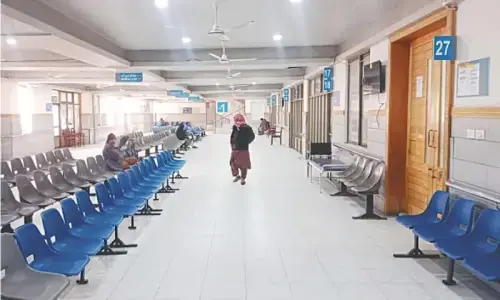
MULTAN, May 27: Owing to procedural flaws, the provincial Health Department has failed to procure medicines proportionate to the budgetary allocation for the fiscal year 2001-2002.
The Punjab government had allocated over Rs700 million funds for the procurement of medicines and other consumables to ensure availability of emergency and other necessary medicines at primary and secondary health facilities.
Sources claimed that at the fag-end of the ongoing fiscal, the Health Department could hardly procure medicines upto 30 per cent of the budgetary allocation.
The state-run health facilities in the Punjab have been facing acute shortage of emergency medicines, consumables and other items because no ‘meaningful’ purchases can be made after the introduction of devolution plan.
The shortage of essential items has also made the pathology laboratories and radiology departments inoperative in most of the institutions in the province.
Under the new district government system, the procurement of medicines has also been entrusted upon the local government instead of the provincial medical store depot (MSD).
Insiders alleged the provincial bureaucracy would receive huge commissions from the pharmaceutical firms on the procurement of medicines worth millions of rupees. The devolution plan had ended their monopoly.
But the task of procuring medicines was given to the districts without making the needful amendments in the purchase manual. Therefore, procedural hurdles in the face of limited financial competency of EDOs (Health) resulted in delay in the procurement of medicines and their acute shortage at the state-run health facilities.
Health sources said the department’s provincial bureaucracy had kept on hard-pressing EDOs to complete the task without delegating to them enough powers for the purpose.
Consequently, reputed national and multi-national firms thought it better not to take part in the bids invited by the financially less-competent EDOs. Small firms took part in the tenders, but most of themcould not meet the requirements of the Health Department viz-a-viz quality and variety of medicines.
However, some districts ventured to procure medicines despite ‘all odds’ under pressure of provincial Health authorities, but then there were accusations of malpractices and irregularities. For instance, a criminal case has reportedly been lodged against Izaz Qasim, son of the Dera Ghazi Khan EDO (health), for supplying substandard medicines through his firm.