0
0

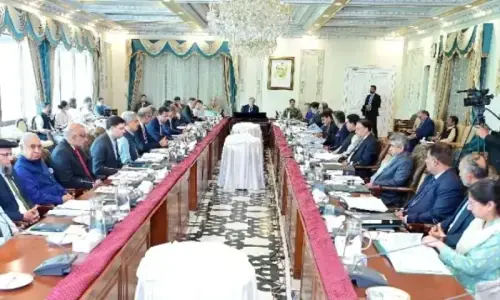
ISLAMABAD, May 16: The president of the World Bank, James D. Wolfensohn, has called upon India and Pakistan to reduce growing tension in the region and divert their resources for poverty alleviation.
“I think conflict prevention is one of the single most important issues in the long-term to approach the poverty eradication”, he further stated.
Speaking at a joint news conference along with Minister for Finance Shaukat Aziz here on Thursday, the World Bank president pointed out that any military confrontation inhibits the ability of a country to alleviate poverty and, “we hope this confrontation becomes less”.
“Both the countries should prevent the growing chances of conflict with a view to ensure South Asia a peaceful region”, he added. He said he would be very much delighted to see deescalation so that the chances of military conflict could be reverted”. He said he has been in Pakistan for the last four days and during this period he also visited Afghanistan. He said his meetings with President Gen Pervez Musharraf and the finance minister were very fruitful to improve the economy specially to address the crucial issue of poverty in the country.
Asked to comment on future political set-up of Pakistan and President Musharraf’s victory in the referendum, Mr Wolfensohn said these were the internal issues and have nothing to do with the World Bank. “But we do hope that there will be a continuity of policies”, he said hoping that the judicial reforms, issues relating to governance and bringing improvements in the state sector specially Water and Power Development Authority, Central Board of Revenue and the Karachi Electricity Supply Corporation will be taken seriously.
He said people of Pakistan were the best judge and this was their job as to who should be brought in power in the October elections. “I do not decide political matters and I only deal with economic issues”.
So far, he said, whatever promises had been made by the government they were fulfilled, “and our support will contingent upon perusing reform process”.
In reply to a question he said that the World Bank will offer $500 million Structural Adjustment Credit (SAC) to Pakistan by June this year. This credit, he said, will be almost interest-free called as International Development Agency loan. Shaukat Aziz said that it will be a single tranche financial support to be disbursed in one go for improving the balance of payment position of the country.
Mr Wolfensohn told a reporter that corruption was one of the serious issues which was seriously being dealt by the government. He said that micro credits were needed to be offered to the people for poverty alleviation.
Mr Wolfensohn also said that social sectors in Pakistan had been neglected in the past, “but I am glad to see that the present government is taking a lot of interest to improve the lot of a common man”. He was of the view that the objectives of removing poverty could not be achieved in a tenure of one government or two governments. “You have to work out a long-term long strategy to deal with this issue”.
He urged the government to achieve five per cent GDP growth rate to effectively look after social sectors specially to alleviate poverty. The government is expecting to have 3.5 per cent GDP growth during the current financial year.
The World Bank president did not agree with the idea that the international donor agencies specially his Bank and the IMF were dictating their terms to offer loans to Pakistan. “We have no conditionalities to offer loans”, he said adding that Pakistan government was itself taking bold decisions to improve the economy.
“We honestly believe that health, education, agriculture and community-based development need to be given importance to alleviate poverty”, he said.
He was asked how could there be any poverty alleviation when the government was increasing the prices of petroleum products and planning to levy 15 per cent across the board General Sales Tax (GST) on medicines. “I think this is an internal issue and you better direct this question to your finance minister”, Mr Wolfensohn said. “Unfortunately I am not the president of Pakistan to take decisions on such issues”, he said in a lighter mood.
Talking about his one-day visit to Afghanistan, he said, he had met government officials in Kabul and was told that a number of issues were likely to be resolved in the forthcoming “Loya Jirga” (parliament).
However, he said that he saw great enthusiasm in the people to have the reconstruction of Afghanistan. He said it was a big task to rehabilitate the country which had been devastated by conflicts of the past.
He said Pakistan’s private sector could play a significant role in the reconstruction of Afghanistan but then hastened to add, “there is a competition as all the countries of the region are interested to take part in the reconstruction of that country”.
The World Bank chief also said that the devolution of power was a good move to bring changes at the grass-root level. This system, he believed, will greatly help to undertake increased health and education related activities in Pakistan.
The development of small and medium enterprises (SMEs) will also help create new jobs and ultimately alleviate poverty.
In reply to a question he said that there was a need to change the culture to promote good governance and remove corruption. “You need to create an equitable society so that your future generation and your kids enjoy the equal opportunities to grow”, he added.
Earlier, Shaukat Aziz said that the World Bank was a key development partner of Pakistan and was taking a lot of interest to improve growth and remove poverty.
Pakistan, he said, was implementing structural reforms agenda to improve its economy which came under severe pressure due to Sept 11 events of 2001. The economic shocks, he said, would have been much more serious, had there been no foreign support including debt re-profiling by the Paris Club.
Mr Aziz said that the federal government was also trying to ensure provincial reforms with the help of the World Bank and other donor agencies.