0
0

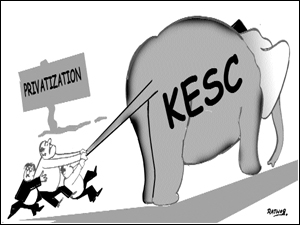 The Federal Minister for Privatization on 22nd March, visited Aptma’s principal office at Karachi, and said that 74 per cent of the KESC shares are being sold in September to an investor who would pump around $500 million during next three to four years in the utility company and will also ensure to bring down power tariffs.
The Minister asked Aptma to take interest in the sell-off of the KESC and try to get hold of at least 10 per cent of the offer so that they could have their director on the utility company’s board. The equity price of the KESC will not be very high, he reportedly added.
The KESC, supplying electricity to the people of Karachi for the last 90 years or so, is presently facing problems of high transmission and distribution losses, high generation cost and other usual inefficiencies of a public sector entity. One expects that the KESC privatization will transform it into a profitable unit as in the past. In addition to the beneficial relief to the government, the privatization is also envisaged to result into lower tariff and better service to all its customers. This may also enhance the competitiveness of the local business and industry. The local business and industry might attempt to acquire 10 per cent equity stake as suggested by the Minister. However, in practice this much stake will not make much difference if the Strategic Investor owns the rest of the shares. Therefore, chances are the local industrial investors might not go for it except for psychological or speculative purposes. They would wish to have a bigger role for themselves provided the privatization scheme is designed in such a way as to allow maximum participation by the local investors. This paper is an attempt to suggest to the government ways and means how the local investors can be attracted and how more competition is introduced in the energy distribution so that the lower tariff to different customers is a possible reality.
Information about the KESC privatization scheme released to the public is sketchy and insufficient. In order to encourage the local investors to come and genuinely participate in the privatization process, it will be desirable if more details of the privatization scheme including the report of the financial advisors are shared now with the local business and the general public. Local business houses may form a consortium of their own to compete with the foreign interested groups. Alternatively, they might join one or the other consortium of foreign investors to bid for the 74 per cent stake in the company. The general public might also offer suggestions for consideration by the government. In the final analysis, the consultation process may help improve upon the original scheme for privatization as well as the price per share.
KESC has been experiencing abnormally high transmission and distribution losses in the past 10-12 years although the position has slightly improved in the year 2000-01 as a result of the support from the Army and the efforts of the KESC management. In 1989-90 T&D losses stood at 20.84 per cent. Situation deteriorated each year and the T&D losses increased to 40.23 per cent in 1999-00. During 2000-01, the losses were reduced to 36.81%. T&D losses are real cash losses. Advanced countries have in certain cases controlled these losses to as low as 7 per cent. This will be a tall order for Pakistan, at least for the moment. However, the norm of T&D losses for Pakistan may be around 14 per cent as compared to actual losses at 36.81% for KESC for the year 2000-01. The absolute numbers for the year 2000-01 show the financial impact of such high losses very clearly. One can also imagine the improvement in profitability that can emerge if T&D losses are brought down to reasonable level. Relevant data taken from KESC Annual Report 2000-01 is presented in 3 tables given below.
As can be seen from Table-1, the quantum of T&D losses is higher than the energy actually purchased from others at a huge cost. One can also judge the extent to which the KESC is dependent on others for providing energy within its license area.
For better appreciation of KESC operations, average unit cost of self-generation, unit purchase price for energy imported from others and the average selling price are given in Table-2:
The above figures give indications on different aspects of the KESC operations. However, the most critical item is the T&D losses that are abnormally high and need to be brought within reasonable limits. Apart from other benefits, this will reduce KESC dependence on other power producers.
Financial data about KESC operations for the last two years is given in Table-3. Financial loss could have been reduced to a large extent if the T&D losses were not so high.
The KESC suffered a loss of Rs 16.201 billion in 2000-01 (Rs 12.787 billion in 1999-00). Major portion of the loss is due to high T&D losses at 36.81% in 2000-01 (40.23% in 1999-00). Now that the Government has reduced / eliminated debts through debt-equity swap, the KESC can expect an improvement in profitability to the extent of interest expense for 2000-01 at Rs 5.724 Billion (Rs 5.481 Billion in 1999-00). Now, the KESC can turn around and show profits if it is able to reduce the T&D losses to about half of the present level. the KESC management, assisted by the Army and supported by the government, has been taking remedial measures and their impact hopefully be reflected through improved operating results for the current year i.e. 2001-02.
It can be said, on the basis of above analysis, that the KESC privatization scheme is largely about controlling the Distribution losses, the Transmission losses being relatively small. The question is why privatize the KESC generation, transmission and distribution function when the problem is mainly with Distribution. Why not start with the spinning- off of the Distribution from the main body? Let the private sector assume Distribution function and earn handsome profits through better control of distribution losses. Profit motive and competition will also encourage the private sector to provide better service to consumers presumably at a lower tariff. With this possibility in view, let us examine if the present privatization scheme has been designed accordingly.
Details of the KESC privatization scheme are presumably being worked out at present. There is mention of sale of 74% shares to the strategic investor who will be investing $400-500 million in the next three to four years to improve its infrastructure and operations. It appears that the KESC privatization will be on a different pattern than the privatization of the power wing of Wapda, which created power generation and power distribution companies, to be privatized in stages. Privatization of the KESC could also be carried out on similar lines. However, it appears here the GOP is maintaining the monopolistic nature of the integrated utility, the ownership of which will transfer through privatization from public sector to the private sector. If this is the case, the scheme might not deliver full potential benefits to the country, the consumers, local business and industry and the investors. In order to realize the maximum potential benefits, the government/KESC management may consider modification of the existing privatization scheme on the following lines:
1- The KESC as a policy may not remain an integrated utility for long. The Generation, the Transmission and the Distribution functions to be transferred to separate legal entities. The Generation and the Distribution entities to be in the private sector. Eventually, the KESC Transmission Grid may be a part of the National Grid System.
2- The KESC is an old integrated utility and before privatization its assets need to be re-valued to arrive at their fair value. This will be fair to the country / shareholders and the new investors.
3- Privatization of the KESC to be in such a way that it supplements the privatization scheme of the Power Wing of WAPDA. In the first instance, the KESC to spin-off the Distribution function, followed by the spin-off of the Generation function. As a result of the privatization of the KESC on these lines, in the end the whole country will have similar utility companies under the same system.
4- Competition is essential for ensuring relatively lower tariff and better services to the consumers. Eventually, every consumer should have the choice to get electricity connection from a distribution company of his / her liking. This might not be possible immediately but at least we should aim at that. Privatization of the KESC and other utilities may be pursued towards this objective. the KESC distribution license area may be divided in five separate areas and the Distribution network in each area may be leased out or sold through open bidding among pre-qualified investors i.e. the power distribution companies. With a view to remove practical difficulties, this will also allow rationalization of the distribution area with the areas presently served by the Wapda distribution companies operating in the adjoining areas.
5- The KESC privatization may start with the Distribution function leased out (or sold) to five private sector companies incorporated in Pakistan. At present, The KESC has 50 or so grid stations. Depending on number of consumers and geographical spread, each Power Distribution Company (PDC) may initially be allowed electricity distribution in the area now covered by ten grid stations. For the time being, the KESC will sell power in bulk to each PDC and meters at each grid station will record energy sold. Under this arrangement, there will be arms-length relationship with the KESC and/or other power generation companies and therefore the allegation of pilferage of energy will be sorted out once for all. This will be the beginning of the competitive pricing at bulk and retail level. Each PDC will be responsible for supplying electricity to the smallest consumer in the area. Also, each PDC will initially take on its roll all KESC employees related to distribution in the area. Banks/DFIs may facilitate the process by providing guarantees or other facilities to PDCs. To maximize profit, the PDCs will overcome present inefficiencies in Distribution in the shortest possible time. New connections will be facilitated. Quality of service and collections are also expected to improve. In due course one PDC may acquire the other PDC companies or they may decide to merge for better synergy.
6- For sometime, the KESC will continue managing and continuously improving both Generation and Transmission. The PDCs, while continuing purchase of power generated by KESC, may in due course substitute the KESC for bulk power purchase from KANUPP, two IPPs in the area and other sources. Private sector may purchase power generation facilities from the KESC. The government may thus expect to get the best price for these KESC assets. To meet the supply gap, the private sector may install additional generation capacity for bulk power sale to PDCs.
7- In the end the KESC will be left with bulk Transmission Grid in its license area. It will also continue owning Distribution facilities leased out to PDCs until the PDCs acquire these assets on ownership basis. The PDCs may be responsible for maintenance of leased assets as well as for the laying of new distribution lines in the licensed areas.
8- The minority shareholders of the KESC need to be looked after in the rationalization exercise for adjusting paid-up capital subsequent to the abnormally large debt-equity swap as well as in the privatization scheme. Similarly the regular employees may be looked after by removing grievances in pay or perquisites, if any, at present as well as in the privatization scheme.
The KESC is an important national asset. Its privatization has to be undertaken in a manner that the country, the consumers, the workers and the local investors realize maximum potential benefits. the KESC is an integrated utility like Wapda of olden days. Privatization of the KESC as an integrated utility is not in line with the privatization of Wapda. Also, its privatization as a single entity may take more time, expenditure and effort. Most of all, it will practically exclude local investors who must be given a fair chance for participation in the privatization process. Starting the privatization process with spin-off of the Distribution function to a number of private sector companies may facilitate participation by local investors, introduce more competition with possibly better sale price to the government and also ensure regular supply of electricity / services to the people at competitive cost. Local investors and businesses need to be brought in so that the people may enjoy the real benefits of the privatization. This will also benefit the industry as it may expect power supply at reasonable rates and thus help rationalize its cost of production.