0
0

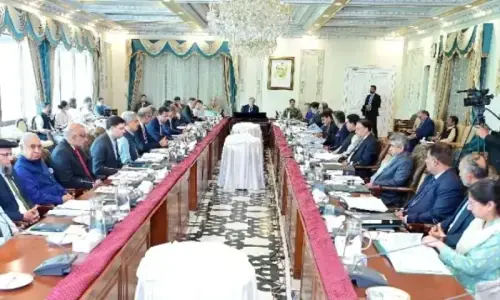
ISLAMABAD, March 28: The Cabinet Committee on Deregulation was informed here on Thursday that there were differences among the provinces as to whether they should collect local taxes or the job be left to the local governments.
The meeting, presided over by Minister for Finance Shaukat Aziz, noted that there was a need to ensure that the transition to new governments of responsibilities was smooth and that in the process new regulations prohibiting business activities were not introduced.
The heads of the sub-committees on eight aspects of business and trade presented their preliminary reports, which were followed by extensive discussions by the committee.
On the labour issues, the meeting was informed that a conference of provincial ministers was scheduled for April 1, where key recommendations for simplification of labour laws and consolidation of labour levies will be formulated for the consideration of the government. It was felt that some reforms be enacted immediately in respect of labour levies where the industry faces the greatest difficulties. For this purpose, it was emphasized that the consolidation of collection at federal and provincial levels within just one agency each of federal and provincial governments and introduction of self-assessment scheme across the board will be a major advance in simplifying the regime. It was agreed that proposal in this regard will be quickly formulated and brought to the next meeting of the committee for its consideration.
In respect of provincial regulations, the committee reviewed the work undertaken by the Sindh government. This was found to be extensive and aimed at greatly simplifying the regulatory regime for business and trade. The government had reduced the number of inspections by various provincial departments from 23 to six that too will be well-coordinated and timed with the target industrial units and business concerns. Similarly, the operating hours for business were completely deregulated. The committee urged other provinces to follow the efforts of the Sindh government and agree on further improvements in the remaining regulations. The provincial finance ministers will meet to further advance the work.
On district government regulations it was reported that there were many responsibilities that the new provincial local government ordinances had devolved to the local government.
On corporate laws and investment environment, it was indicated that two areas of the SECP’s regulations needed reform, namely, the scope of information sought from the listed companies and the applicability for the proposed new governance structure on listed companies. The SECP will develop a new set of guidelines for this purpose by developing a positive list of questions and examine the possibility of restricting the application of new governance structure to only large companies. In general, it was felt that such elaborate laws be applicable only to large and medium-sized companies and much curtailed set of regulations be asked from a small enterprises.
On the investment side, problems relating to Wapda, new income tax law and consolidation of institutions dealing with intellectual property rights were identified as requiring urgent attention. Proposals in this regard are being formulated and will be submitted to the committee in its next meeting.
About the utilities, it was pointed out that all the four utility companies, namely, PTCL, SSGC, SNGPL and Wapda, were working to develop proposals for simplifying their procedures in three key areas of their operations.
The sub-committee on transfer of land titles informed the meeting that rural land titles had fairly simple procedure for transfer but urban transfers were numerous and varied from one city to another. In the case of rural areas, though the transfer mechanism was simple yet to get through the system was daunting. Land records were not computerized and it was not easy to get hold of the functionaries connected with the process.