0
0

Why a referendum?
PRESIDENT General Pervez Musharraf has left no ambiguity about his intentions to continue to wield power even after the October elections. What, however, he has not so far made clear is how he intends to make it. There are reports, not official though, that perhaps he has decided to take the old and tested referendum route to retain power. Even an announcement to the effect is expected on March 23, when a date in May is likely to be fixed for holding such a referendum. In the supreme national interest, one would like to believe that all this is no more than mere speculation and that the present military government has no need to adopt the farcical route to legitimacy that Field Marshal Ayub Khan and General Ziaul Haq took in the past. Both had “won” their respective referendums hands down like so many dictators regularly do in the Middle East and Africa. Ayub secured 95.06 per cent votes in the February 1960 referendum in which the nation’s 80,000 Basic Democrats constituted the electoral college. In Ziaul Haq’s farce, the entire nation was supposed to have given him a 97.71 per cent “yes” vote. Actually, less than 15 per cent of the eligible voters cast their votes. All these devices failed to satisfy the world that the two got what they wanted — legitimacy. Instead, these farcical referendums made the task of restoring democracy more difficult.
Perhaps President Musharraf sincerely believes that the nation needs him at least for another five years to consolidate the reforms he has introduced and to ensure that they are not discarded by his elected successors. But then he would be failing in establishing the supremacy of the very reform that he is trying to introduce in this country — the establishment of the rule of law and the constitutional process — if he were to exempt himself from its purview. No mortal, no matter how exceptional, should consider himself indispensable, especially when he is involved in nation-building. Nations are not made in decades, nor by one or two individuals. It is a long and continuous process in which the whole nation participates. In the process, at times the nation may be led by charlatans and at others by brilliant individuals. But, basically, it is a collective, long and arduous struggle. Disruption in this process occurs only when someone attempts to tailor the process to suit his needs, no matter how sincere he may be.
The president and his advisers would do well to have faith in the collective wisdom of the nation. If the nation sees General Pervez Musharraf himself honouring all the genuine nation-building reforms he is introducing, it would ensure on its own that the elected representatives do not take liberties with them. Thus, the only legitimate route for the general to take is the democratic route for the transfer of power. The Supreme Court’s mandate is not only for the holding of a general election by October 2002, it also binds General Musharraf to transfer power from the military to the elected representatives by coming October. The only choice before him is to go back to the barracks after the elections. If, after retirement from the army and completing the two-year mandatory “silence”, he feels he can be of service to the nation, then he can join a political party or float one of his own and contest a presidential election to run and build the country in his image. A referendum would be a farce that would fool no one, least of all the world at large which is watching each and every of President Musharraf’s actions closely.
A bank’s own lock-up
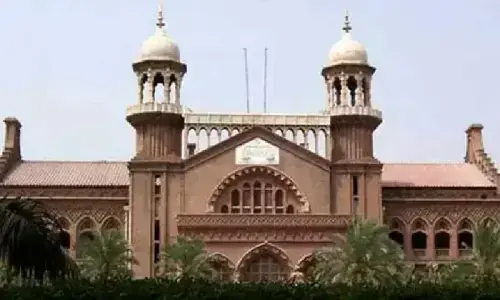
THE recovery by a bailiff of the Lahore High Court of five people from a makeshift jail inside a government-owned bank borders on the grotesque. The court has rightly asked the management of the Small and Medium Enterprise bank in Rawalpindi to explain under what law and authority a jail had been established inside its premises. The matter came to light when a petitioner approached the court for relief, saying that he had been put in this private jail about a month ago despite having paid off a loan. The petitioner said his son had taken the loan and paid it back over six years ago. He had questioned the bank’s authority to put him in a private lock-up. One could not agree more with the petitioner, because even if a person is guilty of defaulting on a loan repayment, that does not entitle the lending agency to keep him locked up.
What happened to this man is nothing short of kidnapping. Such tactics seem to suggest our lending institutions view their creditors as criminals, especially if one looks at the way this man was treated. Banks — at least in theory — are supposed to give loans after examining collaterals and assessing, among other factors, an applicant’s credit-worthiness. Even then, bad debts do occur even in the most organized and controlled of banking systems — and ours is not even in that league. But what is important is how the institution tries to recover them. Unfortunately, there is a growing tendency in Pakistan by banks to browbeat borrowers into paying back their loans. Many of the tactics used, like in this case, would be illegal in most developed economies. Did the law that established the SME bank permit it to have a police force and judicial system of its own? The public would like to know this. If not, then clearly those who locked these people up deserve to be prosecuted on criminal charges.
Murders of another kind
RECKLESS driving and the authorities’ failure to enforce traffic regulations on Karachi’s roads claim over 500 lives every year. Tuesday’s tragic incident in Karimabad was only one such occurrence in which two college girls and a motorcyclist lost their lives and nine bystanders were critically injured when a speeding bus ran them over. As always happens, the erring driver escaped. According to the Federal Bureau of Statistics, some 3,760 lives were lost to reckless driving in Pakistan between January and September last year. The corresponding figure in neighbouring India, a much bigger country, stood at just under 400. This only goes to show how neglected the field of traffic engineering and management is in Pakistan.
As far as the big cities are concerned, accidents cannot be curbed by widening roads and building flyovers. What is needed is the will on the part of the police department to enforce discipline and nab violators of traffic rules. Karachi is a class by itself, where drivers of public buses are a law unto themselves. They do not feel they are under any obligation to follow traffic rules, because they are seldom made to suffer for breaking them. Competing with one another for more passengers, bus and minibus drivers drive recklessly, overtake from both sides, make no difference between a road and a bridge and weave through heavy traffic, often breaking the red light. The police watch this helplessly. An accident is one thing; ploughing one’s bus through a crowd quite another. Since most bus drivers are illiterate, they do not know how many accidents occur in their city in a day. They have no civic consciousness, and shall continue to kill and maime, unless the police make up their mind to do their duty and make roads safer for citizens.