



 0
0

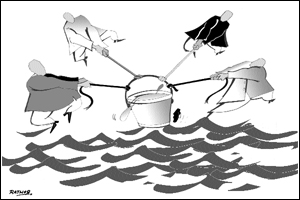 It is a pity that while we must be focussing collectively on devising strategies for the conservation of precious water resources, some elements are trying to engage the federating units in a “tug of war” for vested interests.
While the Rabi crop is facing acute shortage of water due to prolonged dry spell all over the country, the provinces of Punjab and Sindh continue to fight over what little has been left in the reservoirs and rivers. The new water sharing formula, presented by the NWFP in the recent meeting of the Indus River System Authority (IRSA), has failed to resolve the dispute between Punjab and Sindh as none of the provinces is ready to give up even a fraction from their respective positions.
A disappointed secretary IRSA, Sohail Ali Khan, told newsmen after the meeting that “both, Punjab and Sindh, have outrightly rejected each other’s proposals to resolve the water distribution dispute as well as the formula of the NWFP, terming it as violative of the Water Accord, 1991.”
It may be noted that all the provinces had agreed to water-sharing formula in the first government of Nawaz Sharif in March 1991 which was termed by many as a great achievement. But the fact is that this very accord is the root-cause of discord among the provinces, as it fails to provide a comprehensive solution to the dispute. Though, both Sindh and Punjab, accept the accord, the dispute lies in the interpretation of clause 14 (a & b) of the agreement.
The clauses read as following:
a. The system-wise allocation will be worked out separately, on ten daily basis and will be attached with this agreement as part and parcel of it.
b. The record of actual average system uses for the period 1977-82 would form the guide line for developing a future regulation pattern. These ten daily uses would be adjusted pro- rata to correspond to indicated seasonal allocations of different canal systems and would form the basis for sharing shortages and surpluses on all Pakistan basis.
It is this clause that both, Punjab and Sindh, have been twisting for their own interests. When the shortages of water were first experienced in 1994, severe differences surfaced over the allocation of water shares. The situation led to an acrimonious debate as the provinces accused each other of stealing or wasting water. An inter-provincial ministerial meeting held under Malik Ghulam Mustafa Khar, the then minister for water and power, reached an ad-hoc agreement saying that “The shortages between Sindh and Punjab will be shared according to historical use”.
It may be noted here that water availability in the 1991 water accord was assumed at 114.35 million-acre feet (MAF) though net water usage was never above the level of 103 MAF. This very fact enables Punjab stick to its stance that water resources up to 103 MAF should be divided on “historical use basis.” Sindh on the other hand, has been criticizing the 1994 arrangement since its inception and has repeatedly termed it as favouring Punjab.
According to new formula, presented by NWFP member, Sindh and Punjab should be given water shares on the average releases/basis of historical use 1994 and Water Accord of 1991. But, the provinces have unanimously rejected this formula creating troubles for the CE secretariat, which was quite optimistic about some break-through in the recent meeting, as it had already given a deadline to IRSA, to reach on some kind of consensus on the issue before 8th of March, 2002.
There has always been a strong sense of deprivation regarding distribution of water in the hearts of Sindhis for a long time. The people of Sindh somehow feel that IRSA, which was designed to safeguard the fairness of the matter and assure the implementation of 1991 water accord, is playing in the hands of populous province of Punjab. Neither have the Punjabis been less vocal against Sindh, accusing the later of politicizing a technical issue and harming the national unity.
Water supplies to both the provinces have already been cut marginally due to consistent decline in water level in the reservoirs, particularly at Tarbela, which has reached the dead level. Currently Punjab and Sindh are facing 40 per cent and 50 per cent short supply respectively in their share of water. There is a fear that the both the provinces may not get 70 per cent of their water share in next two months.
Though the rains have finally broken and the catchment areas of rivers are getting snowfall, assuring more water for the summer, but the damage has already been done to important wheat crop. The met office’s warning that there may be another 20-25 per cent shortfall in rains this season is indicative of more problems in the days to come. The overall growth of economy suffered a big blow due to drought-like situation in the last fiscal year. It is likely to happen again in the current financial year.
The fact is that the water in the dams in not enough to go around and both Punjab and Sindh are trying to maximize their share. The dispute is all set to ruin the national unity if not solved amicably and immediately. IRSA, which is a power- vested body has so far failed to end this long outstanding source of discord. It was required to prepare a permanent water- sharing arrangement between all the units of the federation. Worryingly and unclearly, the body has not been able to deliver.
One good thing, however, that emerged after the recent meeting, is that IRSA is sending a set of proposals to President General Pervez Musharaff to decide the issue. These suggestions reportedly include, non-imposition of any compromise formula, adherence to the 1991 water accord and interpretation of clause 14b of the agreement by an independent body.
The issue is assuming alarming proportions, with the situation going on in the region, specially the threat from the eastern borders, the country can ill-afford such a discord. The country is facing the worst time of its history and needs a strong sense of unity among the people of all the provinces. The issue may become a major destabilizing factor and may have grave consequences for the country in the near future if not handled with care.
More importantly, this is one area where Musharraf-led military regime has failed to make any headway in creating any inter-provincial consensus, along with the issue of building new reservoirs. Now in the absence of the Council of Common Interest (CCI), General Pervez Musharraf is left alone to decide the ever-lingering dispute. Moreover, he has few options to move ahead with as, to make an ad-hoc arbitration keeping in view the requirements of justice and leave the permanent solution to the elected government, or seek the arbitration of the Supreme Court of Pakistan, settling the issue once and for all.




























